Master Data Structures and Algorithms Course
If you want a backend career that lasts, stop treating DSA as trivia. Treat it as your foundation for system design, performance, scalability, and technical judgment.
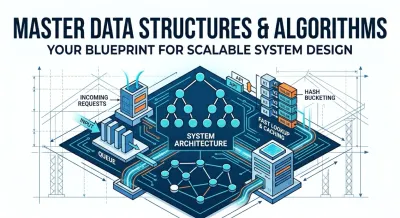
Most advice about a data structures and algorithms course is backward.
It treats DSA like a gatekeeping ritual. Memorize patterns. Grind problems. Survive the interview. Then move on to “real engineering.” That mindset produces developers who can reverse a linked list on command and still make bad architecture decisions in production.
You should learn DSA for a different reason. You’re learning how software behaves under pressure. You’re learning why one endpoint stays fast while another collapses under load. You’re learning why one schema ages well and another becomes a maintenance tax. That’s the core value.
If you want a backend career that lasts, stop treating DSA as trivia. Treat it as your foundation for system design, performance, scalability, and technical judgment.
Your Data Structures Course Is Lying to You #
Most courses lie by omission.
They tell you DSA is about solving abstract problems quickly. They don't tell you that the same ideas decide whether your API scales, whether your cache strategy works, and whether your database access patterns stay sane after the product grows.
The narrow interview-only framing is also out of touch with reality. Demand for deep DSA knowledge is clearly real. In Fall 2025, Stanford’s core algorithms course saw a 48 percent enrollment increase, making it one of the most popular classes on campus, according to The Stanford Daily’s report on Fall 2025 enrollment. People aren't rushing into these classes because they love puzzles. They're doing it because these skills still shape serious engineering work.
The interview mindset breaks down fast #
Interview prep teaches optimization without context. Real engineering is context.
In an interview, the answer is often “use a heap” or “use a hash map.” In production, the next questions matter more. What's the read-write ratio? How much memory can you spend? Does order matter? Will another engineer understand this six months from now? How does this choice interact with the database, cache, and queue?
A weak course trains recall. A strong course trains judgment.
Stop asking, “What’s the fastest answer to this puzzle?” Start asking, “What failure mode am I preventing in a real system?”
Learn like an architect #
If you're serious about backend work, your goal isn't to become a better contestant. Your goal is to become the engineer people trust with important systems.
That means learning DSA in a way that connects to API design, data modeling, caching, concurrency, task scheduling, and long-term maintainability. The right course doesn't just teach what a tree is. It teaches why hierarchy matters, when lookup speed matters, and how structure choices ripple through an entire codebase.
Why DSA Is Your Architectural Blueprint #

When you choose a data structure, you're making an architecture decision.
Pick a hash map for user lookup, and you're saying retrieval speed matters more than ordered traversal. Pick a queue for background work, and you're defining processing discipline. Pick a tree, and you're modeling hierarchy explicitly instead of faking it with flat structures and messy conditionals.
That’s why DSA matters far beyond a coding test. It gives you the vocabulary for designing systems on purpose instead of by accident.
Structure first, code second #
Junior developers often think architecture starts with frameworks. It doesn't. Frameworks sit on top of deeper decisions.
The first architectural question is usually about shape. How should the data live? What access pattern dominates? What operations happen most often? What needs to stay cheap?
If you don't answer those questions well, no framework saves you.
A lot of online education still misses this. According to Coursera-linked coverage cited in the course brief, 2025 Blind surveys with 60k responses showed Big Tech companies value system design nearly as much as, and in some backend roles more than, pure DSA puzzle-solving, yet 80% of online courses still overfocus on the puzzle side. That's a training mismatch.
Good architecture is controlled trade-offs #
You don't become a strong engineer by chasing “optimal” in the abstract. You become one by making deliberate trade-offs.
Use a simple structure when simplicity improves correctness. Use a more advanced structure when scale or latency demands it. Reject cleverness when the operational cost is too high. Accept complexity when the business case is real.
Practical rule: If you can't explain why a structure fits the workload, you haven't designed the system. You've guessed.
The right mental model is simple. Data structures are the beams. Algorithms are the load calculations. Together, they determine whether the system bends, breaks, or scales cleanly.
A short explainer can help if you need a visual reset before applying those ideas in projects.
Thinking in Trade-offs Not Just in Code #
A beginner asks, “How do I solve this?”
A senior engineer asks, “What does this solution cost, and who pays for it?”
That shift is the core purpose of learning DSA. Big O isn't just math notation. It's a shorthand for discussing system behavior before users feel the pain.
Big O is a decision language #
When you say lookup is O(1) on average with a hash table, you're really saying repeated reads can stay cheap as the dataset grows. When you say insertion into an array-backed structure may cost O(n), you're acknowledging that movement and resizing have consequences.
Software rarely fails from one bad line of code. It fails from a bad choice repeated at scale.
Use Big O to ask better questions:
- Read-heavy workload: Is faster lookup worth extra memory?
- Write-heavy workload: Will insert and delete patterns punish this choice?
- Ordered data: Do you need sorted traversal, or are you paying for order you don't use?
- Team cost: Will the implementation stay understandable under pressure?

A concrete example beats ten lectures #
Python gives you a perfect lesson in trade-offs. In practical benchmarks, Python’s array-based list can outperform deque by 5-10x for random access operations, as noted in GeeksforGeeks’ DSA tutorial and benchmark discussion.
That result shouldn't surprise you if you understand structure costs. Random access favors contiguous, array-backed storage. A doubly linked structure solves a different problem better.
Here's the important part. Neither structure is “better.” One is better for the access pattern.
The habit you need to build #
When you're studying, stop celebrating only correct answers. Start documenting trade-offs.
A useful review after every problem looks like this:
- State the dominant operation. Reads, writes, ordering, traversal, or prioritization.
- Name the rejected alternatives. Not just the chosen one.
- Explain the cost. Memory, implementation complexity, edge cases, or maintainability.
- Tie it to production. Cache, feed ranking, queue handling, search, indexing.
If you can't compare two valid approaches and defend one, you haven't learned the lesson yet.
That's how DSA becomes engineering judgment instead of academic memory.
A Structured Path for Learning Data Structures #
Failure in DSA isn't due to incapability. It's because the learning path is chaotic.
They consume explanations in random order, solve disconnected problems, and never attach concepts to real software. That’s why so many learners feel stuck between “I watched the lesson” and “I can build something useful with this.”
That gap is real. A YouTube-based source cited in the brief claims AI algorithms courses have surged 40% on major platforms, while only 15% of foundational DSA courses integrate practical, Python-specific backend use cases for APIs or AI. I agree with the broader point even without the hype. Too many courses teach theory in isolation.

Stage 1 builds durable foundations #
Start with core structures and force yourself to implement and use them in small programs. Arrays, stacks, queues, hash tables, trees, recursion, sorting, searching. Nothing fancy.
But don't stop at definitions. Attach each topic to a tiny artifact.
- Arrays and lists: Build paginated result handling.
- Hash tables: Build a simple cache or lookup service.
- Queues and stacks: Model background jobs or undo history.
- Trees: Represent categories, comments, or file-like hierarchies.
The win here isn't volume. It's familiarity.
Stage 2 trains pattern recognition #
Once the basics are stable, begin grouping problems by engineering pattern instead of platform tag.
Use buckets like these:
- Lookup optimization for caches, indexes, and deduplication
- Traversal for file systems, dependency graphs, and menus
- Priority handling for schedulers, retries, and rate-limited tasks
- Windowing and scanning for logs, analytics, and stream processing
At this stage, one structured resource is enough. If you want a guided Python track with interactive exercises, Codeling’s Essential Data Structures and Algorithms with Python is one example of a course built around browser-based practice rather than passive watching.
Stage 3 turns knowledge into evidence #
Now build portfolio projects where DSA choices are visible.
Good project ideas include:
- A REST API with caching rules that make your data access strategy explicit
- A task runner that uses priority queues and retry logic
- A search or autocomplete feature that forces you to think about lookup structures
- A graph-based dependency visualizer for packages, workflows, or recommendations
Learn one concept. Apply it. Explain why you used it. That's how knowledge sticks.
If your course doesn't push you toward artifacts, benchmarks, and design decisions, it isn't preparing you for backend engineering. It's preparing you to feel busy.
Connecting DSA to Real-World Backend Systems #
The easiest way to tell whether you're learning DSA properly is to ask one question.
Can you point to a backend feature and name the underlying structure choices?
If you can't, you're still studying abstractions. Backend engineering gets easier when you start seeing products as collections of constrained data problems.
Three backend examples that matter #
A URL shortener is the cleanest starting point. The core requirement is fast lookup from short code to destination URL. That's a hash map mindset. You want direct access by key, simple write behavior, and predictable retrieval.
A background job system needs order and urgency. Some work can wait. Some can't. That's where queues and heaps become practical. A basic queue handles first-in-first-out flow. A priority queue handles jobs that should run sooner because they’re urgent, expensive to delay, or tied to user-visible actions.
A social feed combines multiple concerns. You need storage, ranking, filtering, and efficient traversal through changing content. That's not one structure. It's a composition problem. Lists, heaps, hash-based deduplication, and graph-like relationship thinking can all appear depending on the feature.
| Backend Problem | Core DSA Concept | Real-World Application Example |
|---|---|---|
| URL resolution | Hash-based lookup | Mapping a short code to a full destination quickly |
| Job execution order | Queue or heap | Running background tasks by arrival order or priority |
| Feed assembly | Lists, heaps, graph thinking | Building and ranking user content from many sources |
You should study systems, not isolated tricks #
If you want your DSA learning to become portfolio material, take a simple service and force yourself to describe its internals.
Ask things like:
- Lookup path: What needs constant-time retrieval?
- Ordering rule: What must stay sorted or prioritized?
- Mutation cost: Where do inserts and deletes happen most often?
- Traversal model: Is the data flat, hierarchical, or relational?
Then document those decisions in the project README. That turns “I know algorithms” into “I know why this architecture works.”
A practical next step is to study Python algorithm examples for backend-oriented problem solving and then rebuild one idea inside your own API project.
The strongest portfolio project isn't the most complex one. It's the one where every design choice has a reason.
That's the standard hiring managers care about when they look past tutorials and toy apps.
Advanced Algorithms for Modern AI and API Development #

Once the fundamentals are solid, advanced algorithms stop looking academic. They start looking like an advantage.
Dynamic programming, balanced trees, tries, and graph algorithms all show up when systems become large enough, connected enough, or performance-sensitive enough that naive approaches stop working.
Why advanced DSA keeps paying off #
Dynamic programming is a perfect example. In theory, it teaches you to reuse overlapping subproblems. In practice, it teaches you how to avoid waste in optimization-heavy workflows. According to CodeChef’s DSA roadmap, dynamic programming can reduce complexity from exponential 2^n to linear O(n). That’s not a classroom trick. That’s the difference between an approach that collapses and one that remains usable.
The same source notes that self-balancing trees like AVLs are benchmarked 20-30% faster for insertions than unbalanced trees. That matters anywhere you care about stable performance under growth, especially indexing and lookup-heavy components.
Where this shows up in modern work #
For backend systems, balanced trees matter when ordered access and consistent update behavior both matter. Graph algorithms matter when entities relate to each other in meaningful ways, such as recommendations, dependencies, permissions, or workflow orchestration. Tries matter when prefix search matters, such as autocomplete, command interfaces, and text-heavy AI features.
For AI-flavored backend work, these ideas are even more practical. Token pipelines, retrieval layers, ranking logic, and structured context assembly all benefit from engineers who think in operations, not just model calls.
If you're building AI-backed products, it's worth pairing DSA study with implementation-focused material like this Hugging Face transformers tutorial for applied Python workflows. The point isn't to become a researcher. It's to understand the infrastructure around the model.
Don't specialize too early #
A common mistake is trying to jump straight into advanced topics before your fundamentals are automatic.
Use this filter instead:
- If performance pain is obvious, reach for a deeper structure.
- If the data has relationships, think graphs.
- If repeated subproblems appear, think dynamic programming.
- If ordered operations must stay fast, think balanced trees or other ordered structures.
Advanced DSA isn't a separate subject from backend engineering. It's what backend engineering turns into when the easy solutions stop working.
Becoming an Architect Not Just a Coder #
A good data structures and algorithms course should change how you think, not just what you can solve.
You should leave it better at making decisions. Better at spotting trade-offs early. Better at choosing simplicity when it wins and stronger structures when scale demands them. That’s the difference between a coder who finishes tickets and an engineer who shapes systems.
The interview grind culture reduces DSA to a temporary obstacle. That's a waste. The return on learning DSA is long-term judgment. You carry it into API design, database access, caching strategy, job scheduling, indexing, search, and performance tuning.
Don't measure progress by how many problems you brute-forced this week. Measure it by whether you can explain why your service uses a queue, why your cache uses a hash-based lookup, why your feed logic needs ranking discipline, or why a naive traversal would become expensive later.
Learn the structure. Learn the cost. Learn the trade-off. Then build something that proves you understand all three.
That’s the path worth taking if you want a career with depth.
If you want a structured way to build that mindset, Codeling offers a hands-on path into backend engineering with Python, covering DSA alongside Git, Linux, REST APIs, and AI-oriented development so you can turn theory into portfolio-ready systems.