What Is a REST API Endpoint
The question of what is a REST API endpoint isn't really a vocabulary problem. It's an architecture problem
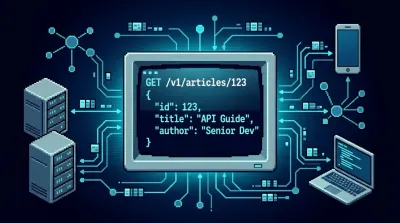
If you're learning backend development, you've probably seen URLs like /users/42, /posts, or /api/v1/orders and thought, "I get that this is an API route, but what exactly makes it an endpoint?"
That's a good question, because what is a REST API endpoint isn't really a vocabulary problem. It's an architecture problem. Junior developers often treat endpoints like framework syntax. Senior developers treat them like public contracts.
That shift matters. Once your frontend, mobile app, admin dashboard, background jobs, and third-party integrations all depend on the same API, an endpoint stops being "just a URL." It becomes a promise about how your system behaves.
Why API Endpoints Are the Backbone of Modern Apps #
Modern apps are rarely one thing. You might have a React frontend, a Python backend, a database, a payment provider, and a notification service. Those pieces need a shared language so they can exchange information without knowing each other's internal details.
That shared language is the API. The endpoint is the specific address where one part of the system asks for something or tells another part to do something.

A user taps "View Order History" in your app. The frontend doesn't query the database directly. It sends a request to an endpoint such as /orders. The backend receives that request, checks permissions, fetches the data, and returns a response. That pattern shows up everywhere.
REST APIs have become the dominant architectural standard for web services, with 93% of organizations using them as their primary API architecture, which is why endpoint design is core backend knowledge, not niche trivia, as noted in DreamFactory's REST API adoption overview.
Why this matters for developers #
If you only memorize route syntax, you'll build endpoints that work in a demo. If you understand endpoints as contracts, you'll build systems other developers can trust.
A good endpoint gives clients three things:
- A stable location: They know where to send the request.
- A clear meaning: They know what resource they're dealing with.
- Predictable behavior: They know what action happens when they use a specific HTTP method.
Practical rule: If another developer can't guess what your endpoint does from its path and method, the design probably needs work.
That's why endpoint design sits so close to software architecture. It's where your data model, business rules, and system boundaries become visible to the outside world.
If you're still fuzzy on the API itself, this primer on what an API is and how it works is a useful companion. It helps connect the endpoint idea to the broader request-response model you use every day as a backend engineer.
The Anatomy of a REST API Endpoint #
A REST API endpoint isn't a random string. It's a structured address with a job. The easiest way to understand it is to compare it to a mailing address.
A mailing address tells a delivery service where to go. An endpoint tells a client where a resource lives and how to interact with it.

Take this example:
https://api.example.com/v1/articles/123?include=author
You can break it into parts.
The pieces that make up an endpoint #
-
Base URL This is the foundation, such as
https://api.example.com/v1. It tells you which API you're talking to and often includes versioning. -
Path
/articlespoints to a collection of resources. -
Resource identifier
/123points to one specific article inside that collection. -
Query parameters
?include=authormodifies the response. It doesn't usually identify a different resource. It asks for a different representation or filtered result. -
HTTP method The URL alone isn't the full story.
GET /articles/123means retrieve the article.DELETE /articles/123means remove it.
Here's a quick visual explainer before we go deeper.
Why structure matters #
A clean endpoint structure reduces mental load. When paths follow a consistent hierarchy, developers can predict the API instead of memorizing it.
That means favoring resource paths like these:
- Collections:
/articles - Single resources:
/articles/123 - Related resources:
/articles/123/comments
It also means resisting the urge to model every relationship as an extensively nested URL. API designers commonly warn against nesting beyond 2 to 3 levels, and one analysis cited by Sigma Computing's REST API guide found that overly nested endpoints can raise error rates by 25% to 40% in large APIs.
Deep paths usually signal muddled ownership. When you see something like
/articles/123/comments/456/author/789, stop and rethink the resource model.
A senior design instinct #
A junior developer often asks, "Can I make this route work?"
A senior developer asks, "Will another team understand this route six months from now?"
That's the true anatomy of an endpoint. Not just slashes and parameters, but a path structure that reflects how your system thinks about resources.
Speaking the Language of Endpoints HTTP Methods #
If the endpoint path is the noun, the HTTP method is the verb. Together, they create meaning.
/users/42 by itself doesn't say much. GET /users/42 means fetch a user. PATCH /users/42 means update part of that user. DELETE /users/42 means remove it.
That distinction is one of the most important habits in API design. You shouldn't invent your own action language when HTTP already gives you one.
Common HTTP methods and their properties #
| Method | Action | Idempotent? |
|---|---|---|
| GET | Read a resource or collection | Yes |
| POST | Create a new resource | No |
| PUT | Replace a resource entirely | Yes |
| PATCH | Update part of a resource | Yes, if designed correctly |
| DELETE | Remove a resource | Yes |
What these methods really mean #
GET should read data without changing server state. If a GET request updates records, triggers side effects, or mutates state, you've broken an expectation every client developer brings to the table.
POST is usually for creation. It's the right choice when the server decides the new resource's identity or when the action isn't naturally idempotent.
PUT is for full replacement. If the client sends the same PUT request multiple times, the resulting state should be the same.
PATCH is for partial updates. Use it when the client is changing only specific fields, such as a user's email or profile image.
DELETE removes a resource. Repeating the same DELETE request shouldn't produce a different final state.
Predictability beats cleverness. APIs age well when they follow conventions other developers already understand.
Why idempotency matters #
Idempotency sounds academic until a retry happens in production.
Networks fail. Clients retry. Proxies resend. A mobile app may submit the same request twice after a flaky connection. If your endpoint semantics are sloppy, duplicate requests can create duplicate side effects.
That's why method choice isn't cosmetic. It's reliability engineering.
A common mistake is using POST for everything because frameworks make it easy. That works until another engineer tries to reason about retries, caching, monitoring, or client behavior. Then the shortcuts become bugs.
Designing Endpoints Like a Senior Engineer #
The biggest leap in API design is learning to think in resources, not controller actions. Your endpoint should describe what the thing is, not what function you wrote.
That means /users is better than /getUsers. /orders/123/cancel might be appropriate in a narrow case, but most of your API should still center on nouns. Resource-oriented design produces APIs that feel coherent instead of improvised.

Treat endpoints as contracts #
An endpoint is a public agreement between your system and its clients. Once a mobile app, frontend team, or integration partner depends on it, changing its shape casually becomes expensive.
That's why good endpoint design starts with questions like these:
- What resource does this represent
- What operations should clients be allowed to perform
- What data must every request include
- What assumptions am I forcing clients to make
Beginner confusion frequently arises at this point. Many new developers expect endpoints to remember prior interactions. They think the endpoint itself somehow holds session context or knows what happened last time. But REST endpoints are stateless and don't retain client information between requests, which often causes architectural mistakes for beginners, as explained in Red Hat's overview of REST APIs.
Statelessness is a feature #
Statelessness means each request must carry the information the server needs to process it. Authentication goes in headers. Filtering goes in query parameters. New data goes in the request body. Resource identity goes in the path.
That's not a limitation. It's one of the reasons REST systems scale well and behave predictably.
If a request only works because the server remembers what the client did earlier, the contract is weak.
Stateless design gives you cleaner load balancing, simpler debugging, and fewer hidden dependencies between requests. Any server instance can handle the request because the request is self-contained.
What better thinking looks like #
Bad endpoint design often sounds like application internals leaking out:
- Verb-heavy routes:
/createUser,/updateProfile,/deleteComment - Session-dependent behavior: routes that assume prior invisible steps
- Unclear ownership: endpoints that bundle unrelated concerns
Better design is quieter and more disciplined:
- Resource-based paths:
/users,/profiles/42,/comments/18 - Explicit inputs: path params, query params, headers, and body each have a clear role
- Stable contracts: clients don't need insider knowledge to use the API
If you want to sharpen that architectural instinct, this guide on REST API design best practices goes deeper into naming, consistency, and long-term maintainability.
Essential Practices for Production-Ready Endpoints #
An endpoint that "works" isn't automatically ready for production. Production-ready endpoints need to survive change, misuse, load, and other developers.
The first essential practice is versioning. When clients depend on your API, you can't freely reshape request bodies or response formats without consequences.
Version early and deprecate clearly #
Versioning tells clients which contract they're using. A path like /v1/users makes change visible and controlled.
Logs from over 10,000 APIs show that unversioned endpoints are a leading cause of breakage incidents, which is why Moesif's guide to API endpoints emphasizes versioning and clear deprecation policies for reliability.
That advice isn't theoretical. If you release /users with one response shape and later change it without versioning, every dependent client becomes a migration project.
A practical standard looks like this:
- Start with a versioned base path:
/v1/users - Keep old versions alive during migration: don't force instant upgrades
- Publish deprecation windows clearly: clients need time to adapt
Secure the contract #
An endpoint is a door into your system. If you don't control who can use it and what they can do, you've designed a liability.
Security starts with two separate questions:
- Authentication: Who is making this request?
- Authorization: Is this caller allowed to perform this action?
You also need to think about exposure. If your paths reveal predictable identifiers, you should assume people will try enumeration attacks. That doesn't mean path IDs are forbidden. It means access control, validation, and rate limiting can't be afterthoughts.
Good API security doesn't rely on secret URLs. It relies on explicit checks.
Keep responses bounded and usable #
A common anti-pattern is returning "everything" because it feels simpler in development. In production, that choice creates slow responses, memory pressure, and painful client behavior.
Pagination solves part of that. Instead of dumping an entire collection, list endpoints should return a manageable slice and give the client a way to fetch the next slice.
Structured error responses matter too. A client should be able to tell the difference between bad input, missing authentication, missing permissions, and a server-side failure. If every failure becomes a vague error blob, consumers can't recover intelligently.
Production-ready endpoints aren't just functional. They're disciplined under stress.
From Theory to Practice with Django Ninja #
Architectural ideas become clearer when you see how little code it takes to express them well. Django Ninja is a good example because it encourages clean routing and schema-driven design instead of route chaos.
Frameworks like Django Ninja can map endpoints directly to schema-defined views and auto-generate OpenAPI documentation, which can speed iteration by up to 30% in production-grade API work, according to the same source referenced earlier in the anatomy discussion.
Here's a small example:
from ninja import NinjaAPI

api = NinjaAPI()

@api.get("/articles/{article_id}")
def get_article(request, article_id: int):
    return {"id": article_id, "title": "Example article"}
That tiny endpoint contains several important ideas:
- Resource-based path:
/articles/{article_id}models a thing, not an action - HTTP method:
GETtells clients this is a read operation - Path parameter:
article_ididentifies one resource - Predictable contract: the route is easy to understand without extra explanation
You can build a lot from this small pattern. Add authentication, validation, schema definitions, and versioned routers, and you have the foundation of a professional API.
If you want a hands-on walkthrough, this Django REST API tutorial is a practical next step. For structured practice, Codeling offers browser-based Python and API exercises that cover Django Ninja, REST design, and portfolio-style backend projects.
The bigger lesson is simple. Frameworks are there to support good thinking, not replace it. A solid tool can help you move faster, but it won't save a confused resource model or an unstable contract.
If you're serious about becoming a backend engineer, Codeling is one way to practice these ideas through a structured Python curriculum that includes REST API design with Django Ninja, browser-based coding exercises, and portfolio projects that mirror real backend work.