What Is a Pull Request: PR Lifecycle & Best Practices 2026
A pull request is a formal request to merge code from one branch into another, and it gives your team a place to review and discuss the change before it goes live.
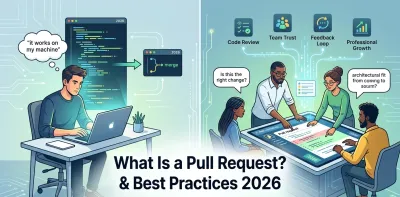
A pull request is a formal request to merge code from one branch into another, and it gives your team a place to review and discuss the change before it goes live. In practice, it's the checkpoint between “it works on my machine” and “this belongs in the shared codebase.”
If you're learning on your own, a pull request can feel like bureaucracy. You write code, it runs, so why not just merge it and move on?
That feeling usually lasts until you work with other developers. The moment several people touch the same codebase, every change affects someone else. A new endpoint might break a frontend assumption. A refactor might make testing easier for one feature and harder for another. A small naming decision might shape how future code gets written.
That's why pull requests matter. They aren't just a GitHub screen you click through. They're where teams slow down enough to ask: Is this the right change, in the right place, in the right shape, for the system we're building?
From Solo Project to Team Player #
A shared codebase changes the job.
You are no longer writing code only to make a feature work. You are writing it so other engineers can review it, trust it, extend it, and debug it six months later. That shift is what turns coding into team engineering, and the pull request sits at the center of it.
A pull request works like a workshop table where the whole team can gather around one proposed change. The code is there, but so is the reasoning behind it. Reviewers can ask why a new pattern was introduced, whether the change fits the architecture, and what tradeoffs were made. That conversation protects the codebase, but it also trains the people working in it.
Why direct pushes break down #
Consider a bug fix in authentication. The code change might be small, but the impact rarely is. A teammate may know about a logging requirement you did not see. Someone else may catch a security concern, a testing gap, or a naming choice that will confuse future contributors.
Without a pull request, those questions arrive late, after the code is already in the shared branch. Then the team is reacting instead of reviewing.
A pull request creates a pause with purpose.
- It gives reviewers a clear checkpoint. They can inspect the change before it affects everyone else.
- It creates space for design discussion. Teams can ask whether the solution fits the system, not just whether it passes locally.
- It builds a feedback loop. Junior engineers get context and coaching. Senior engineers stay connected to how the codebase is evolving.
Practical rule: If other people will maintain, depend on, or learn from the code, open a pull request.
Why this matters for your growth #
Early in your career, it is easy to treat a pull request as a permission slip to merge code. Strong engineers learn to treat it as a record of judgment.
The title shows whether you can frame a change clearly. The description shows whether you understand impact and tradeoffs. The discussion shows how you respond to feedback, defend a decision, or change your mind when someone points out a better approach. Those are technical skills, but they are also career skills.
Hiring managers and senior teammates rarely judge engineers only by whether their code runs. They also notice whether that engineer communicates well, works with review comments productively, and contributes to shared architectural understanding. A good pull request makes that visible.
So if you are asking what a pull request is, start there. It is the place where code review, team trust, system design, and professional growth meet.
The Core Concept of a Pull Request #
The easiest way to understand a pull request is to stop thinking about Git commands and think about construction work.
An architect doesn't walk onto a site and start moving walls. They submit plans, other people review those plans, and only then does the team build against a shared understanding. A pull request works the same way. You're proposing a change to a system that other people rely on.
Atlassian puts this cleanly: a pull request is not just a notification. It's a formal review object that captures the source branch, destination branch, and proposed code delta so teammates can inspect, discuss, and approve changes before merge, reducing the chance of unreviewed code entering the mainline branch, as described in Atlassian's guide to making a pull request.
The three parts that matter #
A pull request usually contains three basic ingredients:
| Part | What it means | Why it matters |
|---|---|---|
| Source branch | The branch where your work lives | It isolates your changes from stable code |
| Target branch | The branch you want to merge into | It shows where the change is headed |
| Diff | The exact lines added, removed, or modified | It lets reviewers inspect what actually changed |
This structure is why pull requests work so well for distributed teams. One developer can open a PR in the morning, another can review it later, and the whole discussion stays attached to the actual code delta instead of getting lost in chat.
Pull request versus merge request #
You'll also run into a naming difference that confuses a lot of beginners.
GitHub uses pull request. IBM notes that GitLab calls the same process a merge request. The idea is the same: a contributor creates a feature branch, makes changes, and opens a review so teammates can inspect the diff before the code is merged into the main branch.
That naming difference matters less than the principle behind it. The team is saying, “Don't place code directly into the shared branch. Propose it, explain it, and let others evaluate it.”
A good pull request answers two questions at once: “What changed?” and “Why is this the right change for this codebase?”
Why the formality is useful #
Beginners sometimes hear “formal review object” and think it sounds heavy. In reality, that formality removes confusion.
Without a dedicated review object, teams end up spreading one change across commit messages, chat threads, screenshots, and memory. A pull request brings all of that into one place. It gives reviewers the branch context, the diff, the conversation, and the approval trail.
That isn't just process for process's sake. It's a design habit. Good engineering teams make important changes visible before they become permanent.
Anatomy of the Pull Request Lifecycle #
A pull request has a rhythm. Once you see that rhythm a few times, the process stops feeling mysterious and starts feeling predictable.
A strong pull request works like a quality-control gate. The author isolates work on a feature branch, pushes commits, then opens the PR with a clear title and summary. Reviewers can request edits, and the PR updates automatically as new commits are pushed, which shortens feedback loops, as explained in PagerDuty's overview of pull requests.

What the lifecycle usually looks like #
-
You create a feature branch This is your workspace for one idea. Maybe you're fixing a serializer bug, adding pagination, or refactoring a service class. The branch keeps that work isolated so the main branch stays stable.
-
You make commits as the work takes shape Good commits don't need to be literary masterpieces, but they should reflect intentional progress. They create a history that helps reviewers understand how the change evolved.
-
You push the branch and open the pull request You stop thinking only like a coder and start thinking like a collaborator. Your title, summary, and test notes should help another person review the change without guessing your intent.
A helpful companion if you're still building your Git habits is this guide on using Git for version control in real projects.
What happens after the PR opens #
Once the PR exists, two review loops begin at the same time.
The first is human review. Teammates read the diff, ask questions, point out edge cases, and suggest cleaner designs. The second is automated review. Continuous integration checks might run tests, linting, or static analysis before anyone approves the merge.
Here's a simple way to think about those loops:
- Human review checks judgment. Does the change fit the architecture? Is the naming clear? Will the next developer understand it?
- Automated checks verify consistency. Does the code still pass the project's standards and test suite?
Later, when conflicts appear or commit history gets messy, it helps to understand interactive rebase and conflict resolution. Not because every PR needs advanced Git surgery, but because clean history and calm conflict handling are part of professional workflow.
After feedback arrives, you update the branch. The PR refreshes automatically with your new commits. That matters because the conversation stays tied to the current version of the code instead of drifting into stale screenshots or side messages.
This short walkthrough helps if you'd rather see the flow in action.
The merge isn't the whole point #
Many beginners treat merge as the finish line. In strong teams, the true value often happens before that click.
The best pull requests don't just move code forward. They move shared understanding forward.
That's why a PR lifecycle matters beyond mechanics. It teaches you to isolate change, explain intent, respond to feedback, and leave behind a traceable decision record. Those are core engineering habits, not Git trivia.
The Art of Effective Code Review #
A pull request becomes much more useful once comments start to shape it. That comment thread is where a team tests ideas, protects the codebase, and teaches shared standards in public. For a junior engineer, that matters beyond the current task. Review history becomes a record of how experienced developers reason about tradeoffs, and learning to participate well is part of becoming someone teammates trust with larger decisions.
A healthy review culture builds collective ownership. The code may have one author, but the result belongs to the team. That is why pull requests matter so much to career growth. They show how you explain decisions, how you respond to feedback, and whether you can improve a design without turning every comment into a debate.

What good reviewers actually do #
Good reviewers read a pull request the way a future maintainer will read the code. They are not scanning only for mistakes. They are asking whether the change will still make sense next month, under pressure, when someone else has to extend it.
That usually shows up in a few habits:
- They ask clarifying questions before jumping to conclusions.
- They explain tradeoffs instead of treating personal preference as a rule.
- They focus attention where risk is highest. A hidden coupling problem deserves more discussion than a small style issue.
- They check fit with the system. Does the change follow existing patterns, or does it implicitly introduce a second way to solve the same problem?
- They leave comments that teach. A useful review helps the author improve this PR and write better code in the next one.
A good mental model is editor and author, not inspector and suspect. The reviewer helps make the work clearer, safer, and easier for the next person to change.
If your team uses release criteria or completion standards, tie review comments back to those shared expectations. Reading about understanding the agile quality checklist can help frame feedback around agreed quality bars instead of personal mood.
How to receive review without getting defensive #
Receiving feedback is a skill too.
Many early-career developers read comments as a judgment on intelligence. In practice, review comments usually point to one of three things: the intent is hard to see, the change creates risk, or there is a simpler option that better fits the codebase. Seen that way, review becomes less like grading and more like design discussion.
Treat review comments as feedback on the change, not a verdict on your potential.
Reply with context. Explain the constraint you were working under. Ask whether the suggested pattern is preferred for consistency across the project. If you disagree, stay concrete and discuss the tradeoff in terms of readability, performance, testability, or maintenance. That habit makes you look more professional than silent compliance or defensive pushback.
Review improves testing too #
Strong review often reveals weak tests before production does. A reviewer may understand your implementation and still ask, "How would we know this works if the edge case shows up?" That question is a gift. It pushes the PR from "I think this is right" to "we can prove the intended behavior."
That is one reason learning how to write unit tests in Python pays off early. Tests make your reasoning visible. They also help reviewers spend less time guessing and more time discussing the design of the change.
The habit that compounds over a career #
The long-term benefit of code review is subtle at first. After enough PRs, you start anticipating reviewer questions while you write. You choose clearer names. You split risky changes into smaller pieces. You explain edge cases before anyone asks. You begin to write for teammates, not just for the compiler.
That shift is part of growing from someone who can complete tasks into someone who can contribute to a team's engineering judgment. Pull requests are the workspace where that growth happens in public.
Common Pull Request Pitfalls to Avoid #
Most bad pull requests aren't bad because the author lacks effort. They're bad because the author didn't shape the change for review.
A reviewer doesn't experience your work the way you did. They don't have your mental timeline. They only see the branch, the diff, the description, and the current state of the code. If those are messy, review gets slow and trust drops.
Teams often measure PR size and cycle time as engineering health signals. Better Scientific Software notes that PR size is commonly measured by files or lines changed and recommends keeping PRs small, while teams also track cycle time from open to merge as a more useful signal than vanity counts in this discussion of pull request size.

The monster PR #
This is the classic anti-pattern. One PR changes routing, models, API responses, naming conventions, tests, docs, and maybe some unrelated cleanup for good measure.
The problem isn't just size. It's reviewability.
When a PR tries to do too much, reviewers can't easily tell which part deserves attention. Important risks hide inside a flood of harmless edits. The author waits longer for feedback. Other work gets blocked because the branch becomes a bottleneck.
A better habit is to break large work into smaller reviewable slices. Sometimes that means shipping behind a feature flag. Sometimes it means merging infrastructure changes first and behavior changes second. That's architectural thinking, not paperwork.
The empty description #
A vague PR description wastes reviewer time immediately.
Bad examples are easy to recognize: “updates stuff,” “bug fixes,” or “refactor.” None of those tell a reviewer what problem you're solving, what changed, or how to validate it.
A useful PR description should answer:
| Question | Why the reviewer needs it |
|---|---|
| Why was this change needed? | So they can judge whether the approach fits the problem |
| What changed? | So they can scan the diff with the right mental model |
| How should this be tested? | So they can verify behavior without guessing |
Merge conflicts you postpone #
Some developers ignore conflicts until the PR is already under review. That creates avoidable friction.
When your branch drifts too far from the target branch, conflict resolution becomes harder and reviewers lose confidence that the diff still reflects a clean change. Resolve conflicts early, test again, and keep your branch current enough that the final merge isn't a surprise.
Small, clear pull requests show respect for reviewer attention. That's part of being a professional engineer.
How to Create Portfolio-Worthy Pull Requests #
A strong GitHub profile doesn't just show finished repositories. It shows how you work.
That's where pull requests become valuable even on solo projects. If you're trying to get hired, don't treat your repository like a dumping ground for final code. Treat it like a record of professional process. Open branches for features. Create PRs for bug fixes. Write descriptions as if another engineer has to review them.
This is one of the most practical answers to what is a pull request for a learner. It's not only a team tool. It's also a way to practice the habits teams expect.
Use PRs to demonstrate engineering maturity #
When you open a PR on your own project, you're simulating real collaboration. You're forcing yourself to explain intent, isolate scope, and review your own work before merging.
That tells a hiring manager more than “I built a Flask app.” It shows that you can work with discipline.
A simple pattern that works #
You don't need a complicated ritual. You need consistency.
- Name branches clearly so the purpose is obvious from the start.
- Write the why in the PR description, not just the code change.
- Keep one concern per PR whenever possible.
- Add test instructions so a reviewer knows how to verify behavior.
- Review your own diff first before asking anyone else to trust it.
If you're building projects specifically to strengthen your portfolio, these Python project ideas for practical portfolio work are a good place to apply that workflow.
What a hiring manager can learn from your PRs #
A portfolio project says you can finish something. A thoughtful pull request can say much more:
- You communicate clearly
- You think in increments
- You understand reviewability
- You care about testing and maintainability
- You can explain the reasoning behind your code
Those are team skills. Teams hire for them.
One of the best habits you can build is opening a PR even when nobody is waiting on the other side. Write it for an imagined teammate. Leave context. Mention tradeoffs. Note what you'd improve next. Then merge it after a self-review.
That habit turns your Git history into evidence of how you think, not just what you typed.
If you want to practice these habits in a structured way, Codeling helps you learn backend engineering through hands-on Python projects, real Git workflows, testing, APIs, and portfolio-ready work you can show to employers. It's a strong fit if you want more than tutorials and want a path that builds the habits behind professional pull requests.