Python Developer Roadmap 2026: Become Job-Ready
A backend engineer doesn’t get hired because they’ve touched fifteen libraries. They get hired because they can take a messy requirement, reduce it to clear pieces, make reasonable trade-offs, and ship something another developer can maintain.
You’re probably looking at some version of the same problem most aspiring backend developers hit. One roadmap says learn Python syntax first, another says jump straight into Django, another pushes algorithms, another tells you to build AI apps immediately. After a few weeks, you’ve consumed a lot of content and built very little.
That confusion usually comes from treating a roadmap like a shopping list. It isn’t. A useful python developer roadmap teaches judgment. It shows what to learn, but it also teaches when a concept starts to matter, why teams use it in production, and what bad habits will slow you down later.
Beyond Checklists A Modern Python Developer Roadmap #
The biggest mistake I see is simple. People collect tools instead of building an engineering model in their head.
A backend engineer doesn’t get hired because they’ve touched fifteen libraries. They get hired because they can take a messy requirement, reduce it to clear pieces, make reasonable trade-offs, and ship something another developer can maintain. That’s why a real python developer roadmap has to be organized around thinking, not just technology names.
Python is worth betting on for this path because the demand isn’t hypothetical. Python became the top language developers wanted to learn in the 2023 Stack Overflow Developer Survey, and its backend rise was tied to frameworks such as Django and FastAPI, which pushed the roadmap toward core Python, web APIs, and database integration, as summarized by roadmap.sh’s Python roadmap overview.
That matters because it changes the learning order. You don’t start with system design diagrams. You start by learning how code expresses logic. Then you learn how to structure that logic into applications. Then you learn how to make those applications reliable in production.
A roadmap should remove noise, not add more of it.
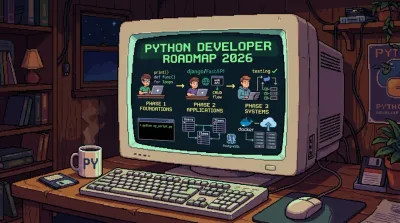
The sequence I recommend has three phases:
- Foundational thinker. Learn how programs behave, how to break work into functions, and how to use professional tools from day one.
- Application builder. Move from scripts to web backends, APIs, databases, and code organization that survives growth.
- System architect. Learn production readiness, testing strategy, deployment discipline, and the trade-offs that define senior work.
If you want a useful companion for that mindset shift, thinking like an engineer is the right framing. It focuses on how engineers approach problems before they touch code.
The rest of this roadmap follows that same principle. Learn each layer only when you’re ready to use it for something real.
Phase 1 The Foundational Thinker #
Beginners often underestimate this phase because it looks basic. It isn’t. In this phase, you form habits that either help you for years or force you to relearn everything later.

Learn logic before architecture #
At the start, Python syntax is not the goal. Syntax is only the surface. The essential skill is problem decomposition.
When you write conditionals, loops, functions, and simple data transformations, you’re learning how to turn vague instructions into precise behavior. That’s the muscle employers care about. A junior developer who can break a problem into small, testable steps is far more useful than someone who memorized a framework tutorial.
Focus first on a narrow set of concepts:
- Variables and control flow. These teach cause and effect. If input changes, what path does the program take?
- Functions. These teach boundaries. What should this unit do, and what should it ignore?
- Lists and dictionaries. These teach modeling. How do you represent data in a way that makes operations simple?
- File handling. This teaches state, failure, and the fact that real programs interact with messy outside systems.
A lot of beginners rush through fundamentals because they want to “get to the core stuff.” This is the core stuff. Frameworks only magnify your current level of clarity.
Start using Git and the terminal immediately #
Git and the Linux command line aren’t advanced topics. They’re part of basic professional literacy.
If you only write code in an editor and click around a GUI, you’re hiding from the environment where backend work happens. Servers, deployment workflows, debugging sessions, and collaboration all depend on comfort with the terminal. Git teaches a different lesson. It teaches accountability. Every commit is a decision record.
Practical rule: if a project matters enough to save, it matters enough to put in Git.
That habit changes how you work. You stop making random edits. You begin making intentional changes with names, scope, and history.
A solid beginner setup should include:
| Skill | Why it matters |
|---|---|
| Python fundamentals | Teaches logic and data flow |
| Git basics | Teaches disciplined iteration |
| Terminal navigation | Teaches environment awareness |
| Small scripts | Turns concepts into behavior you can observe |
Build tiny projects that force decisions #
Your first projects shouldn’t be impressive. They should be constrained enough that you can finish them and explain them.
Good examples at this stage include:
- A file organizer. Read files from a directory, classify them, move them safely, and handle errors.
- A command line task tracker. Store tasks, update status, and persist data in a simple format.
- A log parser. Read text input, extract patterns, summarize results, and present output clearly.
Each one teaches a backend habit. Input validation. Error handling. Separation of concerns. State management. Those concepts show up again later in APIs and services.
If you want a practical beginner path built around exercises rather than passive watching, learning Python for beginners is a useful reference point. The key is the workflow, not the branding. Write code, get feedback, repeat.
What not to do in this phase #
A few traps waste a lot of time:
- Don’t chase advanced syntax too early. Decorators and metaclasses are not where your main advantage lies yet.
- Don’t treat memorization as mastery. If you can’t build a small tool from scratch, you don’t own the concept.
- Don’t postpone tooling. Waiting to learn Git or the terminal “later” makes later much harder.
Foundations are boring only when they stay theoretical. Once you use them to solve real, small problems, they become the base layer of everything else.
Phase 2 The Application Builder #
This is the phase where many learners either level up fast or stall out completely. The difference usually comes down to one thing. They either start building systems, or they stay stuck writing isolated scripts.

Stop collecting tutorials and start building applications #
At this point, passive learning becomes a liability. You can feel productive for months while avoiding the hard part, which is making design decisions yourself.
That’s why structured, project-based learning matters so much here. Learners on a structured, project-based Python backend track were about 2 to 3 times more likely to land a job within a year than learners using unstructured tutorials, and successful programs spent roughly 30 to 40 percent of time on backend-specific tools, reflecting that over 75 percent of job postings required this hands-on experience, according to Scaler’s Python roadmap analysis.
That tracks with what teams hire for. Nobody needs another person who watched a playlist on REST APIs. They need someone who has already dealt with route design, validation, database schemas, broken migrations, and confusing edge cases.
If you haven't built an application end to end, you don't yet know where your weak spots are.
Learn OOP as a complexity tool #
Object-oriented programming gets taught badly. Beginners often hear abstract definitions and end up thinking it’s about jargon. It isn’t. OOP matters because systems get harder to reason about as they grow.
Use classes when they make boundaries clearer. Don’t use them to prove you know inheritance. A useful mental model is this: OOP helps you package behavior with the data and rules that belong to it.
That becomes practical when you build features like:
- User accounts with permissions and state
- Orders or carts with lifecycle rules
- Service objects that coordinate API calls, validation, and storage
You don’t need a giant class hierarchy. You need code that makes domain concepts obvious.
Choose a framework for the job you want #
For backend work, I usually tell juniors to choose one main framework and go deep enough to understand its shape.
A good comparison looks like this:
| Option | Best use |
|---|---|
| Django | Full-featured applications with admin, ORM, auth, and clear conventions |
| Flask | Lightweight services when you want more assembly by hand |
| FastAPI | API-heavy services with strong typing and modern request handling |
Django is often the best teaching tool for beginners because it forces you to work within conventions. That’s good. Constraints teach architecture. FastAPI is strong when your target is API-centric backend work. Flask is useful if you want a smaller surface area and more manual control.
Whichever you choose, don’t treat the framework as the product. The product is the system you build with it.
APIs and databases are where backend thinking matures #
Once you build a web backend, two skills start to matter immediately. Interface design and data modeling.
An API is a contract. It’s not just a route that returns JSON. It defines what clients can rely on, how errors are shaped, and how your application evolves without breaking consumers. Bad API design creates pain long after the code “works.”
Databases teach another important lesson. Data lasts longer than code. A sloppy schema is expensive because every future feature has to work around it.
When learning SQL and PostgreSQL, spend your energy on questions like these:
- What is the source of truth for this data?
- Which fields are required and why?
- What relationships should exist at the database layer versus the application layer?
- How will this model change when the product grows?
Those questions matter more than memorizing every query variation.
Build fewer projects, but make them complete #
A half-finished clone app doesn’t help much. A smaller but complete backend does.
Strong portfolio projects in this phase usually include:
- A blog or content API with authentication, CRUD operations, pagination, and validation
- A small commerce backend with products, carts, orders, and role-based access
- A team task manager with users, projects, comments, and activity history
Each project should force you to handle models, routes, serializers or schemas, permissions, and data consistency. It should also live in GitHub with a clean README, setup instructions, and commit history that shows real work.
If you want a concrete example of API-first backend development, this Django REST API tutorial is aligned with that kind of build-focused progression. Codeling follows a similar structure with browser-based exercises and synced local-style projects, which is useful if you need a guided way to move from concepts into complete backend applications.
The application builder phase is where your work starts looking like a job instead of practice. That’s why it’s the most important section of the roadmap.
Phase 3 The System Architect #
A junior developer asks, “Does it work?” A stronger engineer asks, “Will this keep working when other people change it, deploy it, and depend on it?”
That question marks the start of architectural thinking.

Production readiness is one skill with several faces #
Testing, containerization, deployment workflows, debugging, and performance are often taught as separate topics. In real backend work, they’re all the same conversation. The conversation is production readiness.
If your code only works on your machine, it isn’t ready. If nobody can deploy it safely, it isn’t ready. If small changes break unrelated behavior, it isn’t ready.
That mindset changes what you optimize for. You stop writing code only for yourself. You write for teammates, future maintenance, and operational stability.
Senior engineers don't just deliver features. They reduce the cost of change.
Testing should protect behavior, not implementation details #
A lot of early tests are too tightly coupled to the code structure. They verify internal methods, exact call order, or private implementation choices. That makes refactoring painful.
Better tests protect behavior that matters to users or other systems. If an API endpoint should reject invalid input, preserve authorization rules, and return the right shape, test those outcomes. Let the implementation evolve underneath.
A practical testing stack usually grows in layers:
- Unit tests for focused business logic
- Integration tests for database interactions and service boundaries
- API tests for request and response behavior
- Regression tests for bugs you never want to see again
This isn’t about purity. It’s about confidence. Good tests let you move faster because they make change safer.
Docker and CI CD teach consistency #
Docker matters because environments drift. You install one version locally, a teammate has another, deployment behaves differently, and now everyone is debugging setup instead of software.
Containerization reduces that class of problem by making runtime assumptions explicit. Even if your first Dockerfiles are simple, the lesson is valuable. Define the environment. Don’t rely on hope.
CI/CD matters for the same reason. It formalizes the path from code change to verified deployment. Even a basic pipeline teaches discipline:
- Run tests automatically.
- Reject broken changes early.
- Standardize what “ready to merge” means.
- Make releases repeatable.
That’s architecture in practice. Not diagrams. Operational predictability.
Performance and debugging are design feedback #
Performance work isn’t mostly about heroic optimization. Most of the time it reveals design choices you postponed examining.
If a view is slow, ask why it needs that much data. If a task blocks too long, ask whether the responsibility is in the wrong place. If a query explodes under load, ask whether the data model matches the access pattern.
Here’s a compact view of what changes in this phase:
| Earlier mindset | Architectural mindset |
|---|---|
| Code that passes | Code that stays reliable over time |
| Local success | Repeatable environments and deploys |
| Feature completion | Operational confidence |
| Fix the bug | Remove the class of failure |
What mature backend work looks like #
It usually looks less glamorous than people expect.
- You simplify boundaries so failures are easier to isolate.
- You write docs that explain decisions so teammates don’t reverse-engineer intent.
- You add guardrails through tests, linting, review standards, and deployment checks.
- You optimize selectively based on observed bottlenecks, not guesswork.
That’s why the final phase of a python developer roadmap isn’t about learning one more library. It’s about learning to treat software as a long-lived system.
Specialization The AI Engineer Path #
A lot of developers hear “AI engineer” and assume they need to become a machine learning researcher. Most don’t. In product teams, the role is often much more practical. It’s usually a backend engineer who knows how to integrate models into useful software.

AI engineering builds on backend fundamentals #
That distinction matters. If you can’t design APIs, manage data flow, handle failures, and think about production behavior, AI features become demos instead of products.
An AI engineer working in application teams often does work like this:
- Integrates model APIs into an existing backend service
- Designs retrieval pipelines for internal documents or product data
- Handles prompt inputs and output validation
- Stores conversation state and usage metadata
- Builds safeguards around latency, cost, and unreliable model responses
That’s backend engineering with a new category of dependency.
The practical stack to learn #
Don’t start with obscure theory unless your target role demands it. Start with the pieces you’ll ship.
A sensible specialization path includes:
- LLM API integration. Learn request structure, response parsing, retries, and fallback behavior.
- Prompt engineering. Not as magic phrasing, but as interface design. You’re defining instructions, constraints, and expected output shape.
- Vector databases and RAG concepts. Learn how retrieval improves relevance when models need external context.
- Evaluation habits. Judge systems by consistency, failure modes, and usefulness, not just whether one output looked impressive.
Treat model output as untrusted input from a powerful but inconsistent collaborator.
That one rule will save you from a lot of sloppy architecture.
Where people go wrong #
Many developers jump straight into chaining tools together without understanding the system they’re building. They get a chatbot working, then struggle when responses become inconsistent, context retrieval gets noisy, or users trigger edge cases.
The fix is rarely “better prompting” alone. Usually it’s better software design:
- Separate retrieval from generation
- Log prompts and outputs for review
- Validate structured responses before acting on them
- Keep business rules outside the model whenever possible
The next resource is worth watching once you’ve built at least one backend API and want to see how modern AI application work fits into that foundation.
A good AI engineer still thinks like a backend engineer #
That means you still care about contracts, observability, resilience, and maintenance. You don’t hand responsibility to the model unless the model is the correct layer for that responsibility.
Strong AI products usually come from disciplined engineering, not from novelty. The teams that win here don’t just add a model. They wrap it in clean interfaces, retrieval logic, safety checks, and useful workflows.
If you follow this specialization, don’t abandon the core python developer roadmap. Build on top of it.
Demonstrating Your Value to Employers #
By the time you’ve learned fundamentals, built applications, and started thinking in systems, one challenge remains. You need to make your ability obvious to someone who doesn’t know you yet.
That’s where many capable juniors fail. They have decent skills, but they present them like a course transcript.
Your projects should tell an engineering story #
Hiring managers don’t just scan for a finished repo. They look for signs of judgment.
A good GitHub project shows more than code files. It shows how you think:
- A clear README that explains the problem, architecture, setup, and key design choices
- Commit history with meaningful messages that reflects actual iteration
- Project structure that separates concerns instead of dumping everything into a few files
- Evidence of testing so the reviewer can see you care about reliability
- Practical decisions documented such as why you chose Django, PostgreSQL, or token-based auth
A project becomes much stronger when you can answer, “Why is it built this way?”
Employers don't hire portfolios. They hire the decision-making the portfolio reveals.
Write a resume that highlights outcomes and scope #
Most junior resumes are too tool-heavy. They read like a keyword pile. Python, Django, Git, SQL, Docker, REST, Linux. That doesn’t tell anyone whether you can build anything.
Instead, anchor your resume around projects and responsibilities. Describe what you designed, what the system does, and what technical problems you handled.
A better framing looks like this:
| Weak resume line | Stronger resume line |
|---|---|
| Used Python and Django | Built a backend API in Python and Django with authentication, relational data models, and test coverage |
| Know Git and GitHub | Managed feature branches, pull requests, and documented project setup in GitHub repositories |
| Worked with SQL | Designed relational schemas and implemented API endpoints backed by PostgreSQL queries and ORM models |
This doesn’t require fake metrics. It requires concrete scope.
Interviews reward explanation more than memorization #
You don’t need to sound like a textbook. You need to sound like someone who has built and debugged real software.
When you discuss a project, be ready to explain:
- Why you chose the framework
- How you modeled the data
- What trade-offs you made
- How you handled auth, validation, or testing
- What broke and how you fixed it
- What you would improve in a second version
Those answers separate builders from course completers. A junior who can explain trade-offs calmly is much more convincing than one who recites definitions.
Present yourself as someone ready to contribute #
That means your public materials should align:
- GitHub shows clean, active project work
- Resume shows build experience and technical scope
- Interview answers show reasoning and ownership
- LinkedIn or portfolio site presents a coherent backend identity
Keep the message consistent. You’re not just someone learning Python. You’re someone building backend systems in Python and understanding the decisions behind them.
That’s what this roadmap is really for. Not checking boxes. Demonstrating that you can think, build, and explain your work like an engineer.
If you want a structured way to practice that progression, Codeling offers a hands-on backend path in Python that includes browser-based exercises, Git and Linux workflows, API development, and portfolio-style projects. It’s a practical option for learners who want structure without relying on passive tutorials.