Computer Science vs Programming: The 2026 Career Guide
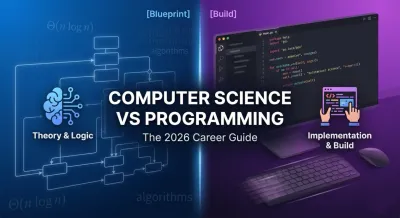
The practical way to think about computer science vs programming is simple. Computer science is the blueprint.
You’re probably in one of two situations right now. You’re either trying to break into tech and wondering whether to study computer science or just start programming, or you’re already writing code and starting to notice that shipping features isn’t the same as understanding systems.
That distinction matters more than most beginners think. It shapes the kinds of problems you can solve, the roles you can grow into, and how resilient your career will be as tools automate more of the routine work.
The practical way to think about computer science vs programming is simple. Computer science is the blueprint. Programming is the build. One helps you decide what should exist and why it should work. The other lets you turn that plan into software people can use.
Choosing Your Foundational Path in Tech #
A lot of junior developers frame this decision the wrong way. They ask, “Which is better?” That’s too shallow. The better question is, “What foundation will still serve me when the tools change?”
If you want a quick entry point, programming feels attractive. You can open VS Code, learn Python, build a Flask app, push it to GitHub, and see visible progress fast. That momentum matters. For many career switchers, it’s the difference between staying committed and quitting in frustration. If that’s you, this guide on changing careers into software engineering is a useful practical companion.
But speed can hide weak foundations. I’ve seen developers build CRUD apps competently and still struggle when the system starts to grow. They can write endpoints, but they can’t reason clearly about data modeling, caching strategy, queue design, indexing, concurrency, or why one design will age better than another.
Your first job may reward implementation speed. Your long-term career rewards judgment.
That’s why the blueprint-versus-craft metaphor matters. Computer science gives you the reasoning model. Programming gives you execution. If you only learn the craft, you can produce code. If you learn the underlying principles too, you can design software that survives scale, change, and complexity.
Here’s the fast comparison before we go deeper:
| Criterion | Computer Science | Programming |
|---|---|---|
| Primary focus | Why systems work | How software gets built |
| Core strength | Abstraction, models, architecture | Implementation, debugging, delivery |
| Best for | Designing robust systems and solving novel problems | Shipping features and building working applications |
| Long-term value | Stronger for high-complexity roles | Stronger for immediate hands-on output |
| Risk if learned alone | Can stay too abstract | Can become tool-dependent |
The smartest path for most aspiring backend and AI engineers isn’t choosing one side forever. It’s understanding which one should lead your development.
Understanding the World of Computer Science #
Computer science isn’t “more school.” It’s the study of computation, structure, constraints, and efficient problem solving. In practice, it teaches you how to think before you build.

When engineers say someone has strong CS fundamentals, they usually mean that person can reason about trade-offs instead of guessing. They know why a hash map beats a list in one case, why a queue changes system behavior, why recursion is elegant but sometimes dangerous, and why a database schema can make an API easy or painful to evolve.
The pillars that actually matter #
For backend and AI work, a few pillars carry most of the weight:
- Algorithms matter when you need software to do work efficiently, not just correctly.
- Data structures shape performance, memory use, and code clarity.
- Computational thinking helps you decompose messy business problems into solvable units.
- System design helps you make software maintainable when real users, real data, and real failures show up.
The point isn’t academic purity. The point is flexibility. An engineer with strong fundamentals can move between frameworks because they understand the ideas beneath the tools.
Why theory becomes practical fast #
Take backend architecture. If you design a REST API without understanding access patterns, you’ll often create endpoints that look clean but generate wasteful database behavior. If you understand data structures and complexity, you start asking sharper questions. What’s the lookup pattern? What grows over time? What should be cached? Where is the bottleneck likely to form?
That’s computer science in daily work. Not chalkboard exercises. Decision quality.
Practical rule: Learn enough theory that your design choices stop being accidental.
The same applies in AI engineering. You don’t need to become a researcher to benefit from CS thinking. You do need to understand how data flows through systems, where latency comes from, how memory pressure appears, and why one orchestration pattern is easier to observe and debug than another.
The architect mindset #
A useful analogy is a skyscraper architect. The architect doesn’t just sketch a building facade. They think about load, materials, constraints, and failure points before anyone pours concrete.
Computer science gives software engineers that same mindset. It teaches you to ask:
- What problem are we really solving?
- What are the constraints?
- Which model will stay correct under pressure?
- What fails first when usage, complexity, or scope expands?
Developers who can answer those questions become trusted quickly. They don’t just code tasks. They shape systems.
Defining the Craft of Programming #
Programming is the hands-on discipline of turning intent into behavior. It’s where architecture becomes endpoints, business rules become functions, and design becomes a working product.

That sounds basic, but it isn’t. Good programming requires precision, taste, discipline, and repetition. Most software projects fail in the implementation details long before they fail in the whiteboard strategy.
What strong programmers actually do #
People reduce programming to “writing code,” but professional programming includes a lot more:
- Translating requirements into clear logic that matches the business need.
- Structuring code so another engineer can understand it six months later.
- Debugging behavior when logs, tests, and assumptions don’t line up.
- Maintaining software as dependencies, product goals, and edge cases keep changing.
A backend programmer working with Python, PostgreSQL, Git, Linux, and Django Ninja spends less time showing off syntax than managing complexity. They write tests, review pull requests, trace failures, clean up naming, and refactor duplication before it spreads.
Craft matters because software lives longer than you expect #
Beginners often optimize for “it works.” Teams optimize for “it keeps working.” Those are different standards.
A quick script can solve a narrow task. A production service has to survive changing inputs, feature requests, operational mistakes, and handoffs between developers. That’s where programming becomes craft. You need conventions, modularity, predictable interfaces, and design patterns that fit the system instead of cluttering it.
Here are a few signs a programmer is maturing into an engineer:
| Signal | Early-stage habit | Stronger habit |
|---|---|---|
| Naming | Names reflect immediate thought | Names reflect domain meaning |
| Error handling | Handles only happy paths | Designs for failure and recovery |
| Testing | Added late, if at all | Built into workflow |
| Reuse | Copies patterns manually | Extracts clear abstractions |
Clean code isn’t about elegance for its own sake. It’s about reducing the cost of future change.
The limit of programming by itself #
Programming alone can get you started. It can even get you hired. But if your learning stops at syntax, frameworks, and tutorials, you’ll hit a ceiling.
That ceiling usually appears when you need to decide between multiple valid implementations. Framework docs won’t tell you when to denormalize data, when to use a queue, when to split a service boundary, or when a “simple” abstraction will hurt observability later. Those calls require deeper mental models.
Programming is essential. It just isn’t the whole discipline.
Comparing Computer Science and Programming Head-to-Head #
The easiest way to compare computer science vs programming is to look at what each one trains you to optimize for. They overlap, but they don’t aim at the same layer of skill.
| Criterion | Computer Science | Programming |
|---|---|---|
| Scope | Broad, conceptual, systems-oriented | Narrower, implementation-oriented |
| Core skills | Algorithms, abstraction, architecture, reasoning | Syntax, tooling, debugging, feature delivery |
| Learning focus | Why a solution works | How to build a solution |
| Primary output | Models, designs, efficient approaches | Working software, scripts, applications |

Scope and objective #
Computer science asks bigger questions. How should information be represented? What algorithmic approach fits this constraint? How do distributed systems coordinate work? How do we minimize complexity while preserving correctness?
Programming asks narrower but still essential questions. How do I implement this endpoint? How should this class be structured? Why is this test failing? How do I deploy this service safely?
Both matter. The difference is altitude. Computer science operates at the level of models and system behavior. Programming operates at the level of execution.
Tools and outcome #
A computer scientist often works with abstract tools first. Data structures, complexity analysis, computational models, and architecture decisions guide the work. A programmer uses practical tools to ship. Languages like Python or Java, version control with Git, test suites, frameworks, CI pipelines, and editors.
Neither side is complete on its own. Architecture without implementation stays hypothetical. Implementation without architecture gets messy fast.
Where the performance gap shows up #
This difference becomes concrete under load. In benchmark comparisons of problem-solving efficiency, computer science professionals show a 25-40% advantage in optimizing algorithms for large-scale systems, measured through time complexity reductions, according to BAU’s comparison of computer programming and computer science. The same source notes that CS-trained professionals routinely choose data structures with O(log n) lookup behavior over naive arrays with O(n) lookups, enabling backend systems such as REST APIs to handle 10,000+ requests per second without bottlenecks.
That doesn’t mean every CS graduate outperforms every programmer. It means training in algorithmic thinking changes the quality of your choices when scale and complexity become real.
A lot of software works at small scale. Fewer systems stay efficient when the easy decisions compound.
What works and what doesn’t #
What works in practice is a layered approach:
- Use programming to develop fluency with tools, workflows, testing, and delivery.
- Use computer science to improve decision-making, performance, and architecture.
- Combine both if you want to work on backend platforms, distributed systems, developer infrastructure, or AI products.
What doesn’t work is staying trapped on one side. Pure theory without building creates brittle confidence. Pure coding without fundamentals creates dependency on tutorials, frameworks, and copy-paste patterns.
That’s the key comparison. Computer science sharpens your judgment. Programming proves your judgment in running software.
How Your Choice Impacts Your Career and Salary #
Career decisions in tech aren’t only about what you enjoy learning. They’re also about where that path leads when the market shifts.

If you build your identity around implementation alone, you’re competing hardest in the layer most exposed to automation, templating, and outsourcing pressure. If you build around systems thinking, architecture, and deeper problem solving, you move toward roles where judgment is harder to replace.
The long-term market signal #
The clearest signal comes from job projections. Jobs for computer and information research scientists are projected to grow 15% from 2021 to 2031, while employment for computer programmers is projected to decline by up to 10% over the same period, according to Rice University’s summary of U.S. Bureau of Labor Statistics projections. That same source frames the divergence around demand for AI, data science, and machine learning capabilities, while routine programming tasks face more automation and commoditization.
This is the strategic point many learners miss. The market still needs people who can code. But it increasingly rewards people who can model complex systems, reason about trade-offs, and build in areas where generic tooling isn’t enough.
Salary follows complexity and leverage #
The same Rice source reports that median annual earnings for computer science master’s holders exceed $126,830, while bootcamp-trained programmers average a $69,079 starting salary, and Payscale lists $105,000 for a master’s in programming. You shouldn’t treat those figures as guarantees for any individual path. You should treat them as signals about how depth, specialization, and role scope affect earning power.
For junior developers, salary usually follows three things:
- How hard your problems are to solve
- How much business risk your decisions carry
- How transferable your thinking is across tools and domains
A developer who can implement tickets has value. A developer who can redesign a service boundary, choose a better data model, or improve the architecture behind an AI workflow usually has more influence.
Which roles each path tends to open #
Programming-heavy paths often lead first into application development roles. That can mean feature development, front-end implementation, internal tooling, QA automation, or product-focused software work. Those are legitimate paths, and many strong engineers start there.
A stronger computer science foundation tends to open doors into work that sits closer to systems and strategy. Think research-oriented roles, AI engineering, infrastructure work, distributed backend systems, and architecture-track positions. If you want a grounded overview of where software careers branch from there, this software engineer career description describes the field effectively.
The more your work depends on judgment under uncertainty, the more valuable foundational knowledge becomes.
That’s why I push junior developers toward fundamentals even when they’re eager to rush into frameworks. Frameworks change. Hiring filters change. The engineers who keep growing are the ones who understand the system underneath the tool.
The Optimal Learning Roadmap for Backend Engineers #
For backend engineers, the best answer to computer science vs programming isn’t either-or. It’s sequence.
Start with enough programming to become productive. Then study enough computer science to stop building fragile systems. Then go back to programming with better judgment.
A practical order that works #
This sequence tends to work well for self-taught developers and career switchers:
-
Learn one language Pick Python and stay with it long enough to become comfortable with functions, classes, modules, error handling, testing, and debugging. Don’t switch languages every few weeks.
-
Add core CS concepts early Study data structures, algorithms, and Big O notation while you’re still building. The goal isn’t memorization. The goal is learning to recognize trade-offs in real code.
-
Move into backend architecture Learn HTTP, REST API design, authentication, database modeling, caching, background jobs, and service boundaries. This is where theory starts paying rent.
-
Build projects with operational realism Simple toy apps aren’t enough. Build services that use PostgreSQL, GitHub workflows, testing, and clear documentation. Make them understandable to another engineer.
What to study beyond syntax #
A lot of learners waste time consuming endless tutorials on frameworks without building durable skill. A better focus is the stack of ideas underneath the framework:
- Data modeling for relational databases like PostgreSQL
- API design with explicit contracts, status codes, and validation
- State and concurrency in server-side systems
- Observability through logs, tests, and reproducible debugging
- Code organization using patterns that reduce coupling
Those topics are what separate a code learner from a backend engineer.
What does not work #
What usually fails is fragmented learning. One week of Python. Then a JavaScript course. Then Docker videos. Then an LLM tutorial. Then a half-built app abandoned at authentication.
That approach creates exposure, not competence.
A better path is consistent layering. If your goal is backend engineering, follow a structured progression and keep applying each concept to a real project. This guide on how to become a backend developer is a good example of that more disciplined roadmap.
Learn tools in the context of systems. Learn theory in the context of projects.
That balance gives you something rare in junior candidates. You can both build and explain why your design choices make sense.
Answering Your Key Questions #
Do you need a computer science degree to learn CS principles #
No. You need disciplined study, not necessarily a university transcript. You can learn algorithms, data structures, architecture, and complexity analysis outside formal education if you follow a structured path and apply the ideas in real projects.
The mistake is assuming informal learning should also be unstructured learning. It shouldn’t.
Can you become a successful developer without deep CS knowledge #
Yes, especially in the early stages. Many developers start by learning programming first and get hired through practical project work.
But the ceiling appears later if you never strengthen the foundation. You may still ship code, but system design, performance, and architectural decisions will stay harder than they need to be.
Should you start with programming or theory #
Start with programming, but don’t stay there too long without introducing theory. Beginners need feedback and momentum. Writing code gives both.
Once you can build basic programs, add computer science fundamentals quickly. That’s the point where your learning starts compounding instead of just expanding.
What should aspiring backend and AI engineers prioritize #
Prioritize Python, data structures, algorithms, API design, databases, testing, and architecture. Learn Git and Linux early. Build projects that show clear reasoning, not just feature lists.
If you can explain why you chose a schema, endpoint shape, or abstraction, you’re already thinking at a higher level than many entry-level candidates.
If you want a structured way to build both the why and the how, Codeling is worth a look. It teaches backend engineering through a hands-on Python path that covers fundamentals, object-oriented programming, data structures and algorithms, Git, Linux, REST APIs with Django Ninja, and modern AI engineering with LLMs. Instead of passive watching, you work through browser-based exercises and local projects that mirror real development workflows, so you build portfolio-ready applications while learning the reasoning behind them.