Software Engineer Career Description: A 2026 Guide
Most advice about becoming a software engineer is too shallow to be useful. This guide will explain everything you need to know.
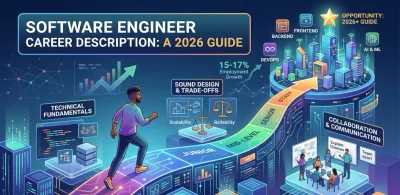
It tells you to learn a language, build a few projects, practice interviews, and apply everywhere.
That advice isn’t wrong. It’s incomplete.
A real software engineer career description has less to do with memorizing syntax and more to do with learning how to design systems, manage trade-offs, and make software easier for other people to change. That’s the part beginners often miss. Writing code matters, but code is only one artifact in a longer chain of thinking.
The opportunity is still large. The U.S. Bureau of Labor Statistics projects 15 to 17 percent employment growth from 2024 to 2034, with approximately 287,900 to 327,900 new software developer jobs over the decade and 129,200 openings annually according to the BLS software developer outlook. That kind of demand is exactly why a vague understanding of the role is risky. If you enter the field thinking the job is mostly typing code, you’ll train for the wrong thing.
Beyond the Hype The Real Software Engineer Job #
A software engineer is not just someone who can build an app.
A software engineer is someone who can take a messy business problem, turn it into a reliable technical design, implement it with discipline, and keep it maintainable after the first release. That last part matters more than beginners expect. Plenty of people can get a feature working once. Far fewer can make it safe to extend six months later when requirements change.
Programming is part of the job, not the whole job #
The hype around the field usually focuses on tools. Python. JavaScript. React. Django. Kubernetes. AI coding assistants.
Tools matter, but the job is bigger than the stack. You’re paid to make good technical decisions under constraints. Sometimes the right answer is to build a new service. Sometimes it’s to simplify an existing one. Sometimes it’s to say no to a feature because the operational cost will outweigh the value.
A junior coder often asks, “How do I build this?” A software engineer also asks, “Should this be built this way at all?”
That shift in thinking is where the profession starts to become engineering.
The title covers many kinds of work #
The same title can describe people doing very different jobs:
- Backend engineers design APIs, model data, and handle scaling concerns.
- Frontend engineers build interfaces and manage client-side state.
- DevOps and platform engineers focus on deployment pipelines, infrastructure, and reliability.
- AI and ML engineers build systems around models, data workflows, and inference.
What they share is not a language or framework. It’s a habit of structured problem-solving.
The real pressure is quality under change #
Most software fails in boring ways. Not because the team couldn’t code, but because the system became hard to understand, hard to test, or hard to evolve. That’s why the strongest engineers think about failure modes, interfaces, data flow, deployment, and maintenance before they think about clever implementation details.
If you want the plain version of the job description, it’s this:
- Understand the problem
- Design a solution
- Build it clearly
- Verify it works
- Ship it safely
- Maintain it without creating chaos
That’s the core software engineer job.
What a Software Engineer Actually Builds #
People often describe software engineers as “people who write code.” That’s like describing an architect as “someone who draws lines.”
The lines matter. The blueprint matters more.
Code is the output of a design process #
A software engineer builds systems, not isolated scripts. Even a small feature usually sits inside a wider environment that includes:
- Business rules such as permissions, pricing logic, or workflows
- Data models that shape how information is stored and queried
- Interfaces such as APIs, forms, or internal service contracts
- Operational concerns like logging, testing, deployment, and rollback
A feature that “works on my machine” isn’t enough. Engineers have to think about who will maintain it, how it behaves under edge cases, and what happens when another team depends on it.
The work follows a lifecycle #
The software development lifecycle sounds formal, but in practice it’s just a disciplined loop.
| Stage | What the engineer is really doing |
|---|---|
| Design | Clarifying requirements, identifying constraints, choosing a reasonable architecture |
| Implementation | Writing code that matches the design and stays readable |
| Testing | Verifying behavior, catching regressions, checking assumptions |
| Deployment | Shipping changes safely through version control and release workflows |
| Maintenance | Fixing bugs, improving structure, supporting future changes |
The strongest engineers don’t treat these as separate silos. They think ahead. If deployment will be painful, they simplify the design. If testing will be brittle, they reconsider boundaries. If maintenance will be expensive, they refactor before the complexity hardens.
Engineering is mostly trade-offs #
There is no perfect architecture. There is only a better fit for the current constraints.
You will trade speed for maintainability. Simplicity for flexibility. Centralization for team autonomy. Performance for development time. The mistake juniors make is assuming every system has one ideal answer if you just know enough computer science.
That’s not how production software works.
Practical rule: Prefer the design that your team can understand, test, and operate reliably. Clever code ages badly when nobody wants to touch it.
Good engineers reduce future pain #
That’s why design patterns, naming, boundaries, and modular structure matter. They are not academic decoration. They are ways to control complexity.
A backend engineer designing a REST API, for example, isn’t just deciding endpoint names. They’re deciding how clients depend on the service, how validation happens, where business logic lives, how errors are modeled, and whether the next feature will fit naturally or require a rewrite.
That’s the difference between coding and engineering. Coding solves the immediate task. Engineering solves the task in a way that survives contact with the future.
The Three Pillars of Engineering Excellence #
Strong engineers are rarely the ones showing off obscure syntax tricks. They are the ones a team trusts with messy systems, unclear requirements, and changes that cannot break production.
That trust usually rests on three things. Solid fundamentals, sound design judgment, and clear communication.

Technical fundamentals #
Fundamentals are not academic homework. They are the tools you use to avoid expensive mistakes.
Data structures and algorithms matter because software lives under constraints. Latency budgets, memory limits, query costs, and throughput targets all show up sooner than beginners expect. A backend engineer choosing a queue, cache strategy, or lookup method is making algorithmic decisions, whether they use that label or not.
Hiring teams know this. They use DSA questions imperfectly, but for a practical reason. They want evidence that you can reason about time, space, and failure cases before those issues hit production.
Object-oriented programming matters less as a religion than as a way to control complexity. Good OOP separates responsibilities, protects invariants, and gives code a shape other engineers can work with. Bad OOP hides simple logic behind five layers of abstraction. The point is not to worship classes. The point is to keep behavior, data, and boundaries understandable.
Systems basics belong in this pillar too. Concurrency, networking, databases, caching, and API design affect daily engineering work far more than many tutorials admit. A junior coder can build a feature that works on their laptop. An engineer understands what happens when ten thousand users hit it at once, when one dependency times out, or when two services disagree about data.
Problem solving and design #
This pillar is where careers start to split.
Early-career developers often focus on finishing the ticket in front of them. Engineers step back and ask what kind of change they are introducing into the system. That shift matters more than memorizing another framework.
A useful design review usually starts with questions like these:
- Where does this logic belong so it stays testable and reusable
- What assumptions are we making about data volume, latency, or traffic
- How does this fail, and what does the user experience look like when it does
- Are the boundaries clear enough that another engineer can extend this later
- Does this solution reduce complexity, or just move it somewhere less visible
That is architectural thinking. It is not reserved for staff engineers drawing boxes on whiteboards. It shows up in ordinary choices such as whether validation belongs in a controller or domain layer, whether a background job should be idempotent, or whether a service boundary will help the team or create more operational overhead.
A few principles hold up well in real codebases:
- Prefer explicit boundaries: Keep business rules out of delivery layers such as controllers, routes, and UI handlers.
- Model the domain carefully: Weak naming and poor data models create confusion that spreads into every feature.
- Design for change, not fantasy scale: Handle the likely next set of requirements without building a miniature distributed system on day one.
- Use patterns to remove repeated decisions: Service layers, factories, and strategy objects help when they clarify intent. They hurt when they add ceremony without solving a real problem.
I have seen junior engineers improve quickly once they stop asking, "How do I code this?" and start asking, "What future changes will this make easy or painful?" That is the mindset shift.
Good architecture makes common changes cheap and risky changes obvious.
Collaboration and communication #
Engineering is a team sport, even when the code looks solitary.
Promotion usually follows trust, and trust grows when other people can understand your decisions. TripleTen notes in its overview of software engineering responsibilities that planning work and explaining technical choices are part of the job, not optional extras. That matches how real teams operate. Engineers who can explain trade-offs, write clearly, and reduce confusion become much more valuable than engineers who only ship code in isolation.
In practice, this looks like:
- Writing short design notes that explain the problem, constraints, and chosen trade-offs
- Leaving useful pull request feedback that teaches, questions assumptions, or catches risk
- Documenting decisions so the next engineer understands why the code is shaped this way
- Explaining technical choices to non-engineers in terms of cost, risk, and user impact
- Helping less experienced teammates without using jargon as a shield
This pillar is often underestimated by self-taught developers and early-career engineers. They spend hundreds of hours learning syntax and very little time learning how to make their thinking visible. That becomes a ceiling. Past the junior stage, your job is not just to produce code. It is to help a team make better technical decisions, with less confusion and less rework.
Specializations and Career Progression #
“Software engineer” is a broad label. The day-to-day reality depends heavily on specialization.
If you’re early in your career, don’t try to master everything at once. Choose a direction, go deep enough to become useful, then broaden from a stronger base.
Common paths inside software engineering #
Here’s the short version of what different tracks tend to optimize for.
| Specialization | Core focus | Typical concerns |
|---|---|---|
| Backend | APIs, databases, business logic, service reliability | Data modeling, performance, security, maintainability |
| Frontend | User interfaces and client behavior | State management, accessibility, responsiveness, UX consistency |
| DevOps and platform | Infrastructure and delivery systems | CI/CD, observability, deployment safety, environment management |
| AI and ML engineering | Model-backed product features and data-driven systems | Data pipelines, inference workflows, evaluation, integration |
One trend is especially worth noting. AI Engineer positions have grown 143 percent since 2024, reflecting a strong shift toward modern specializations, according to Codesmith’s analysis of the 2025 software job market. That doesn’t mean everyone should chase AI titles blindly. It does mean the market is rewarding engineers who can work with modern data and automation-heavy systems.
Backend is a strong foundation #
For many learners, backend is the best starting point because it forces good habits. You deal with data integrity, business rules, API contracts, authentication, and persistence. Those problems teach engineering discipline fast.
You learn that software isn’t just screens. It’s state, failure handling, and reliable behavior under change.
Career growth is mostly about scope #
A lot of people think career progression is about becoming faster or learning more tools. That helps, but promotions usually come from broader ownership.
Here’s a practical view.
Software Engineer Career Levels and Expectations
| Level | Scope of Work | Key Responsibilities | Core Skills Focus |
|---|---|---|---|
| Junior | Individual tasks within a defined feature | Implement tickets, fix bugs, learn team standards, ask good questions | Syntax, debugging, Git workflow, testing basics, code readability |
| Mid-Level | Complete features across components | Break down work, make sound implementation choices, own delivery with less oversight | DSA fluency, OOP, API design, database thinking, communication |
| Senior | Systems and cross-team impact | Design solutions, review architecture, mentor others, prevent classes of problems | System design, trade-offs, technical leadership, documentation |
| Staff or Principal | Organization-wide technical direction | Set standards, guide platform decisions, align teams, influence long-term architecture | Strategic thinking, deep architecture judgment, influence without authority |
What changes as you move up #
The biggest shift is not coding less. It’s thinking wider.
- Junior engineers focus on correctness.
- Mid-level engineers focus on ownership.
- Senior engineers focus on system shape and team effectiveness.
- Staff engineers focus on coordination, direction, and durable technical decisions.
If you want to advance, stop measuring yourself only by output. Start measuring whether your work reduces confusion, avoids rework, and helps others move faster with confidence.
A Day in the Life of a Backend Engineer #
The stereotype is a lone programmer staring at a terminal for ten straight hours. Real backend work is more mixed than that.

Morning starts with alignment #
A normal day often begins with a stand-up or short team sync. Nobody needs a dramatic speech. The useful version is simple. What’s moving, what’s blocked, and what needs coordination.
Then the main work begins.
A backend engineer might spend the first deep-work block adding a new API endpoint. That usually means more than writing a route handler. You might update the data model, validate input, enforce authorization rules, add tests, and think through how error responses should behave.
If you’re learning this path, a practical backend-focused guide like this roadmap for becoming a backend developer gives a realistic sense of the skill stack involved.
Midday is often about investigation #
Some days go smoothly. Many don’t.
A bug report comes in. The failure only happens under a specific combination of request data. Logs show one symptom, but not the cause. Now the job becomes tracing execution, checking assumptions, reading older pull requests, and reproducing the issue locally.
Here, engineering feels less like creation and more like diagnosis.
Good debugging is disciplined skepticism. Don’t trust your first theory just because it sounds plausible.
Often the fix is small. The work is in narrowing the search space.
Afternoons bring collaboration #
Later in the day, you might review a teammate’s pull request. Maybe the code works, but the design couples two responsibilities too tightly. Maybe the query belongs in a service layer. Maybe the naming hides what the code is doing.
Then there may be a design discussion for an upcoming feature. Not every meeting deserves your energy, but design reviews do. They’re where teams decide whether a system will stay understandable or drift into accidental complexity.
A healthy backend day usually includes all of this:
- Focused implementation
- Debugging and verification
- Code review
- Design discussion
- A small amount of coordination
That mix is why the job stays interesting. You’re not just producing code. You’re shaping systems and helping a team make better technical decisions.
Your Practical Roadmap to Becoming a Software Engineer #
The slowest way to become a software engineer is to keep collecting beginner skills.
A lot of learners stay busy for months without getting closer to the job. They switch languages, chase frameworks, and finish courses that never force them to make design decisions. Activity feels like progress until they try to build something without step by step instructions.
A better roadmap is narrower. It trades variety for depth, because depth is what builds engineering judgment.

Start with one language and one execution path #
Pick a language that lets you build useful software early and stay with it long enough to notice patterns. Python works well for many learners because the syntax stays out of the way while you learn program structure, backend fundamentals, and automation.
Then move past syntax as soon as possible. Learn how to break code into modules, model behavior with classes when they help, handle failure cases, write basic tests, and work with files and structured data.
The goal is not to master every feature of the language. The goal is to turn vague ideas into programs with clear boundaries.
Build fundamentals that hold up under pressure #
Self-taught developers often postpone computer science basics until interview prep. That usually backfires. If you do not understand how data moves through a program, or why one approach uses more time or memory than another, your code gets harder to trust as the project grows.
Study data structures and algorithms with a practical lens. Arrays, hash maps, stacks, queues, trees, and graphs matter because they shape how systems behave under load. Big O matters because trade-offs are everywhere. A simple solution that works for 100 records may fail badly at 100,000.
Treat this as engineering, not trivia practice. Implement the structure yourself. Explain why you picked it. Measure the cost of a poor choice.
Learn the workflow that real teams depend on #
Employers do not hire for coding alone. They hire for contribution inside a team and a codebase that already exists.
That means learning the tools and concepts that show up in everyday work:
- Git and GitHub: commits, branches, pull requests, code review, merge conflicts
- Linux command line: files, processes, environment variables, basic shell usage
- HTTP and REST: request methods, status codes, idempotency, API design
- Databases: schema design, joins, indexing, migrations, data integrity
Project-based study works better here because the tools make sense in context. A guide like Codeling’s career change roadmap for software engineering is useful when it pushes you to ship working applications instead of only consuming lessons.
Build projects that force architecture decisions #
Many learners stay too shallow. They build apps that prove they can follow a tutorial, but not apps that prove they can make trade-offs.
Good projects create pressure. They force you to decide where logic belongs, how to structure data, how to recover from failure, and how to keep the code understandable after the third feature request.
Strong early projects usually look like this:
- A CLI application with validation, file handling, and meaningful error cases.
- A REST API with authentication, persistence, tests, and clear route boundaries.
- A multi-user application where roles, permissions, and data ownership affect the design.
- An integration project that calls third-party services and handles retries, rate limits, and partial failure.
Build fewer projects. Finish them more carefully.
Later, watch this for a practical perspective on the transition from learning to building:
Habits that waste months #
Several patterns show up again and again in stalled learners.
- Tutorial hopping: you repeat familiar steps without making independent decisions
- Framework-first learning: you memorize library conventions before learning core programming ideas
- Avoiding debugging: you miss the skill that sharpens reasoning and exposes bad assumptions
- Building only toy apps: you never run into the constraints that teach architecture
The roadmap is simple to describe and harder to follow. Pick a stack. Learn the fundamentals. Build projects that hurt a little. Then improve them until your code shows engineering judgment, not just syntax recall.
From Learning to Earning How to Prove Your Skills #
Hiring managers can’t see your intentions. They can only see evidence.
That’s why a strong portfolio beats vague claims every time. A certificate may show that you completed a course. A real project shows how you think. It reveals whether you can structure code, define boundaries, model data, use version control properly, and ship something that another engineer could maintain.
What a useful portfolio proves #
The strongest portfolio projects don’t try to impress with novelty alone. They prove engineering habits.
Look for evidence of:
- Clean architecture: logical separation of concerns
- Readable Git history: meaningful commits and sensible pull request flow
- Testing discipline: enough coverage to trust changes
- Documentation: setup steps, decisions, trade-offs, known limitations
- Realistic backend concerns: auth, persistence, validation, error handling
That proof matters because 90 percent of mid-to-senior software engineering roles mandate OOP proficiency, and a portfolio demonstrating clean architecture and Git workflows is the most direct way to show readiness for real-world collaboration, according to Udacity’s software engineer job description.
Resumes get attention, projects win trust #
A resume helps you enter the conversation. Your work keeps you in it.
When an interviewer opens your GitHub profile, they’re not just checking whether the app runs. They’re looking for signs that you understand maintainability. They want to see whether your code reflects engineering judgment or just output.
The portfolio that gets traction usually isn’t the one with the most projects. It’s the one where the projects look like they were built by someone ready to join a team.
If you want a practical next step, study what employers look for in hiring through this guide on getting a software engineering job.dev/blog/how-to-get-a-software-engineering-job/). Then build your portfolio to answer those expectations directly.
Codeling helps aspiring backend engineers learn through structured, hands-on Python work instead of passive video watching. If you want a path that includes OOP, DSA, Git, Linux, REST APIs, and portfolio-ready projects built in a realistic workflow, explore Codeling.