Best Course on Python
Which course helps you build a portfolio that showcases clean architecture and robust design, not just isolated code snippets?
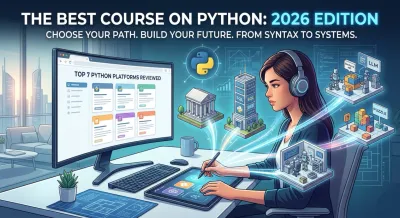
Choosing your first or next Python course is a strategic decision that shapes your software development career. Many aspiring developers get stuck in 'tutorial hell,' endlessly watching videos without building the architectural thinking and problem-solving skills employers actually hire for. They learn syntax but not system design. This guide is different.
We won't just list popular options; we'll dissect them based on the principles that matter for long-term success. Our evaluation focuses on how each platform moves you from basic scripts to building scalable, production-ready applications. This is about finding the best course on python that doesn't just teach you the language but teaches you how to think like a software engineer.
Which course helps you build a portfolio that showcases clean architecture and robust design, not just isolated code snippets? Which one is right for a complete beginner aiming for a backend role versus a developer upskilling in APIs?
This article cuts through the noise to help you find the right path for your specific goals. We will analyze the top platforms, including Codeling, Coursera's Python for Everybody, and Harvard's CS50p, among others. Each review includes direct links and screenshots to help you compare their project-based learning, teaching philosophy, and overall value in preparing you for a real-world engineering career. Let's find the course that builds your skills, your portfolio, and your future.
1. Codeling: The Hands-On Path to Backend Engineering and AI #
For learners who prioritize building job-ready skills over passively watching videos, Codeling emerges as a standout choice. It distinguishes itself by treating learning not as an academic exercise, but as a direct simulation of professional software development. This platform offers one of the most practical and focused programs available for those aiming to become backend engineers, making it our featured recommendation for anyone serious about a career in these fields.

The core philosophy behind Codeling is that you learn to code by coding, and you learn to build production systems by building them. The curriculum is meticulously structured, guiding you from Python fundamentals to advanced topics like REST API design with Django Ninja and modern AI engineering with Large Language Models (LLMs). This isn't just about syntax; the platform emphasizes higher-level principles, teaching you the "why" behind the "what." You'll learn how to think about system architecture, apply design patterns, and structure your code for scalability and maintainability, skills that are critical in a professional setting.
Key Strengths and Features #
What truly sets Codeling apart is its dual learning environment. You start with browser-based interactive exercises that provide instant feedback, perfect for grasping new concepts without complex setup. Then, you transition to synchronized local projects that mirror a real developer's workflow. This approach ensures you are comfortable with the exact tools and processes used in the industry, including Git for version control, the Linux command line for server management, and deploying applications.
"No more guessing what to learn next. It's a clear path to where I want to go." - Amelia, Codeling Student
The platform is designed around a portfolio-first principle. Every project is a complete, standalone application ready for your GitHub profile. These are not trivial exercises but demonstrable artifacts that showcase your ability to build and deploy APIs, manage databases, and write comprehensive tests. For a hiring manager, a link to a well-documented, functional project on GitHub is far more compelling than a certificate of completion.
Features at a Glance:
- Real-World Workflow Simulation: Combines browser-based exercises with local development projects to teach professional practices.
- End-to-End Curriculum: A structured path covering Python fundamentals, OOP, data structures, algorithms, SQL, APIs (Django Ninja), and AI integration.
- Portfolio-Ready Projects: Build and deploy functional backend applications that serve as tangible proof of your skills.
- Focus on Engineering Principles: Emphasizes software architecture and design best practices, not just coding syntax.
- Community and Motivation: Features like leaderboards and project challenges help maintain momentum and engagement.
Who Is It Best For? #
Codeling is an excellent fit for career switchers and self-taught developers who need a structured path to bridge the gap between basic knowledge and job-readiness. It is also ideal for computer science students seeking to translate theoretical knowledge into practical, portfolio-worthy projects. Finally, existing developers can use the platform to upskill in modern backend technologies like REST APIs and AI engineering.
However, learners whose primary goal is front-end development or UX design will need to look elsewhere, as the curriculum is laser-focused on backend and AI disciplines.
Pricing and Access #
Codeling offers the first 2 chapters of every course for free.
For access to every course and the ability to earn certificates, you'll need a paid membership.
Website: codeling.dev
2. Python for Everybody Specialization (University of Michigan on Coursera) #
For learners taking their very first steps into programming, the "Python for Everybody" Specialization is a foundational pillar. Taught by the charismatic Dr. Charles Severance ("Dr. Chuck"), this five-course sequence on Coursera has become a go-to starting point for millions. Its core strength lies in its accessibility and its direct focus on using Python to accomplish practical, data-oriented tasks, making it a powerful on-ramp for those intimidated by dense computer science theory.
Unlike courses that immediately dive into complex algorithms or object-oriented design, this specialization grounds you in the "why" of programming from a data-centric perspective. It answers the question, "What can I actually do with this?" from day one. This approach builds confidence by delivering small, tangible wins early and often, which is crucial for maintaining motivation when learning to program.
Learning Structure and Key Outcomes #
The specialization is structured as a clear, five-part journey. It begins with the absolute basics of programming and Python syntax before moving into more involved topics. The progression is logical and builds upon itself, ensuring learners are never left behind.
- Course 1: Getting Started with Python: Covers variables, conditional execution, and functions.
- Course 2: Python Data Structures: Dives into core structures like lists, dictionaries, and tuples.
- Course 3: Using Python to Access Web Data: Teaches you to work with network protocols, web scraping, and data formats like JSON and XML.
- Course 4: Using Databases with Python: Introduces basic database design and SQL for managing data.
- Course 5: Capstone Project: A final project where you build applications to retrieve, process, and visualize data.
This structure makes it a contender for the best course on python for beginners who want to understand how programming is used for practical data handling.
Ideal Audience and Strategic Value #
This course is exceptionally well-suited for absolute beginners, career changers from non-technical fields, or anyone who wants to learn programming for data analysis or web scripting without the pressure of advanced software engineering concepts. It serves as a perfect prerequisite before tackling more specialized backend frameworks or architectural design courses.
However, aspiring software engineers should view this as a starting point, not a final destination. The curriculum intentionally de-emphasizes software architecture, design patterns, and testing methodologies. After completing it, you will need to seek out other resources to learn about building robust, scalable, and maintainable applications.
Expert Insight: "Python for Everybody" excels at teaching you how to be a scripter and a data wrangler. It's less about building complex software systems and more about equipping you to automate tasks and interact with the web's vast data resources.
Access and Cost: You can audit the course materials for free on Coursera. For full access to graded assignments, mentorship, and the shareable certificate upon completion, you will need a Coursera Plus subscription (typically around $59/month) or to pay for the specialization directly.
Find the course here: Python for Everybody Specialization
3. CS50’s Introduction to Programming with Python (Harvard / edX / CS50 site) #
For learners who want to build a rock-solid foundation in both Python and computer science fundamentals, Harvard's CS50P is an academic-level powerhouse. As a spin-off of the legendary CS50, this course brings the same rigor, production quality, and emphasis on problem-solving to a Python-specific curriculum. It’s less about quick scripting and more about thinking like an engineer from day one, instilling best practices that are crucial for a software development career.

Unlike bootcamps that prioritize speed, CS50P focuses on deep comprehension and discipline. Its demanding problem sets force you to not only find a solution but to find an efficient and well-structured one. The course introduces core software engineering principles like testing and exception handling early, training you to write reliable code rather than just code that works once. This academic approach makes it a standout choice for those serious about professional programming.
Learning Structure and Key Outcomes #
The course is structured as a series of lectures, each accompanied by a challenging problem set that requires applying the concepts in a meaningful way. The curriculum is modern and covers topics essential for building real-world applications.
- Core Syntax and Control Flow: Starts with functions, loops, and conditionals.
- Error Handling and Testing: Introduces exceptions and the importance of writing tests (
pytest) early in the learning process. - File I/O: Covers reading from and writing to files, including common formats like CSV.
- Regular Expressions: Teaches powerful pattern matching for text processing.
- Object-Oriented Programming (OOP): Provides a formal introduction to classes, objects, and inheritance. If you need a deeper dive into this topic, this Python object-oriented programming tutorial is a helpful resource.
- Final Project: A capstone where you must design, implement, and present a substantial Python project of your own conception.
Completing CS50P makes it a top contender for the best course on python for learners who value academic rigor and want to establish strong software development habits.
Ideal Audience and Strategic Value #
CS50P is ideal for determined beginners, aspiring software engineers, and self-taught developers who want to fill in the formal computer science gaps in their knowledge. Its emphasis on testing and structured problem-solving provides immense value for anyone aiming for a backend engineering role. The reputation of Harvard's CS50 program also carries significant weight on a resume.
However, the pace can be intense. Those looking for a more relaxed introduction might find the problem sets overwhelming. This is not a course where you can passively watch videos; it demands active participation and a genuine commitment to solving difficult challenges. It's built to create resilient and thoughtful programmers, not just Python scripters.
Expert Insight: "CS50P isn't just a Python course; it's a software engineering primer. It teaches you the how of Python and the why of good software design, including testing and architecture. It forces you to build the mental models of a professional developer."
Access and Cost: The course is available entirely for free, including all lectures and problem sets, on CS50's official website. You can also audit it on edX. For a verified certificate to add to your LinkedIn profile or resume, you can enroll in the verified track on edX for a fee (typically around $199).
Find the course here: CS50’s Introduction to Programming with Python
4. Automate the Boring Stuff with Python (Al Sweigart — Udemy + official site) #
For those who learn best by doing, Al Sweigart’s "Automate the Boring Stuff with Python" is a classic for a reason. It bypasses abstract computer science theory in favor of immediate, practical gratification. The course’s entire philosophy is built around teaching Python as a tool to automate the repetitive, mundane tasks that fill our daily lives, making it a powerful entry point for non-programmers and office professionals.

Unlike traditional programming courses, this resource answers the question "Why should I learn this?" with tangible results from the very first chapters. You aren't just learning syntax; you are learning how to manipulate Excel spreadsheets, parse PDF and Word documents, scrape websites for data, and send automated emails. This project-first approach creates a rapid feedback loop that builds motivation by showing you the real-world value of your new skills almost instantly.
Learning Structure and Key Outcomes #
The course is structured around a series of practical projects, each designed to solve a common "boring" task. It begins with Python fundamentals and then applies them to increasingly useful automation scripts. This unique structure ensures that learners are always working toward a visible, concrete goal.
- Part 1: Python Programming Basics: Covers foundational concepts like data types, flow control, functions, and error handling.
- Part 2: Automating Tasks: This is the core of the course, with chapters dedicated to:
- Web scraping with
RequestsandBeautiful Soup. - Working with Excel, Google Sheets, CSV, and JSON files.
- Controlling the keyboard and mouse for GUI automation.
- Sending emails and text messages.
- Manipulating images, PDFs, and Word documents.
- Web scraping with
This hands-on methodology makes it a top contender for the best course on python for anyone aiming to boost their personal productivity or add scripting skills to a non-tech role.
Ideal Audience and Strategic Value #
This resource is exceptionally well-suited for absolute beginners, office workers, data analysts, students, or anyone who wants to see an immediate return on their learning investment. Its focus on practical task automation makes programming feel less like an academic discipline and more like a superpower for efficiency. It’s an excellent way to get your feet wet without the pressure of software engineering principles.
However, its strength is also its limitation. "Automate the Boring Stuff" is not a guide to building large-scale software. It intentionally omits topics like object-oriented architecture, design patterns, and application testing. Aspiring backend engineers should see this as a fun and practical first step, after which they must pursue more advanced materials to understand how to build resilient and scalable systems.
Expert Insight: This course is a masterclass in teaching you how to become a power user of your own computer. It's about writing scripts to solve personal or office-level problems, not about engineering complex backend services. Think of it as learning to build a set of custom tools rather than constructing a skyscraper.
Access and Cost: A major advantage is its accessibility. The entire book is available to read for free on the official website. The companion video course on Udemy frequently goes on sale, and the author, Al Sweigart, often provides links to significant discounts, allowing learners to get the full video content for a minimal price (typically $10-20).
Find the course here: Automate the Boring Stuff with Python
5. Codecademy: Learn Python 3 (and Python Career/Skill Paths) #
Codecademy champions an interactive, hands-on learning model that eliminates the friction of setting up a local development environment. Its "Learn Python 3" course is built around an in-browser coding console with instant feedback, making it an incredibly approachable starting point. This tight feedback loop-where you write code and see the result immediately-is perfect for building foundational knowledge and muscle memory with Python's syntax.

While the initial course focuses on syntax, variables, and functions, Codecademy’s true value for aspiring engineers lies in its structured Career and Skill Paths. These paths bundle the core Python curriculum with essential computer science principles, backend development topics, and portfolio-worthy projects. This guided journey moves you from writing simple scripts to understanding how to build components of larger applications.
Learning Structure and Key Outcomes #
The platform is designed to take you from zero knowledge to job-readiness through a series of connected modules. The initial Python 3 course serves as the entry point, but the more advanced paths provide the architectural context needed for a software career.
- Learn Python 3 Course: Covers syntax, functions, control flow, lists, dictionaries, and classes. It’s the essential grammar of the language.
- Skill Paths (e.g., "Learn Intermediate Python"): Build on the basics with topics like decorators, generators, and algorithms.
- Career Paths (e.g., "Backend Engineer"): This is where Codecademy connects Python to the larger software ecosystem. Learners explore APIs, build web apps with Flask, manage databases with SQL, and understand fundamental design patterns.
This path-based structure makes it a strong contender for the best course on python for self-starters who value a well-defined, step-by-step curriculum that extends beyond a single language.
Ideal Audience and Strategic Value #
Codecademy is ideal for beginners who are easily discouraged by complex setup and prefer to learn by doing. The interactive environment provides constant reinforcement. The Career Paths are especially valuable for career-changers who need a roadmap that covers not just Python, but the related skills required to be a functional backend developer. If you want to build a portfolio, these paths include dedicated programming projects for beginners and more advanced learners.
However, a drawback is the platform's sandbox nature. While it's great for learning, it abstracts away the realities of managing a real-world development environment. Aspiring engineers must eventually transition to building and deploying applications on their own machines to gain practical experience with package management, server configuration, and deployment pipelines.
Expert Insight: Codecademy excels at teaching the "what" and "how" of coding through repetition and immediate feedback. To master the "why," serious learners should supplement its curriculum by actively building projects outside the browser and studying software architecture principles independently.
Access and Cost: The basic "Learn Python 3" course has free introductory lessons. To access the majority of the content, quizzes, portfolio projects, and the Career/Skill Paths, a paid plan is required. The Plus plan is around $17.49/month (billed annually), while the Pro plan, which adds job-readiness resources and AI assistance, is around $29.99/month (billed annually).
Find the course here: Codecademy: Learn Python 3
6. Real Python (membership with courses and learning paths) #
For developers aiming to transition from writing basic scripts to building professional-grade software, Real Python is an essential resource. It's not a single course but a vast, curated library of in-depth written tutorials and video lessons. The platform's strength is its unwavering focus on the "how" and "why" behind production-ready Python, covering best practices, testing, and software architecture that many introductory courses omit.

Unlike platforms that guide you through a singular, linear path, Real Python functions more like a professional development library. It empowers developers to dive deep into specific topics as needed, from advanced object-oriented design to effective code packaging. This approach is ideal for those who have grasped the basics and now need to understand how to write clean, maintainable, and scalable code that stands up to real-world demands.
Learning Structure and Key Outcomes #
Real Python is organized around structured learning paths, individual tutorials, and video courses, all vetted by a team of experienced Pythonistas. This modular structure allows you to either follow a guided curriculum or explore topics based on your immediate professional needs. The content quality is exceptionally high, emphasizing industry standards.
- Learning Paths: These curated collections of tutorials and videos guide you through broad topics, such as "Web Development with Flask" or "Data Science with Python," providing a clear roadmap.
- In-Depth Articles: Thousands of articles cover everything from fundamental concepts to niche topics like metaprogramming or performance optimization.
- Video Courses: These complement the written content, often providing a more visual and practical demonstration of complex subjects.
- Community and Support: Membership includes access to weekly office hours and a private community, offering a direct line to experts for troubleshooting and architectural advice.
This makes Real Python a top contender for the best course on python for developers seeking to elevate their skills from an intermediate to a professional level.
Ideal Audience and Strategic Value #
This platform is perfectly suited for developers who have completed a beginner course and are asking, "What's next?" It is ideal for aspiring software engineers, backend developers, and anyone who wants to learn to write code that is not just functional but also robust, testable, and well-designed. It bridges the critical gap between academic knowledge and on-the-job competence.
However, absolute beginners might find the sheer volume of content overwhelming. The platform's strength is its depth, which assumes a foundational understanding of Python syntax and programming logic. For new learners, it is best used as a second step after completing a more introductory program like "Python for Everybody."
Expert Insight: "Real Python teaches you how to think like a professional Python developer. It's less about holding your hand through a single project and more about giving you the architectural principles and practical patterns needed to build any project well."
Access and Cost: Real Python operates on a membership model. A paid subscription is required for full access to all courses, learning paths, community features, and downloadable materials. While some articles are available for free, the core value lies in the complete library and structured paths. Pricing information is available upon starting the checkout process.
Find the course here: Real Python Membership
7. JetBrains Academy / Hyperskill (Python Developer & Backend tracks) #
For learners who believe the best way to learn is by doing, JetBrains Academy and its platform, Hyperskill, offer a project-based curriculum that closely mirrors a professional developer's environment. Instead of passive video lectures, this platform integrates theory with immediate, hands-on practice directly within JetBrains IDEs like PyCharm. This approach is designed to build muscle memory not just for Python syntax, but for the entire development workflow, from writing code to debugging and testing.

The core philosophy of Hyperskill is "learning by building." You select a project, and the platform generates a personalized study plan with the specific theory topics and practical exercises needed to complete it. This project-first methodology is a powerful motivator, as every piece of theory has an immediate, practical application. You are not just learning abstract concepts; you are acquiring the exact knowledge needed to build a specific, functional application.
Learning Structure and Key Outcomes #
Hyperskill's structure is unique because it is not linear in the traditional sense. It's an interconnected map of topics and projects, allowing learners to forge their own path based on their goals. The "Python Developer" and "Python Backend Developer" tracks are particularly strong, guiding you through a series of increasingly complex projects.
- Project-Based Tracks: Choose a path like Python Backend Developer, which includes projects on building APIs with Django and interacting with databases.
- Knowledge Map: All topics are interconnected, showing you how concepts relate to one another and what you need to learn for your next project.
- IDE Integration: Practice and build projects directly in PyCharm, learning the tools professional developers use daily.
- Capstone Projects: The tracks culminate in substantial projects like creating a social media backend or a text-based adventure game, which serve as excellent portfolio pieces.
This structure makes it a strong candidate for the best course on python for aspiring engineers who want to learn professional tooling and development practices from the start.
Ideal Audience and Strategic Value #
This platform is exceptionally well-suited for self-directed learners who thrive on building complete projects rather than consuming lectures. It is perfect for those aiming for backend engineering roles, as its focus on Django, APIs, and databases aligns directly with industry needs. If you want to understand what it's truly like to work as a developer, this is one of the closest educational experiences you can get. If you want to understand the career path better, you can learn more about how to become a backend developer.
However, learners who prefer a more guided, instructor-led experience might find the self-driven nature of Hyperskill challenging. The platform provides the map and the tools, but you are the one who has to drive the journey forward. It demands a high degree of personal motivation and discipline to work through the projects.
Expert Insight: Hyperskill's greatest strength is its focus on workflow, not just code. By forcing you to use a real IDE and manage projects from start to finish, it teaches the "how" of software development, a skill often missed in more academic courses. It's less about holding your hand and more about giving you a professional-grade workshop.
Access and Cost: Hyperskill offers a free tier that allows you to access most theory topics and complete a limited number of practice problems each day. To unlock unlimited problem-solving, full project access, and IDE integration, a Premium subscription is required, which is available via monthly or annual plans (typically starting around $25/month if paid annually).
Find the course here: JetBrains Academy on Hyperskill
Top 7 Python Courses Comparison #
| Item | Implementation complexity 🔄 | Resource requirements 💡 | Expected outcomes ⭐📊 | Ideal use cases ⚡ | Key advantages ⭐ |
|---|---|---|---|---|---|
| Codeling | Moderate — hands‑on, dev‑workflow focused | Moderate — browser + local IDE, GitHub; paid (demo available) | Production-ready backend APIs, DBs, tests, LLM integrations | New and aspiring developers, career switchers, portfolio builders | End-to-end projects, instant feedback, GitHub portfolio, structured curriculum |
| Python for Everybody (Coursera) | Low — linear, instructor‑led sequence | Low — course access via Coursera (subscription for cert) | Practical scripting, web data & SQL fundamentals | Absolute beginners, data scripting on‑ramp | Clear progression, proven instructor, practical focus |
| CS50’s Intro to Programming with Python | High — rigorous problem sets, academic pace | Low monetary — free audit; high time/effort | Strong fundamentals: testing, OOP, problem‑solving | Learners seeking rigorous CS‑quality foundation | Academic rigor, strong reputation, free audit route |
| Automate the Boring Stuff | Low — project-driven, approachable | Very low — free book; optional Udemy cost | Fast practical automation (spreadsheets, PDFs, scraping) | Non‑programmers wanting immediate productivity gains | Highly applied projects, free readable book |
| Codecademy: Learn Python 3 | Low — interactive, browser‑based practice | Low–Moderate — browser; key content behind paid tiers | Basic Python fluency; beginner projects (paid tiers) | Beginners who want guided, instant feedback practice | Immediate feedback, no local setup, career paths available |
| Real Python | Moderate — self-directed, curated content | Moderate — membership for full access | Production‑grade skills: testing, packaging, performance | Intermediate devs leveling to professional practices | High editorial quality, office hours, active community |
| JetBrains Academy / Hyperskill | Moderate — project/IDE integrated workflow | Moderate — JetBrains IDE; premium unlocks projects | Project‑based portfolios and IDE fluency; backend skills | Learners preferring IDE workflows and capstone projects | IDE integration, realistic dev workflows, capstones |
Your Next Move: Choosing a Path, Not Just a Course #
The search for the "best course on python" ultimately ends not with a single universal answer, but with a clear, personal decision about your specific destination. We've journeyed through seven distinct platforms, moving past the surface level of Python syntax to evaluate how each one fosters the deeper skills of a professional software developer: architectural thinking, project-based problem-solving, and the adoption of industry best practices. Your choice should be a direct reflection of your career goals.
If your aim is a gentle, practical introduction to scripting and automation, Al Sweigart's Automate the Boring Stuff remains a fantastic starting point. For those who desire a rigorous, academic foundation in computer science principles and code quality, Harvard's CS50P provides an unmatched, challenging environment. These courses build a solid base.
However, for learners aiming to transition into a professional software engineering role, particularly in backend development, the decision requires more nuance. The focus shifts from just learning Python to learning how to think and build like an engineer. This is where the learning environment itself becomes a critical factor.
Bridging the Gap from Learner to Engineer #
The most significant challenge for aspiring developers isn't learning Python; it's bridging the vast gap between writing small scripts and building complex, maintainable applications. The courses we've examined tackle this challenge in different ways.
- For the Self-Guided Explorer: Platforms like Real Python offer a rich, deep library of expert topics. This is ideal for developers who already have some experience and can chart their own course, diving into specific subjects like performance optimization or advanced Django patterns as needed.
- For the Project-Focused Builder: JetBrains Academy and Codeling present a more structured alternative. They build their curriculum around tangible projects, mirroring a real-world developer workflow from the start. This approach forces you to connect concepts, manage dependencies, and think about the end-to-end system, not just an isolated function.
Key Insight: True engineering skill is developed not by memorizing syntax, but by wrestling with architectural decisions. Ask yourself: "Does this course teach me what to type, or does it teach me why I'm building it this way and what the trade-offs are?"
Making Your Decision: A Final Checklist #
As you make your final choice, move beyond the course syllabus and consider these higher-level factors. The best course on Python for you will be the one that aligns with your learning style and professional ambitions.
- Goal Alignment: Are you learning to automate tasks, build a web application, or enter the field of AI? Match the course's core strength (e.g., scripting, web development, data science) to your primary objective.
- Project Philosophy: Does the course use "toy problems," or does it guide you through building a portfolio-worthy project with real-world complexity? Look for projects that require you to integrate multiple technologies, manage a database, and deploy your work.
- Architectural Focus: Does the curriculum explicitly teach software design patterns, API design principles, and system architecture? Learning to structure code for scalability and maintainability is more valuable than learning a dozen obscure library functions.
- Learning Environment: Do you thrive with self-directed study (Real Python), academic rigor (CS50P), or a guided, mentorship-driven path that simulates a professional team (Codeling)? Be honest about what keeps you motivated.
Ultimately, your journey into software development is a marathon, not a sprint. The initial course you choose is just the first step, designed to equip you with the foundational knowledge and, more importantly, the mental models to continue learning effectively for years to come. Choose the path that doesn't just teach you Python, but teaches you how to become a problem-solver, an architect, and a builder.
Ready to stop just learning syntax and start building like a professional engineer? Codeling provides a structured, project-based curriculum designed to build your portfolio and master the architectural thinking required for a backend career. See how our approach transforms learners into job-ready developers at Codeling.