What Is Vibe Coding: A Guide to Modern Software Development
So, what exactly is vibe coding and does it have any place in real software engineering?
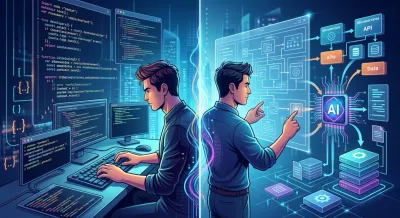
So, what exactly is vibe coding?
It's a new way of thinking about software development where you describe the outcome you want—the "vibe"—and an AI partner generates the code to make it happen. This flips the developer's role on its head. You stop being a line-by-line bricklayer and start acting as a high-level architect, focusing on the big picture instead of the tiny details.
The Architect vs The Builder #
Think about a film director on a massive movie set. The director doesn't personally operate the camera, build the scenery, or apply makeup to the actors. Their job is to hold the vision. They communicate the mood, the pacing, and the emotional core of a scene—the "vibe"—to a skilled crew who then handles the technical execution.
Vibe coding brings this exact same dynamic to building software.
Instead of getting lost in the weeds of syntax, you become the director. You set the high-level vision and guide the AI—your new technical crew—to assemble the application. It reframes development from a purely technical grind into a deeply strategic and creative process.
From Syntax to Strategy #
For decades, learning to code meant one thing: memorizing syntax, libraries, and the weird quirks of a programming language. This is like forcing a film director to know how to manually operate every single piece of equipment on set. While that technical knowledge has its place, it's not the same thing as having a great vision.
Vibe coding elevates your focus to what really matters in creating solid, scalable software. Instead of getting stuck asking, "What's the right syntax for this loop?" you start asking much bigger, more impactful questions:
- System Architecture: How should the different services in my app talk to each other?
- Design Patterns: What's the most efficient and maintainable way to solve this common problem?
- User Experience: What's the core job the user is trying to do, and how should that feel?
Your most valuable skill is no longer just writing code, but thinking critically about the entire system. You make the architectural decisions that ensure the final product is secure, efficient, and won't fall apart in six months. The AI handles the grunt work of translating those decisions into clean, functional code.
To see how these two approaches stack up, here's a quick comparison.
Traditional Coding vs Vibe Coding at a Glance #
| Aspect | Traditional Coding | Vibe Coding |
|---|---|---|
| Primary Focus | Writing correct syntax and implementing logic line-by-line. | Defining high-level goals and system architecture. |
| Developer's Role | The Builder: Focused on the "how." | The Architect: Focused on the "what" and "why." |
| Core Skill | Language proficiency and algorithmic implementation. | System design, clear communication, and strategic thinking. |
| Workflow | Code → Test → Debug → Repeat. | Prompt → Review → Refine → Integrate. |
| Bottleneck | Developer's typing speed and knowledge of syntax. | Developer's ability to articulate a clear vision. |
This table makes it clear: the shift isn't about replacing developers, but about changing the nature of their work from tactical implementation to strategic direction.
The Rise of Intention-Driven Development #
The term itself blew up after Andrej Karpathy, the legendary AI researcher and a co-founder of OpenAI, coined the term vibe coding. In a viral X post from February 2025, he declared it was time to "fully give in to the vibes, embrace exponentials, and forget that the code even exists."
This wasn't just catchy phrasing; it perfectly captured a massive shift happening in the industry. By early 2025, Large Language Models (LLMs) like ChatGPT and Claude had become so good they could generate complex, working code from a simple natural language prompt in seconds—a task that would have taken a human developer hours.
In this new world, the most valuable skill isn't your ability to write perfect code. It's your ability to clearly articulate your intentions. The developer's role is evolving into a master communicator and system designer.
This intention-driven development means that a deep understanding of high-level principles is now more critical than ever. When you master software architecture, design patterns, and system logic, you can guide AI tools to produce better results, faster than ever before. This frees you up to solve bigger, more interesting problems.
Mastering the Core Principles of Vibe Coding #
Getting good at vibe coding isn't about writing a lazy prompt and crossing your fingers. That's a surefire way to generate a chaotic mess of code that you’ll regret later.
Real vibe coding is a discipline. It demands clear communication, a solid grip on software architecture, and an iterative mindset.
You have to shift your thinking from just being a coder to being a system architect. The AI is your new junior developer—it's incredibly fast but has zero context, experience, or judgment. Your job is to be the lead engineer, providing the high-level vision it needs to produce code that actually follows sound engineering practices.
Ultimately, mastering what is vibe coding is less about the prompt itself and more about how you lead the entire development process.
Craft Precise and Context-Rich Prompts #
The quality of the code you get out is a direct reflection of the quality of the instructions you put in. A vague request like "build me a user login system" is going to get you generic, insecure, and probably useless code.
A master of vibe coding provides prompts that are more like a technical spec than a casual request. There should be no room for the AI to guess.
Think of it like giving a construction crew a detailed blueprint instead of a napkin sketch. Your prompt needs to outline the exact behavior, constraints, and architectural patterns you expect.
A great prompt doesn't just ask for code; it communicates intent. It explains the "why" behind the "what," giving the AI the necessary context to make intelligent implementation choices that fit within your broader system design.
For example, a strong prompt for a user authentication component would not just ask for a function. It would specify the design pattern to use (e.g., repository pattern), the expected inputs and outputs, error handling requirements, and how it should integrate with other services via a well-defined API contract. This level of architectural detail guides the AI toward a robust, maintainable solution.
Embrace Iterative Refinement #
The first chunk of code an AI spits out is almost never the final version. Treat it as a first draft—a starting point. The real magic happens when you start a feedback loop: prompt, review, and refine.
Don't just accept what it gives you. Analyze it with a critical eye. Does it align with your architectural principles? Is it efficient? Does it follow established design patterns? Use your own knowledge to spot the weaknesses, then write follow-up prompts to fix them. This back-and-forth is how you shape the AI’s raw output into something polished and production-ready.
This approach also turns the AI into a powerful learning partner. You can ask for different approaches to the same problem, have it explain its own code, or even ask it to find flaws in its own logic.
- Review and Validate: Always double-check the AI’s logic, especially for anything business-critical.
- Request Alternatives: Ask for a few different solutions so you can compare design patterns.
- Demand Simplicity: If the code is a tangled mess, tell the AI to refactor it for clarity. This is where knowing principles like DRY is a huge help. You can learn more by exploring the Don't Repeat Yourself (DRY) principle in our detailed guide.
Maintain Human Oversight and Accountability #
At the end of the day, you are the architect. You're accountable. The AI is just a tool, and like any powerful tool, it’s dangerous if you use it blindly.
Your expertise in software design, security, and performance is what separates a professional from a prompter. You are responsible for every single line of AI-generated code that gets committed to your project.
This human oversight is the single most important principle of vibe coding.
Think of yourself as the lead engineer doing a tough code review. Your job is to catch the subtle bugs, spot potential security holes, and ensure the new code fits cleanly into the existing architecture. By holding this standard, you're not just writing prompts—you're a strategic engineer guiding a powerful new technology to build resilient, maintainable systems.
How Vibe Coding Accelerates the Development Lifecycle #

The biggest, most obvious win with vibe coding is speed. Sheer, unadulterated speed.
By getting AI to handle the grunt work of writing boilerplate code, developers are freed from the tedious, repetitive tasks that used to eat up their days.
Instead of spending hours manually setting up a new project, you can get the same result in minutes. This leap lets you jump straight to the interesting stuff—the high-level architectural problems that actually make or break a product.
This isn't just about working faster; it's about thinking bigger. The whole process changes from a slow, methodical grind to a rapid-fire cycle of building, testing, and learning.
From Days to Minutes Generating Core Components #
Think about all the foundational pieces every backend application needs. Setting up a database schema, scaffolding a REST API, or writing a decent test suite—these tasks could easily consume days of a developer's time.
With vibe coding, that timeline gets crushed. A developer can describe the structure and behavior they want in a detailed prompt, and the AI generates the code almost instantly. The job shifts from tedious typing to high-level supervision.
For example, a developer can now:
- Generate Full API Scaffolds: Describe the data models, endpoints, and architectural patterns (like MVC or microservices), and get a working project structure ready for refinement.
- Create Database Schemas: Outline tables and relationships in plain English and receive the corresponding SQL or ORM models that conform to normalization best practices.
- Draft Comprehensive Tests: Provide a service's API contract and ask for a full suite of unit and integration tests that cover all important edge cases.
This isn't just an efficiency boost; it's a massive strategic advantage. It lets a single developer or a small team get a Minimum Viable Product (MVP) out the door at a pace that was once unthinkable.
The Power of Rapid Prototyping #
One of the oldest bottlenecks in software has always been the lag between having an idea and getting a tangible prototype into users' hands. Vibe coding shatters that barrier.
It’s no surprise that this approach has slashed prototyping times by up to 70% for companies everywhere. According to recent data, AI-assisted coding has boosted developer velocity by 55% year-over-year. In fact, 62% of teams in the US and UK now use LLMs for initial drafts, adopting a "code first, refine later" mindset. You can see more data on how AI is reshaping software development in this detailed analysis.
Vibe coding allows you to fail faster, learn quicker, and pivot with minimal sunk cost. When you can build and test a prototype in an afternoon, you can explore more ambitious ideas without risking weeks of engineering effort.
This ability to validate ideas so quickly changes everything. It creates a more agile, responsive, and experimental engineering culture.
Shifting Focus to High-Value Engineering #
When you offload the "how" of coding to an AI, you get to spend your brainpower on the "why" and "what." Your mental energy is no longer drained by syntax and boilerplate; it’s free to tackle much bigger, more critical problems.
This elevates the role of a developer from a simple coder to a true system architect. The most important questions are no longer about implementation details but about core design principles. For a deeper dive on building a solid testing foundation, check out our guide on how to write effective unit tests in Python.
This shift means more time spent on the things that create real, lasting value, like:
- Designing for Scalability: How will this system hold up with a thousand users? What about a million?
- Implementing Robust Security: Where are the weak points? How do we lock them down?
- Optimizing Performance: Where are the bottlenecks? How can we make this thing faster and more efficient?
Ultimately, vibe coding is a powerful force multiplier. It empowers developers to build better, more resilient software by letting them focus on the architectural decisions that truly matter.
Designing Resilient Systems in a Vibe Coding World #
So, you're letting an AI write your code. That’s great. It’s fast. But as the AI cranks out functions and classes, your job is changing, whether you realize it or not. You're no longer just laying bricks; you're the architect drawing the blueprints for the entire building. Your focus has to shift from the code itself to the system that holds it all together.
Here's the problem: an AI doesn't know about your grand vision. It just knows about the one function you asked it to write. This is why good architecture isn't just a "nice-to-have" anymore. It's a survival skill.
Without a solid plan, you'll end up with a "big ball of mud"—a tangled mess of AI-generated code that’s impossible to debug, maintain, or build upon. Your real job in this new world is to create a clean, organized structure where AI-generated parts can be plugged in, tested, and even thrown away without causing a total collapse. This is where timeless design principles become your most valuable weapon.
Building with Interlocking Blocks #
The best way to manage an AI-assisted codebase is to think in terms of modular design. Stop seeing your application as a single, giant sculpture. Instead, imagine it's built from a set of independent LEGO blocks. Each block, or module, does one specific job and has very clear boundaries.
This approach is a lifesaver when working with an AI:
- Isolation: When a module is a self-contained unit, you can let an AI rewrite its guts without worrying that it'll secretly break something on the other side of the application.
- Testability: Small, focused modules are a dream to test. You can write simple, targeted tests to prove an AI-generated piece of code does exactly what you expect before you let it anywhere near the rest of your system.
- Replaceability: Did the AI spit out a buggy or inefficient component? No problem. Just toss that LEGO block in the bin and generate a new one. No system-wide rewrite needed.
Thinking this way forces you to define clear responsibilities and interfaces from the start, giving the AI a perfect set of instructions to follow.
The Power of Strong API Contracts #
In a system made of LEGOs, the way the blocks connect is just as important as the blocks themselves. That's where API contracts come in. An API contract is a strict, formal agreement that dictates exactly how different parts of your system talk to each other. It spells out what data to send, what to expect in return, and how to handle errors.
Think of it like the standardized plumbing in your house. Every faucet and pipe is built to the same spec. That's why a plumber can swap out a broken part in minutes without having to rip out all the walls and redesign your entire water system.
A well-defined API contract is your shield. It guarantees that even if the internal logic of an AI-generated component goes completely haywire, it won't break the other components as long as the contract itself is honored.
This is the absolute foundation of any scalable application. By enforcing these strict communication rules, you build a stable system where individual pieces can change and evolve on their own.
Adopting a Microservices Mindset #
For bigger applications, you can take modularity even further with a microservices architecture. Instead of having different modules running inside one big application, you break them out into tiny, completely independent services that communicate over a network, usually through APIs.
Each microservice owns a single piece of the business—one for user logins, another for the product catalog, and a third for processing payments. This setup is almost perfectly suited for vibe coding.
Here’s why it’s so effective:
- Fault Isolation: If the AI writes some terrible code that crashes the payment service, it doesn't matter. The user login and product catalog services are completely unaffected and keep on running. The blast radius is contained.
- Technology Freedom: You can build the payment service in Python and the catalog service in a completely different language. This lets you use the best tool (or the best AI prompt) for each specific job.
- Independent Deployment: You can test and deploy an update to a single service without having to touch, or even think about, the rest of the application.
By leaning on these high-level architectural patterns, you create a safety net. You get all the speed and productivity of vibe coding while dramatically reducing the risks. You build a system that’s secure, fast, and—most importantly—won’t become a nightmare to manage six months down the line.
The Modern Learning Path for Backend Developers #
In a world where AI can spit out code on demand, the skills that make a great backend developer have completely shifted. The old path of just memorizing syntax is dead. The new path is about building a deep, architectural understanding so you can be the one guiding the AI, not just accepting whatever it gives you.
Your job is no longer to be just a builder; it's to be the architect. This roadmap focuses on those timeless skills—the ones that let you design, build, and manage complex systems, no matter what tools come and go.
To put it all into context, here’s a quick overview of the modern backend learning journey. We'll break down each stage in more detail below.
Backend Developer Learning Roadmap (Vibe Coding Era) #
This roadmap outlines the essential skills and focus areas for aspiring backend engineers, with estimated timelines for dedicated learners who are putting in consistent effort.
| Stage | Core Skills | Why It Matters for Vibe Coding | Estimated Timeline |
|---|---|---|---|
| Stage 1: Principles | Object-Oriented Programming (OOP), Data Structures & Algorithms | You can't evaluate or debug AI-generated code if you don't understand the fundamental "laws of physics" that govern good software. | 3-4 Months |
| Stage 2: Tooling | Git/Version Control, Linux/CLI, Docker/Containers | These are the non-negotiable tools of the trade. They allow you to manage, package, and deploy code consistently, whether it was written by you or an AI. | 1-2 Months |
| Stage 3: Architecture | Backend Frameworks (Django Ninja, etc.), API Design (REST), Databases (SQL/NoSQL) | This is where you learn to think big picture. You move from writing functions to designing entire systems that communicate effectively. | 3-4 Months |
| Stage 4: Production | Testing (Unit, Integration), CI/CD, Deployment (Cloud/AWS) | You learn to build robust, automated pipelines to ensure the systems you design are reliable and can be updated safely. | 2-3 Months |
| Stage 5: Advanced | Scalability, Caching, Message Queues, LLM/AI Engineering | You start tackling the hard problems: performance under pressure, distributed systems, and how to properly build with AI, not just use it. | Ongoing |
This is a marathon, not a sprint. The timelines are ambitious but achievable if you're focused. Now, let's dig into what each stage really means.
Stage 1: Grasping Foundational Principles #
Before you can ask an AI to design a skyscraper, you'd better understand the physics that keep it from falling over. In software, our "physics" are the core principles of programming. These are the rules that dictate whether a system is clean, maintainable, and scalable.
It all starts with a solid grip on Object-Oriented Programming (OOP). Don't think of OOP as just a way to organize code; it's a mental model for breaking down massive problems into small, manageable, and reusable pieces. When you truly get concepts like encapsulation and polymorphism, you can design systems that are logical and flexible, not just a tangled mess of functions.
Right after that comes data structures and algorithms. This is non-negotiable. Knowing how to store, find, and manipulate data efficiently is what separates an amateur from a professional. This knowledge is what lets you make smart decisions about performance, ensuring the system you ask an AI to build isn't just functional, but fast.
For a deeper dive into these fundamentals, explore our complete guide on how to become a backend developer.
Stage 2: Mastering Essential Tooling #
Once you have the theory down, it's time to master the tools that bring modern software to life. These aren't flashy new frameworks; they are the bedrock of professional development—the tools that enable collaboration and consistency.
The first and most important tool is Git. It's the universal language for version control. It lets teams of developers work on the same code without stepping on each other's toes. Knowing how to manage branches, handle merge conflicts, and review changes is an absolute must-have skill.
Next up is containerization with a tool like Docker. Docker solves the eternal "but it works on my machine!" problem by packaging your application and all its dependencies into a neat, self-contained box. This is critical for reliable testing and deployment, especially when you're trying to integrate components an AI might have generated.
Stage 3: Building Architectural Vision #
This is the final and most important stage. This is where you stop thinking like a coder and start thinking like a software architect—the person who sees the entire system, not just one small part of it.
This means getting comfortable with a backend framework like Django Ninja or FastAPI. Frameworks give you the scaffolding to build applications, but real mastery comes from understanding why they are designed the way they are. This knowledge lets you guide an AI to generate code that is clean, secure, and fits the framework's patterns.
More importantly, this stage is all about API design principles. Modern applications are not single monoliths; they are collections of services talking to each other through APIs. Designing clean, logical, and well-documented APIs is the key to building resilient systems that can actually grow and change over time.
This shift is precisely why understanding system architecture and API contracts is more important than ever. You can't just ask an AI to "build an app" and expect a good result if you don't understand how the pieces should fit together.
A focus on architecture transforms you from a code consumer into a system designer. You stop asking, "How do I write this?" and start asking, "How should this be built?"
This is the kind of high-level thinking that allows you to thrive. You use your deep understanding to direct the tools—including AI—to bring a cohesive vision to life, rather than just asking for disconnected snippets of code. By following this path, you're not just learning to code; you're learning how to build things that last.
Common Questions About Vibe Coding #
Alright, so this whole 'vibe coding' thing probably sounds a bit weird, maybe even a little scary. It’s a big shift in how we build things, and big shifts always bring up tough questions.
Let's cut through the noise and tackle the most common ones head-on.
Will Vibe Coding Make Developers Obsolete? #
This is the big one, isn't it? Let’s get it out of the way: No. Vibe coding won't make developers obsolete, but it absolutely will change what it means to be a developer.
The market for people who just translate simple instructions into boilerplate code is going to shrink, fast. But the demand for real software architects, critical thinkers, and system designers? That's about to explode.
AI is fantastic at executing a specific, well-defined task. It can write a function, sure. But it can’t design a scalable, resilient system from the ground up. It has no real judgment, no understanding of business goals, and no foresight to spot security holes before they happen.
The most valuable developers of tomorrow won't be the fastest typists; they will be the best thinkers. They will be the architects who can create robust blueprints, guide AI tools effectively, and hold ultimate accountability for the system's integrity and performance.
Think of it like this: when the power drill was invented, carpenters didn't go extinct. The ones who learned how to use the new tool just started building houses faster and better than ever before. AI is the new power tool in our toolbox.
What Skills Are Most Important in This New Era? #
As we shift away from typing out every single line of code, a different set of skills moves to the forefront. Memorizing every bit of syntax is becoming less important than deeply understanding the principles that make software work well.
Here's what will define the next generation of top-tier engineers:
- System Architecture and Design: You need to know how to design systems that are modular, scalable, and easy to maintain. This means getting good at things like design patterns, API contracts, and architectural styles like microservices.
- Problem Decomposition: This is huge. Can you take a big, fuzzy business problem and break it down into small, logical, well-defined chunks? That's the core skill you need to give an AI a prompt it can actually work with.
- Critical Evaluation and Debugging: You have to be the quality gate. Your job is to look at AI-generated code and instantly spot the problems. Is it secure? Is it efficient? Are there subtle bugs? Your expert eye is the final check.
- Clear Communication: Writing a good prompt is an act of extreme clarity. You need to articulate what you want so precisely that the AI has no room to misunderstand you.
These aren't brand-new skills, but their value has shot through the roof. It’s a move from being a tactical coder to a strategic designer.
How Can I Start Practicing Vibe Coding Today? #
The best way to start is to stop thinking of AI as a magic box that does your work. Instead, treat it like a very smart, very fast junior developer or a collaborator. You don't need any special tools; you can start changing your workflow right now.
Here’s how to ease into it:
- Don't Let It Code for You (At First): Instead of asking the AI to write a function, ask it to outline the steps to build that function. Then, you write the code yourself and ask the AI for a code review. This builds your own skills while using the AI as a mentor.
- Collaborate on Existing Code: Take a chunk of code you've already written and paste it in. Ask it questions like, "What would you do differently here?" or "Can you help me refactor this for better readability?"
- Iterate on Its Output: Never, ever accept the first answer as final. Look at what it gave you, find the flaws, and give it feedback in your next prompt. This back-and-forth is where the real magic happens.
- Prototype a Small Idea: Come up with a simple project—a personal blog, a tiny API—and try building it mostly with prompts. You’ll learn the art of prompt writing and managing an AI-assisted codebase faster than you think.
Getting good at this is less about the tool and more about the mindset. It's about realizing your true value is in your ability to think, design, and guide—not just to type.
Ready to build the foundational skills needed to thrive in the age of AI-driven development? Codeling provides a structured, hands-on curriculum designed to turn you into a software architect, not just a coder. Learn more and start your journey at https://codeling.dev.