Thinking Like an Engineer: Elevate Your Software Career
Thinking like an engineer isn’t about memorizing more syntax or algorithms. It’s a completely different way of looking at problems.
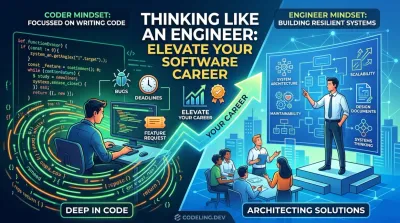
This is the skill that separates developers who just write code from engineers who build solutions that last. It's a skill you can learn, and it's the key to building a real career.
What It Really Means to Think Like an Engineer #
Lots of new developers think the fastest way to get good is to write more code. And yes, practice matters. But the real jump from junior to senior happens when you stop focusing on writing code and start focusing on architecting solutions.
Think of it this way: a coder is like a bricklayer. Their job is to lay the next brick perfectly. They're focused on the immediate task. An engineer is the architect. They have to think about the whole system—the foundation, the load-bearing walls, the plumbing, and how people will use the building for the next 50 years. Adopting that architectural perspective is what it means to think like an engineer.
To make this distinction crystal clear, let's compare the two approaches side-by-side.
Developer Mindset vs Engineer Mindset #
| Aspect | Traditional Developer Approach | Engineering Mindset |
|---|---|---|
| Primary Goal | Write code to implement features. | Design a system to solve a problem. |
| Problem Solving | Jumps into coding quickly. | Deconstructs the problem first. |
| Bugs | Fixes the immediate bug. | Asks why the bug happened and fixes the root cause. |
| Constraints | Views deadlines or tech limitations as obstacles. | Sees constraints as part of the design challenge. |
| Focus | How do I build this now? | How will this be maintained and scaled later? |
| Success Metric | The code works. | The solution is reliable, scalable, and maintainable. |
The table highlights a fundamental difference in perspective. A developer's job is often seen as done when the code is written, while an engineer's job has just begun.
From Reactive Fixes to Proactive Design #
The biggest mental shift is moving from a reactive "fix-it" mode to a proactive "build-it-right" philosophy. When a coder sees a bug, their first instinct is to patch it and move on. An engineer, on the other hand, asks why the bug happened in the first place and looks for a way to redesign the system to prevent that entire class of error from ever happening again.
This isn't magic; it's a structured way of thinking. It boils down to a few core habits:
- Deconstructing Problems: You learn to take a huge, vague request and break it down into small, concrete, and manageable pieces.
- Analyzing Constraints: You stop seeing things like budgets, deadlines, or a legacy tech stack as roadblocks. Instead, they become the guide rails that shape your solution.
- Evaluating Trade-Offs: You understand there's almost never a single "perfect" answer. Every decision is a trade-off between competing needs like performance vs. cost, or speed of delivery vs. long-term reliability. Your job is to make those trade-offs consciously.
- Building for the Future: You don't just build for the feature request you got today. You build systems that someone else (maybe even you, six months from now) can understand, maintain, and extend without wanting to tear their hair out.
Thinking like an engineer means you stop waiting for perfect instructions and start asking the right questions to define them yourself. It's about demanding clarity on requirements, constraints, and success metrics before a single line of code is written.
Ultimately, this is the mindset that turns you from someone who just follows tickets into a genuine, high-impact problem-solver. It’s what elevates your work from a series of temporary fixes to lasting, valuable systems that businesses can rely on. This is the foundation for a long and successful career.
Mastering the First Principles of Engineering Thought #
To move from just writing code to building robust, lasting solutions, you need to adopt the mental models that great engineers live by. These aren't fancy algorithms; they're fundamental ways of thinking that help you tame complexity and make better decisions under pressure. Once you internalize these principles, you start to truly think like an engineer, and that changes how you tackle every single problem.
This is the core difference: a coder focuses on making the individual puzzle pieces fit, while an engineer designs the entire blueprint before a single piece is cut.

While both roles write code, the engineer’s work starts way earlier. It begins with thinking about the system as a whole and what it will need to become in the future. Let’s break down the four pillars of this architectural mindset.
Deconstruct Problems with Decomposition #
First up is decomposition. This is the art of staring down a massive, intimidating problem and breaking it into smaller, manageable chunks. Instead of trying to "build an e-commerce platform," you break it down: user authentication, a product catalog, a shopping cart, and a payment processor.
Now, each of those pieces can be designed, built, and tested on its own before you even think about plugging them together. This simple act keeps you from getting overwhelmed and makes even the most complex projects feel achievable.
A key sign of an engineering mindset is the reflex to break things down before building them up. It's how you turn a vague, overwhelming request into a clear, actionable plan of discrete tasks.
Manage Complexity Through Abstraction #
Next is abstraction, which is just a fancy word for hiding the messy details behind a simple interface. You don't need to understand how an internal combustion engine works to drive a car; you just use the steering wheel and pedals. Those are the abstractions.
In software, a well-designed API is the perfect example. It gives other services a clean, predictable way to interact with your code without needing to know a thing about your internal logic or database schema. Getting good at abstraction is how you build systems that are easy to use, maintain, and expand upon later.
This systematic approach is exactly what the industry is paying for. The engineering software market is booming, with a projected CAGR of 9.80% from 2026 to 2033. For developers, mastering the decomposition of problems into fundamental parts like data structures and algorithms is what leads to a median U.S. salary of $132,270 annually. As we cover in our guide on data structures and algorithms for beginners, these are the building blocks. Even with a global developer population of 28.7 million in 2024, the talent shortage proves that real engineering skill is rare and in high demand. You can explore the full engineering software market research to see just how much that demand is growing.
Innovate Within Constraints #
It’s a common myth that innovation requires total freedom. The truth is, great engineers do their best work when their backs are against a wall. Constraint-based design isn't about seeing budgets, deadlines, or a required tech stack as roadblocks. It’s about using them as creative guideposts.
Constraints force you to find the optimal solution for the real world, not the "perfect" one that only works on a whiteboard. They push you to make smart trade-offs and deliver solutions that are practical, efficient, and actually get shipped.
Build from Foundational Truths #
Finally, we have the most powerful principle of all: First-Principles Thinking. Instead of just grabbing the popular solution or blindly following "best practices," you question everything. You break the problem down to its fundamental, undeniable truths.
For example, if you're asked to add a caching layer, you wouldn't just install Redis because everyone else does. You’d step back and ask:
- What's the fundamental problem we’re trying to solve here? (e.g., reduce database load, make API responses faster).
- What are the absolute truths about our data access patterns? (e.g., this data is read 1,000 times for every 1 time it's written).
- From these truths, what's the most logical way to build a solution from the ground up?
This is how you move from imitating to innovating. It’s how you build solutions that are tailor-made for the actual problem you have, not the one you think you have. This, more than anything, is the ultimate expression of thinking like an engineer.
Adopting Systems Thinking for Smarter Trade-Offs #
A great software developer doesn’t just build isolated features; they see the entire system. To really level up your skills, you have to adopt systems thinking—the ability to zoom out and see how all the independent pieces of an application connect and influence each other. It’s about understanding that a tiny change you make over here can create a massive performance bottleneck or a security hole way over there.
This perspective is everything, because every important decision in software is a trade-off. Let me say that again: there is almost never a single "perfect" solution. Instead, thinking like an engineer means getting really good at making calculated choices that balance competing needs. Without a view of the whole system, your trade-offs are just wild guesses. With it, they become smart, strategic decisions.
The Art of the Deliberate Trade-Off #
A junior developer might hear "make it fast" and immediately start optimizing a single function to shave off milliseconds. An engineer stops and asks, "Fast at what cost?" They instinctively know that cranking up the speed might mean sacrificing data consistency, blowing up the infrastructure budget, or adding so much complexity that the system becomes a nightmare to maintain.
The core of engineering isn't finding the perfect solution; it's about making the best possible compromise given a specific set of constraints and goals. Every architectural decision is a negotiation between opposing forces.
This means you have to stop looking for silver-bullet answers and start weighing your options based on context. For instance, when you're kicking off a new application, one of the first huge decisions is whether to build a monolith or go with microservices.
- Monolithic Architecture: You build the entire application as one big, unified chunk of code. It’s usually way faster to get started and deploy, which is great for new projects and startups. The problem is, they can become a real beast to scale and maintain as they get bigger.
- Microservices Architecture: You break the application into a bunch of small, independent services that talk to each other over a network. This gives you amazing scalability and flexibility, but it also slams you with a ton of operational complexity right from day one.
Neither one is automatically "better." The right call depends entirely on the system's goals, your team's size, and how much you expect it to grow. An engineer makes this choice on purpose, not just because one is trendy this year.
Common Engineering Trade-Offs #
As you grow as a developer, you'll start seeing these trade-offs everywhere. Recognizing them is the first step to making smarter architectural choices that actually serve the business, not just your personal technical preferences.
Speed vs. Reliability
- Speed: You're optimizing for the fastest possible response times. This might involve aggressive caching (which can serve stale data) or using data stores that are fast but less durable.
- Reliability: You're making sure the system is always up and the data is always correct. This often means adding extra checks, backups, and synchronous steps that can slow things down.
Cost vs. Performance
- Cost: You're trying to keep infrastructure spending to a minimum. This could mean running on smaller servers, using cheaper databases, or cutting back on third-party services.
- Performance: You're determined to deliver a lightning-fast user experience. This might require beefy servers, premium database plans, and global CDNs—all of which cost more money.
Flexibility vs. Simplicity
- Flexibility: You're designing a system that can easily change to meet future needs you don't even know about yet. This often leads to more abstract, complex code that's harder for a new developer to understand.
- Simplicity: You're building the most straightforward solution that solves today's problem. It's easier to build and maintain, but you might have to do a major rewrite if requirements change down the road. You can learn more about designing straightforward yet powerful systems in our guide to REST API design best practices.
Mastering systems thinking and the art of the trade-off is what separates a good programmer from a true software architect. It’s the skill that lets you move beyond just closing tickets and start designing the resilient, scalable systems that power modern business.
Building Resilient Systems by Designing for Failure #
A big part of thinking like an engineer is shifting from a coder’s optimism to a kind of prepared pessimism. A coder’s job is to make things work. An engineer’s job is to plan for what happens when they inevitably break. It's not about being negative; it's about building resilience. The goal is to design systems that don't just fall over when something goes wrong.
This mindset directly challenges the "it'll probably be fine" mentality. Instead, you build systems that can handle partial failures and keep running, a concept we call graceful degradation.
Think of a modern ship. It’s built with watertight compartments for a reason. If one section of the hull gets breached, the whole ship doesn't sink because the damage is contained. The ship might be slower and less stable, but it can still limp back to port. In software, this is exactly how we want our backend services to behave—isolating failures to protect the rest of the system and the user's experience.
From Wishful Thinking to Resilient Architecture #
Designing for failure means you stop treating potential problems as afterthoughts and start treating them as requirements. You have to relentlessly ask "What happens when...?" for every single network call, database query, and third-party service you depend on.
Let's take a real-world example. Your e-commerce app uses an external service for payment processing. What happens if that payment gateway goes down right in the middle of your Black Friday sale? An optimistic, brittle design would just crash and burn, showing users an ugly error page and costing you a fortune in lost sales.
A resilient design, on the other hand, expects this to happen.
A mature engineering perspective accepts that failures are not a possibility; they are a certainty. The job isn't to prevent all failures, but to design a system that survives them.
Even if the payment service is down, a resilient system would still let users browse products, add items to their cart, and maybe even save a wishlist. The application degrades gracefully, keeping as much of the site functional as possible until the payment gateway comes back online. That’s the real difference between a professional-grade system and a fragile one.
Essential Patterns for Building Resilient Services #
To get this level of resilience, engineers don’t just hope for the best. We use specific architectural patterns that are designed to handle chaos. These aren't just buzzwords; they're the fundamental tools of the trade for building highly available services.
Here are three of the most critical patterns you need to know:
-
Idempotency: This is a fancy word for a simple idea: making the same request multiple times should have the same effect as making it just once. For example, if a user's connection is laggy and they double-click the "Submit Payment" button, an idempotent API won't charge their card twice. It prevents dangerous side effects from retries, which are a cornerstone of recovering from failure.
-
Circuit Breakers: This pattern stops your application from hammering a service that it already knows is failing. After a few failed attempts to call a dependency, the circuit "opens," and any new calls fail immediately instead of waiting to time out. This is huge. It saves your own application's resources from getting bogged down and gives the failing service a chance to recover without being constantly bombarded.
-
Comprehensive Logging: When things do break—and they will—you need a trail of breadcrumbs to figure out why. Good logging isn't about printing random status messages. It's about creating a clear, structured audit trail of what the system was doing. This is absolutely critical for debugging the root cause of an issue instead of just patching over the symptoms.
By embracing these concepts, you start to move beyond just writing code that works on your machine. You begin architecting professional-grade systems that can survive the messiness of the real world—and that’s a huge part of thinking like an engineer.
A Practical Roadmap to Develop Your Engineering Mindset #
Alright, so you get the theory behind systems thinking and designing for failure. That’s a great start. But knowing the principles is one thing; living them is another. Developing an engineering mindset isn't an academic exercise you can cram for. It’s a habit. It's a muscle you build through deliberate, daily practice.
Here's a no-nonsense roadmap to turn that theory into a career-defining skill. This is about changing how you work, not just what you produce. It's time to stop just diving into code and start building the discipline to think like an architect first.
Start with a Design Document #
Before you write a single line of code, stop. Always start with a design document. And no, this doesn't have to be some 50-page formal specification nobody will read. A simple document outlining the problem, the constraints (time, tech stack, budget), and your proposed solution is one of the most powerful things you can do.
This simple act forces you to wrestle with the messy, ambiguous parts of a problem upfront. You have to ask the hard questions early, exposing roadblocks before they become project-derailing disasters. A good design doc is your blueprint; it gets everyone on the same page about what you’re building and, more importantly, why.
This shift toward rigorous planning is what thinking like an engineer is all about. It’s the mindset that drives real value and separates junior developers from senior-level talent. While quick-and-dirty prototyping has its place, it can't build the scalable, resilient systems that form the backbone of modern business.
Treat Debugging as a Science #
When a bug pops up, the coder’s impulse is to jump in and start changing things randomly, hoping something sticks. That’s a recipe for disaster. An engineer, on the other hand, treats debugging like a scientific experiment. You don’t guess. You form a hypothesis, run a test to prove or disprove it, analyze the result, and repeat.
Your process should look less like flailing and more like this:
- Hypothesize: Based on the evidence (error messages, logs, weird behavior), form a specific theory about the root cause. "I think the database connection is timing out under load because the connection pool is too small."
- Experiment: Design a clean test that will confirm or deny your theory. Maybe you increase the pool size, add specific logging around connections, or write a test that simulates the load.
- Document: Write down what you tried and what happened. Seriously. This stops you from running in circles and creates a breadcrumb trail for the next person (or future you) who runs into this problem.
Actively Participate in Reviews #
Code and design reviews are not about catching typos or flexing how clever you are. They are your single best training ground for thinking like an engineer. This is where you practice articulating your design choices and learn from how others solve problems. Don't just be a passive observer who clicks "Approve."
When you're reviewing someone else's code, don't just look at the 'what'. Dig into the 'why'. Ask questions about their trade-offs. When it's your turn to present, come prepared to defend your decisions and explain how your piece fits into the bigger picture.
This sharpens your ability to think about architecture and communicate complex ideas—a non-negotiable skill for any senior role. The ability to clearly articulate design rationale is every bit as critical as your technical chops.
Deconstruct Real-World Architectures #
Finally, make it a habit to look under the hood of the services you use every day. Don't just binge Netflix; think about how they deliver petabytes of video globally with almost no latency. Don't just buy something with Stripe; wonder how they process millions of payments with near-perfect reliability.
Read their engineering blogs. Watch their conference talks. Try to deconstruct how they tackle massive challenges like:
- High-availability payment processing
- Global content delivery networks
- Real-time data pipelines
This is where a structured learning path comes in. Platforms like Codeling are designed to take you from understanding these concepts in theory to applying them in practice.
A good platform doesn’t just throw information at you. As you can see above, it guides you through a progressive curriculum, systematically turning abstract principles into skills you can prove with a portfolio of real, working projects.
From Writing Code to Architecting Solutions #
This whole journey comes down to a fundamental shift in how you see yourself. It’s about moving beyond being a 'coder'—someone who just translates requirements into syntax—and becoming an 'engineer' who designs and builds resilient, elegant solutions to complex problems. The principles we’ve covered are your map for making that leap.
Thinking like an engineer means you have a durable toolkit of mental models you can pull from. This includes breaking down problems (decomposition), seeing the whole system, designing for failure, and making smart trade-offs. Honestly, these ways of thinking are your most valuable professional assets. They’re far more important than any single programming language or framework you’ll ever learn.
An Ongoing Practice, Not a Final Destination #
Here's the thing: you never truly "arrive" at an engineering mindset. It's not a destination. It's a discipline you practice every single day. Every new feature, every bug you hunt down, and every system you design is another rep, another chance to sharpen your skills. It all starts by consistently asking why before you even think about how.
When you apply these principles day in and day out, you’re doing more than just writing better code. You’re building the foundation for a long, impactful, and genuinely rewarding career as a true software engineer. This is how you go from being a task-taker to a problem-solver who creates real value.
The ultimate goal is to move from simply executing instructions to owning the solution. This means embracing ambiguity, challenging assumptions, and taking responsibility for the long-term health and success of the systems you build.
The most important takeaway is that this is all within your control. This way of thinking isn't some innate talent reserved for a select few. It's a learnable skill. It’s a set of habits that anyone can build with deliberate practice and a bit of dedication.
Embracing this disciplined approach is what separates a competent coder from an indispensable engineer. By choosing to think this way, you’re not just polishing your technical skills—you're investing in a future where you can design, build, and lead with confidence. This mindset is absolutely within your reach.
A Few Questions That Always Come Up #
Even after you know what the engineering mindset is, a few big questions always pop up as you try to make it a habit. Let's tackle them head-on.
How Long Does It Take to Start Thinking Like an Engineer? #
This is the question everyone asks, and the honest answer is simple: forever. It’s not a destination you arrive at or a certificate you earn; it’s a lifelong practice.
But you'll start feeling the shift in just a few months if you’re deliberate about it. The real change happens when things like decomposition and systems thinking become your default reflexes. At first, you’ll have to consciously force yourself to map out dependencies or write a design doc. After a while, you’ll feel naked not doing it. Consistency is what gets you there, not time.
Do I Need a Computer Science Degree to Think This Way? #
Absolutely not. A CS degree gives you a solid foundation in theory, like algorithms and data structures, but the engineering mindset is all about disciplined problem-solving. Anyone can learn that.
Some of the best engineers I know are self-taught. They got there by being relentlessly curious, breaking down real-world systems to see how they work, and applying good design principles to every project they touched. A portfolio that shows clear, structured thinking is worth a hell of a lot more to an employer than a piece of paper.
Thinking like an engineer means using higher-level principles to build productive, scalable systems. This mindset is what senior roles and top salaries are built on. With job growth for developers projected at 17.9% by 2033, far outpacing the average, the demand for true engineering talent is intense. A portfolio demonstrating systematic, architectural thinking—not just coding ability—is what lands you those median U.S. salaries of $132,270 and sets you apart in a field of millions.
What Is the Biggest Mistake Beginners Make? #
Jumping straight into code. It's the most common trap, driven by that urge to feel productive. But coding without a plan is like driving without a map—sure, you're moving, but you're probably going in circles.
This "code first, think later" approach almost always leads to disaster:
- Constant Rework: You solve the wrong problem or miss a key requirement, forcing you to tear down everything you just built.
- Brittle Code: Your solution is a patchwork of quick fixes that shatters the moment anything changes.
- Technical Debt: You create a messy, unmaintainable system that makes all future work a nightmare.
Force yourself to slow down. Think first. A couple of hours spent on a solid design will save you weeks of frustrating debugging and rewrites down the line. That discipline is professional engineering.
Ready to build the habits that define an engineering career? Codeling provides a structured, hands-on curriculum that takes you from theory to practice. Build a portfolio of real, deployment-ready projects and master the skills employers are looking for. Start your journey at https://codeling.dev.