Should I Use AI While Learning to Code? How to Avoid Vibe Coding Hell
AI coding assistants can write code incredibly well. But if you rely on them before understanding the fundamentals, you'll end up stuck in vibe coding hell with no idea how to fix anything. Here's when to use AI and when to learn the hard way first.
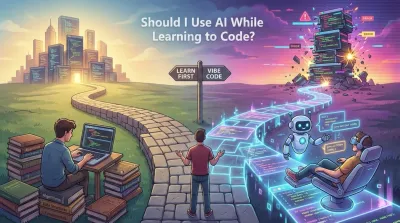
The Temptation of AI-Powered Coding #
Let's be honest. AI coding assistants are incredible. You type a prompt, and boom, working code appears. Need a REST API endpoint? Done. Want to parse a CSV file? Here you go. Database query giving you trouble? Fixed.
It's like having a senior developer sitting next to you 24/7, ready to write whatever code you need. So why wouldn't you use it all the time, especially when you're just starting out?
Well, here's the thing. There's a massive difference between having code and understanding code. And that difference will come back to haunt you.
What is Vibe Coding? #
Before we go further, let's define a term you'll hear a lot: vibe coding.
Vibe coding is when you ask AI to generate code, it works (or seems to work), and you move on without really understanding what happened. You're coding based on vibes. It feels right. It looks ok. Ship it.
The term was coined by Andrej Karpathy (former Director of AI at Tesla and OpenAI researcher) who described it as:
"...a new kind of coding I call 'vibe coding', where you fully give in to the vibes, embrace exponentials, and forget that the code even exists."
When things go well, vibe coding feels magical. But when things break, and they will break, you're left staring at code you don't understand, trying to fix a problem you can't diagnose, using tools you never learned.
Welcome to vibe coding hell.
Vibe Coding Hell: Where Dreams Go to Die #
Imagine this scenario. You've been building a web application for a while. You've used AI to generate most of your code. The app works on your laptop, and you're feeling pretty good about yourself.
Then you deploy to production.
Suddenly, your API endpoints are timing out. Your database queries that worked fine with 100 records are crawling with 10,000. Users are reporting weird edge cases you never considered. Your error logs are filled with stack traces you can't interpret.
You ask the AI to fix it. It suggests changes. You apply them. Now something else breaks. You ask again. More changes. More breakage. You're going in circles, each "fix" introducing new problems because neither you nor the AI has a coherent mental model of what your codebase actually does.
This is vibe coding hell. You're trapped in a system you built but don't understand, and no amount of AI prompting can save you because you lack the foundational knowledge to evaluate whether the AI's suggestions make sense.
Some symptoms of vibe coding hell:
- You can't explain what your code does without reading it line by line
- Every bug fix creates two new bugs
- You copy-paste AI suggestions without understanding why they work
- You're terrified of touching certain parts of your codebase
- You don't know if your code is secure, scalable, or maintainable
- Technical interviews expose massive gaps in your understanding
Sound familiar? Don't worry, there's a way out. But it requires taking a step back.
The Parallel: Tutorial Hell #
If you've been learning to code for a while, you might have heard of tutorial hell. It's when you watch tutorial after tutorial, follow along perfectly, and feel like you're learning. But the moment you try to build something on your own, you freeze. You have no idea where to start.
Tutorial hell and vibe coding hell are cousins. Both give you the illusion of progress without building real understanding.
With tutorials, you're following someone else's thinking. With AI, you're outsourcing your thinking entirely. In both cases, the crucial skill of figuring things out yourself never develops.
The difference is that vibe coding hell can be even more dangerous. At least with tutorials, you're exposed to explanations. With AI, you might never see the reasoning at all. You just get the answer.
Why Fundamentals Matter (Even in the Age of AI) #
Here's an uncomfortable truth: AI doesn't make fundamentals obsolete. It makes them more important.
Think about it this way. AI is a tool, arguably the most powerful coding tool ever created. But tools amplify the skill of the person using them. Give a chainsaw to a skilled lumberjack and they'll clear a forest efficiently. Give it to someone who's never held one and, well, let's just say things won't go smoothly.
When you understand the fundamentals, you can:
-
Evaluate AI output critically. Is this code efficient? Is it secure? Does it follow best practices? You can't answer these questions if you don't know what good code looks like.
-
Debug effectively. When AI-generated code breaks (and it will), you need to understand the underlying concepts to diagnose the problem.
-
Adapt and extend. Requirements change. You need to modify AI-generated code to fit new needs. Without understanding, you're back to prompting and praying.
-
Communicate with other developers. Technical discussions, code reviews, and interviews all require you to articulate your understanding. "The AI wrote it" isn't a valid explanation.
-
Architect systems. AI is great at generating functions and classes. It's less great at designing entire systems. That requires understanding trade-offs, patterns, and how pieces fit together.
When You Should NOT Use AI #
Let me be direct. There are times when using AI will actively harm your learning:
When You're Learning a New Concept #
If you're learning about loops, don't ask AI to write your loops for you. You need to write bad loops. You need to hit off-by-one errors. You need to accidentally create infinite loops and have to kill your terminal. These experiences build intuition that no amount of AI-generated code can provide.
The same goes for any new concept: recursion, object-oriented programming, async/await, database queries, API design. You need to struggle with these concepts yourself before you can meaningfully use AI to work with them.
This is exactly why our Introduction to Programming course has you writing code from scratch with interactive feedback, not watching someone else do it or copying AI output.
When You're Learning a New Framework or Library #
Starting with Django? Don't ask AI to generate your views and models. Work through the official tutorial. Read the documentation. Understand why Django structures things the way it does.
The patterns and conventions of a framework are just as important as the code itself. When you let AI generate everything, you miss the mental model that makes the framework make sense.
When You're Building Something for the First Time #
Never built a REST API before? Build one manually first. Yes, AI can generate one in seconds. But you'll learn far more by:
- Deciding on your URL structure yourself
- Figuring out how to handle different HTTP methods
- Dealing with request parsing and response formatting
- Implementing error handling
- Adding authentication
These decisions force you to think about API design in ways that accepting AI-generated code never will.
When You Don't Understand the Problem #
If you can't explain what you're trying to do in plain English, you're not ready to ask AI for code. You're just hoping the AI understands your problem better than you do. Sometimes it will. Often it won't. And you won't know the difference.
When AI Becomes Your Superpower #
Ok, so I've been pretty hard on AI so far. But here's the thing: once you have the fundamentals down, AI becomes genuinely transformative.
In fact, understanding how to work with AI effectively is becoming a valuable skill in its own right. Our AI Engineering with LLM APIs course teaches you how to build applications that leverage AI properly, but it assumes you already have the programming fundamentals down. That's the key: fundamentals first, then AI superpowers.
After You Understand the Concepts #
Once you understand how loops work, AI can help you write them faster. Once you know what a REST API should look like, AI can help you scaffold one quickly. Once you understand database design, AI can help you write queries more efficiently.
The key word is after. You're now using AI to accelerate work you already know how to do, not to avoid learning how to do it.
For Boilerplate and Repetitive Code #
Experienced developers spend a lot of time on code that's necessary but not intellectually challenging. Configuration files, repetitive CRUD operations, test setup, documentation. This is where AI shines.
When you understand what the boilerplate should do, you can quickly review AI output for correctness. But if you don't understand it, you're just copy-pasting mystery code into your project.
For Learning Syntax in a New Language #
Already know how to program but learning a new language? AI is great for translating concepts. "How do I write a dictionary comprehension in Python?" is a perfectly reasonable question when you already understand what comprehensions are and why you'd use them.
For Exploring Possibilities #
"What are some ways I could structure this module?" or "What patterns could I use for this problem?" AI can be a great brainstorming partner when you have enough knowledge to evaluate its suggestions critically.
For Debugging Specific Errors #
Staring at a stack trace you don't understand? AI can often explain what went wrong and suggest fixes. But notice: you still need to understand enough to know if the suggestion makes sense and to verify it actually fixes the problem.
The Right Approach: Learn First, Accelerate Later #
Here's a simple framework for deciding when to use AI:
Phase 1: Learning Mode When encountering a new concept, technology, or problem space:
- Don't use AI to generate code
- Do use AI to explain concepts if documentation is unclear
- Write code yourself, even if it's slow and painful
- Make mistakes and learn from them
- Build something from scratch at least once
Phase 2: Competence Mode Once you can explain the concept to someone else and build basic implementations without help:
- Use AI to speed up repetitive tasks
- Use AI to explore alternative approaches
- Still review all AI-generated code critically
- Continue learning edge cases and advanced patterns
Phase 3: Expert Mode When you have deep understanding and can quickly evaluate AI output:
- Use AI liberally for productivity
- Focus on architecture and design decisions
- Use AI as a thought partner for complex problems
How to Know If You Actually Understand Something #
Before reaching for AI, ask yourself these questions:
-
Can I explain this concept to someone with no technical background? If you can't simplify it, you probably don't fully understand it.
-
Can I write a basic implementation without any references? You don't need to memorize syntax, but you should know the general structure.
-
Do I understand why this approach is used? Understanding trade-offs matters more than knowing the "right" answer.
-
Can I predict what will happen if I change something? Understanding cause and effect in code is fundamental.
-
Can I debug problems in this area independently? If you need AI to fix every bug, you're not there yet.
If you answered "no" to any of these, you're still in learning mode. Keep at it. The understanding will come.
The Long Game #
Learning to code is a marathon, not a sprint. I know it's tempting to use AI to speed things up, especially when you're just starting out and everything feels hard. But the developers who thrive long-term are the ones who built genuine understanding early on.
Think about where you want to be in two years. Do you want to be:
Developer A: Someone who can prompt AI effectively but panics when the AI can't solve a problem. Who can't pass technical interviews because they never learned the fundamentals. Who is stuck at junior-level work because they can't architect systems or debug complex issues.
Or...
Developer B: Someone who deeply understands how software works. Who uses AI as a powerful accelerator but doesn't depend on it. Who can debug anything, learn any new technology quickly, and contribute to complex systems. Who passes interviews because they can actually explain their code.
The choice is yours. But the path to Developer B runs through the fundamentals, not around them.
Final Thoughts #
AI is the most powerful tool to ever enter the software development world. It will change how we write code in ways we're only beginning to understand.
But it won't change the value of understanding. If anything, as AI becomes more prevalent, the developers who truly understand what's happening under the hood will become more valuable, not less. They'll be the ones who can use AI effectively, who can catch its mistakes, who can build systems that work.
So yes, use AI. Just not yet. Learn first. Struggle first. Build understanding first. Then, when you're ready, let AI make you unstoppable.
The fundamentals aren't a detour on your coding journey. They're the foundation everything else is built on. Take the time to build that foundation well, and you'll thank yourself for years to come.
Now close your AI assistant and go write some code. The bugs you encounter will be your best teachers.
If you need a structured curriculum that will take you from writing your first line of code to building production applications, Codeling has you covered.