A Modern Resume for a Computer Programmer in 2026
Your resume is the main tool you have to tell a story about your growth as a developer.
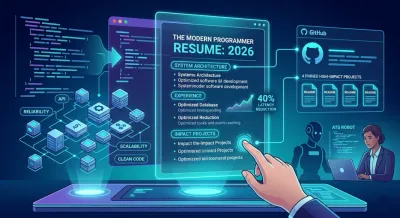
Your programmer resume isn't just a list of jobs you've had. Let's be real, nobody cares that much about your job titles. A modern tech resume is your first product pitch to a hiring manager, and the product is you.
It needs to show how you think, solve problems, and build things. It must demonstrate your grasp of software architecture, design patterns, and the engineering principles that separate a good programmer from a great one.
Crafting Your Modern Programmer Resume #
First thing's first: forget those ancient resume templates that just have you listing technologies and job duties. Seriously. The market has changed. Companies aren't just hiring people to write code anymore; they're investing in engineers who see the bigger picture.
Your resume is the main tool you have to tell a story about your growth as a developer. But it shouldn't be a story about completing tickets. It needs to be about how you tackle tough problems, design systems that don't fall over, and actually help a project succeed long-term.
To help you organize this, here's a quick breakdown of what every high-impact resume needs.
Core Components of a High-Impact Programmer Resume #
| Resume Section | Strategic Purpose | Key Information to Include |
|---|---|---|
| Contact & Links | Make it easy to contact you and see your work. | Name, email, phone, and direct links to your GitHub and Portfolio/Website. |
| Summary | A 2-3 sentence "elevator pitch" for your skills. | Your core specialty (e.g., Backend, API, AI), key technologies, and your engineering philosophy. |
| Experience | Prove you deliver results, not just complete tasks. | Bullet points focused on problems, actions, and quantifiable results (metrics). |
| Projects | Show you can build things from scratch. | 2-3 of your best projects with links to live demos and source code on GitHub. |
| Skills | Provide a quick, scannable list for ATS and recruiters. | Group by category: Languages, Frameworks, Databases, Cloud/DevOps, Tools. |
Each of these sections plays a crucial role, but the real magic happens in how you frame your experience—which means you need to start thinking differently.
Thinking Like an Architect, Not Just a Coder #
Hiring managers are scanning for signs of higher-level thinking. They need engineers who understand not just how to code a feature, but why a certain technical approach is the right (or wrong) one.
This means you have to shift your resume's focus away from a laundry list of languages you've "used" and toward the engineering principles you've actually applied.
Here's what that looks like in practice. You need to show you can think about:
- System Architecture: How have you designed or contributed to the bones of a complex application?
- Design Patterns: Have you used specific patterns like Singleton, Factory, or Observer to solve a recurring type of problem? Mention them.
- Scalability and Performance: How did your code help the system handle more users, reduce latency, or run more efficiently? Use numbers if you have them.
The goal is to present yourself as a product-minded engineer. Your resume needs to answer one core question: "How will this person's architectural understanding and problem-solving skills make our team and our product better?"
The Path to Becoming a Standout Developer #
Look, building these skills is a journey. You learn by doing. But just building a dozen small, disconnected projects won't teach you how to think about architecture. It's a trap many junior devs fall into.
The optimal way to learn is to focus on projects that force you to think about the entire development lifecycle. Instead of shallow tutorials, tackle complex problems that require you to design systems, consider trade-offs, and refactor for performance. Challenge yourself by exploring how to become a more effective software engineer. This is the kind of experience that fills a resume with accomplishments that actually matter.
Ultimately, your resume should be proof of your growth. It needs to show you're not just someone who can write code, but someone who builds resilient, scalable, and well-designed software. When you frame your experience through the lens of architecture and design, you're no longer just another programmer—you're a valuable asset ready to solve real engineering challenges.
Structuring Your Resume for Recruiters and Robots #

Let's get one thing straight: your resume has two audiences, and one of them is a robot. Before any human recruiter lays eyes on your application, it's going to be scanned by an Applicant Tracking System (ATS).
These systems are the first gatekeepers. They parse your resume for keywords, skills, and experience, filtering out anyone who doesn't seem like a good match on paper. Your first challenge isn't to impress a person; it's to create a document that a machine can actually understand.
This is why your resume's structure is non-negotiable. You need a clean, predictable layout that a robot can parse easily and a human can scan in seconds. For almost every programmer out there, the reverse-chronological format is the gold standard. It puts your latest—and most relevant—work right at the top where it belongs.
The One-Page Blueprint #
If you have less than 10 years of experience, your resume needs to be one page. Full stop. Recruiters spend an average of just 7.4 seconds on their first scan. That’s all the time you get. A single page forces you to be ruthless and highlight only what truly matters.
To make that page count, you need a logical flow. I’ve seen thousands of resumes, and this is the order that works best:
- Contact Info & Professional Links: Your name, email, phone, and—most importantly—direct links to your GitHub and portfolio. Make it dead simple for them to see your code.
- Professional Summary: A sharp, 2-3 sentence pitch. This isn't an "Objective" begging for a job. It’s a confident summary of your expertise and the value you deliver.
- Skills: This is your keyword goldmine for the ATS. Group your skills into logical categories (e.g., Languages, Frameworks, Databases, Cloud/DevOps).
- Professional Experience: The heart of your resume. This is where you prove your skills with project-focused bullet points, listed in reverse-chronological order.
- Projects: A curated list of 2-3 of your most impressive personal or academic projects. This shows passion and initiative beyond the 9-to-5.
- Education: Your degree, university, and graduation date. Keep it brief.
This structure tells a clear story, making it easy for both the ATS and the recruiter to quickly find what they're looking for.
Formatting That Passes the Test #
Fancy formatting is the enemy. Multi-column layouts, graphics, and weird fonts will trip up an ATS and get your resume tossed into the digital void. Stick to a simple, clean, single-column design.
Use standard, web-safe fonts like Calibri, Arial, or Georgia in a readable 10-12pt size. When you're done, always save and submit your resume as a .pdf. This locks in your formatting, ensuring that what you see on your screen is exactly what the recruiter sees on theirs.
Your resume is a user interface for your career. If it’s confusing or difficult to navigate, the user—in this case, the recruiter—will simply close the window. The goal is a frictionless experience that quickly delivers the most important information.
Getting the structure right is the foundation for everything else. By optimizing for both robots and humans from the start, you ensure your carefully worded accomplishments actually get seen. This is how you make a powerful first impression and get your foot in the door for the interview.
Showcasing Architectural Thinking and Impact #
This is where the best programmers separate themselves from the pack. Your project section isn't just a grocery list of things you built; it’s the proof of your problem-solving skills. A hiring manager doesn't just care what you made—they want to know why you made it, the roadblocks you hit, and the value it created.
Just writing "Built a REST API" is a huge waste of space. It tells me nothing about your architectural choices, your grasp of system performance, or your ability to think like an engineer. The real goal is to turn those flat descriptions into powerful stories of impact.
To get there, we can borrow the classic STAR method (Situation, Task, Action, Result) but give it a developer-centric twist. Think of it as Problem, Action, and Impact. Every single bullet point should tell this little story.
Problem, Action, Impact: The Developer's STAR Method #
This simple framework forces you to stop listing features and start building an engineering narrative. It's a critical shift for any resume for a computer programmer that actually wants to get noticed. Let's break it down.
- Problem: What was the specific technical or business challenge you were up against? Was it sky-high latency, a database that wouldn't scale, a terrible user experience, or a manual process begging for automation? Be specific.
- Action: What exact architectural, design, or coding choices did you make to solve it? This is your chance to mention the design patterns, frameworks, or algorithms you put into action.
- Impact: What was the measurable result of your work? This is where you drop the metrics: reduced latency, higher user capacity, lower operational costs, or faster data processing.
Even on personal projects, you can find metrics. Did your refactor shrink the codebase? Did you improve your API's response time? You can (and should) measure these things yourself.
Your project descriptions should read like mini case studies, not a feature list. Every bullet point is a chance to prove you don't just write code—you engineer solutions. This shows a level of engineering maturity that recruiters and hiring managers are desperate to find.
From Vague Descriptions to Metric-Driven Achievements #
Let's look at how this actually works. So many programmers write bullet points that are technically correct but communicate zero value. They describe the "what" but forget the "why" and the "so what."
A weak bullet point just lists a technology or describes a basic task. Something like, "Used design patterns in the project." This is a passive statement that leaves me with more questions than answers.
A strong bullet point, on the other hand, is active, specific, and quantified. It frames your work as a concrete achievement.
Let’s see how to transform some common "before" examples into powerful "after" versions that command attention.
Before and After Project Bullet Points #
| Weak 'Before' Example | Strong 'After' Example | Why It Works |
|---|---|---|
| "Built a REST API for a user management system." | "Engineered a scalable REST API using Django, reducing data latency by 40% for an anticipated 10,000 concurrent users." | It specifies the framework, states the architectural goal ("scalable"), and delivers a hard metric ("40% latency reduction") tied to a real-world performance target ("10,000 concurrent users"). |
| "Used Docker for the project." | "Containerized the application stack with Docker, decreasing new developer onboarding time from 2 days to under 30 minutes and ensuring environment parity." | This connects the tool (Docker) to a tangible business outcome (faster onboarding) and a technical win (environment parity), showing you understand development workflows. |
| "Refactored the frontend code." | "Refactored a monolithic React frontend into a component-based architecture, improving page load performance by 25% and reducing code duplication by 60%." | Here, the action is specific ("component-based architecture"), and the impact is measured in both performance ("25% faster") and maintainability ("60% less duplication"). |
See the pattern? The "after" examples are all about software architecture, system optimization, and the real-world value you delivered. They prove you're thinking about the bigger picture.
Showcasing Architectural Thinking #
Your resume needs to show your growth as a developer, and that means highlighting your grasp of high-level concepts. As you write about your projects, look for every chance to explain the principles behind your decisions.
Don't just mention a technology. Explain the architectural pattern you used it to implement.
- Did you implement a microservices architecture to decouple services and boost fault tolerance?
- Did you use the Observer design pattern to build a notification system?
- Did you design a caching layer with Redis to handle high-read traffic and shield the database?
Framing your experience this way speaks directly to senior engineers and hiring managers. It shows you're not just mindlessly following tutorials—you're on the path to mastering the craft of software engineering. This is how you elevate your resume for a computer programmer from a simple skills list to a powerful testament of your engineering talent.
Integrating Your GitHub and Portfolio Projects #
So you've polished your resume and dropped a link to your GitHub in the header. Job done, right? Wrong. Just linking to your profile is a huge missed opportunity. A hiring manager isn't going to sift through your messy history of forked tutorials to find gold.
Think of it this way: your resume makes a claim, and your GitHub is where you prove it. It's the interactive, living-and-breathing evidence that you can actually build things. It's your chance to guide a recruiter or engineering manager directly to your best work and show them how you think.
A well-organized GitHub turns your bullet points into reality.
Curating Your GitHub for Impact #
Your GitHub profile is often the very next click a hiring manager makes. A chaotic profile cluttered with half-finished side projects and forgotten class assignments sends a clear message, and it's not a good one. You need to be intentional.
Start with your profile's README. This is prime real estate. Use it to write a short developer bio that echoes the summary on your resume for a computer programmer. Talk about your core skills, your philosophy on building software, and what kind of problems get you excited.
Next, you need to clean house. Pin your best projects—the ones that truly showcase your skills in architecture, clean code, and problem-solving. A focused profile with 4-6 high-quality projects is infinitely more impressive than a messy one with 50 random repos. Archive or privatize everything else.
Making Your Projects Recruiter-Ready #
For every single project you pin, the README.md is your most important asset. This is where you connect the dots for someone who might not have time to read a single line of your code. Don't just list the tech stack; tell the story of the project.
A great project README.md should clearly answer these questions:
- The Problem: What challenge were you trying to solve? Why does this project exist? Frame it as a simple problem statement.
- The Solution: How did you solve it? Describe your architectural decisions. Did you use microservices? What design patterns (like MVC, Singleton, or Factory) did you implement, and more importantly, why?
- Key Features: Walk them through 2-3 of the most impressive features. Explain the technical choices you made to build them.
- Setup and Usage: Give clear, copy-and-paste instructions on how to get the project running locally. This shows you think about the developer experience beyond just yourself.
A well-documented project
README.mdis a sign of a mature developer. It shows you care about maintainability, knowledge transfer, and the developer experience—qualities that are highly valued in any engineering team.
From Code to Clean Architecture #
Beyond good documentation, the code itself has to pass the "sniff test." A recruiter will often pass your profile to a senior engineer for a quick look. They aren't going to do a full code review, but they will absolutely look for signs of professionalism and quality.
This is your moment to prove you understand best practices. Your code should speak for itself:
- A Logical Project Structure: Your files and directories should be organized in a way that’s intuitive and easy to navigate.
- Clean and Readable Code: Use consistent naming conventions. Write comments where the why isn't obvious from the what. Break complex logic into smaller, single-purpose functions.
- A Solid Git History: Your commit messages should be descriptive and clear. A messy Git log suggests a messy thought process. If you need a refresher, our guide on how to use Git for version control is a great place to start.
By putting in this effort, you stop treating your GitHub like a dusty attic and start using it as a powerful, interactive portfolio. It’s the feature film to your resume’s trailer, offering undeniable proof that you don't just talk the talk—you build thoughtful, well-architected software.
Tailoring Your Resume for Specialized Roles #
Sending out a generic resume is a rookie mistake. It's like using the same API key for every service—you might get lucky once, but you’re mostly just getting ignored. When you're aiming for specialized roles like Backend Engineer, API Developer, or AI/ML Engineer, a one-size-fits-all approach is a guaranteed path to the "no" pile.
Let's be real: hiring managers for these jobs aren't looking for a jack-of-all-trades. They have specific, gnarly problems to solve, and they need to see—in about six seconds—that you have the right architectural chops to handle them.
This means you have to reframe your experience for each and every application. And no, this isn't just about swapping a few keywords. It’s about understanding what makes that role tick and making sure your resume speaks that language fluently. You need to prove you’re not just a programmer, but the right one for their team.
Customizing for a Backend Engineering Role #
When a company is hiring for the backend, they’re obsessed with three things: scalability, reliability, and performance. They need to build systems that won't fall over under load, can grow with the user base, and feel snappy. Your resume has to prove you think this way.
So instead of just listing "Node.js" or "PostgreSQL," you need to frame your skills around the problems you solved. Show them you think about the bigger picture.
- Database Design and Optimization: Don't just say you used SQL. Talk about how you designed a schema to slash query times or implemented indexing that cut latency in a production environment. Did you handle a tricky database migration? Put it in.
- Scalability Concepts: Mention the specific architectural patterns you’ve used. Did you build something with a microservices architecture to isolate failures? Did you implement a caching layer with Redis to survive a traffic spike? These are the details that matter.
- Concurrency and Asynchronous Processing: Talk about building responsive, non-blocking apps. Mention how you used message queues like RabbitMQ or SQS to handle long-running background jobs without freezing the user experience.
Focusing on this level of design shows you’re not just a coder—you’re an engineer who builds robust systems. The job market is hungry for this kind of versatility. For example, in many statistical programming roles, while SAS is still common (94.7% of postings), employers now require both R and Python in 56.1% of jobs. Interestingly, 75.4% of those roles don't list a specific number of years of experience, showing they value demonstrated skills over just tenure.
Highlighting Skills for API and AI Roles #
When you shift your target to an API or AI/ML role, the emphasis changes. Scalability still matters, but other concepts move to the forefront. You need to prove you can build the glue for modern software or that you know your way around complex data pipelines. If you're serious about this path, our guide on how to become a backend developer is a good place to dig deeper.
For an API Developer role, recruiters are looking for:
- API Design Principles: Your resume needs to mention your experience with RESTful design, clear endpoint naming, versioning, and solid error handling.
- Security and Authentication: Highlight your knowledge of OAuth 2.0 or JWT. Show them you know how to build secure endpoints, not just functional ones.
- Documentation: Ever tried using an API with bad docs? It's a nightmare. Mentioning your experience with tools like Swagger/OpenAPI shows you care about the developer experience.
For an AI/ML Engineer position, it’s all about the data, the models, and the infrastructure:
- Model Integration and Deployment: Describe how you’ve taken a trained model from a data scientist and actually put it into production behind an API.
- Data Pipelines: Show you've built and managed the pipelines needed for training or real-time inference. Mentioning tools like Apache Kafka or cloud services is a huge plus.
- Performance at Scale: Talk about optimizing model inference speed or managing the infrastructure needed to serve predictions to thousands of users per second.
By tailoring your resume this way, you stop being a "programmer who knows Python" and become an "AI Engineer who builds scalable model-serving APIs." That specific, targeted positioning is what gets a recruiter’s attention and lands you the interview for the job you actually want.
Common Resume Pitfalls and How to Avoid Them #
You can be an incredible programmer, but if your resume makes basic, avoidable mistakes, your application is going straight to the 'no' pile. It's harsh, but it's true. A sloppy resume hints at sloppy code. It's that simple.
The biggest mistake I see, time and time again, is the generic, one-size-fits-all resume. Sending the same document for a backend API role and an AI/ML position is a guaranteed way to show you aren't paying attention. It tells the hiring manager you're just spamming applications, not that you have a genuine interest in their specific problems.
Another classic error is making your resume a boring log of your daily tasks. Recruiters don’t care that you "worked on tickets." They want to see how you solved problems and made an impact.
From Passive to Powerful #
Passive language is a resume killer. Phrases like "was responsible for" or "worked on" are weak. They don't show ownership. You're a builder, an engineer—your language should reflect that.
Use strong, active verbs that put you in the driver's seat. Think "architected," "optimized," "deployed," or "refactored." This isn't just about sounding impressive; it's about shifting the focus from what you were assigned to what you achieved.
- Before: "Worked on a Python script."
- After: "Developed a Python script to automate data validation, reducing manual errors by 95%."
- Before: "Was part of a team that built an app."
- After: "Architected a modular component system for a new React application, which decreased future feature development time by 30%."
The "Technology Hoarder" Mistake #
A classic mistake on a resume for a computer programmer is the "technology hoarder" skills section. Listing every single library you've ever touched, including that one you used for an hour back in 2018, just creates noise.
A bloated skills list screams "jack of all trades, master of none." It suggests you have a shallow understanding of many things rather than the deep expertise they're actually looking for.
Your resume isn't a brain dump; it's a curated marketing document. Highlight the technologies that are most relevant to the job and that you can confidently discuss in depth, especially those related to software architecture and design patterns.
Avoiding these common traps transforms your resume from a simple job history into a powerful argument for why you're the right engineer for the role. Proofread it like you'd review a critical code change, use active language, and always, always focus on the impact you made.
Programmer Resume FAQs #
Let's tackle a few common questions that always seem to pop up when programmers are building their resumes. These are the tricky spots that can make or break how your experience comes across.
What's More Important: High-Level Concepts or Specific Technologies? #
Ah, the eternal debate. The honest answer? You need both, but they play for different audiences.
Think of it this way: specific technologies like Python, Django, or AWS are your ticket past the first gatekeeper—the ATS. No matching keywords, no human eyes on your resume. It's a simple, and sometimes brutal, numbers game.
But once a human does see it, especially a senior engineer or a hiring manager, that's when high-level concepts steal the show. This is where you talk about system architecture, design patterns, and scalability. This stuff proves you don't just write code; you understand how to build durable, well-engineered software.
The magic happens when you weave them together. A top-tier resume shows how you used specific technologies (the how) to execute on high-level architectural principles (the why). It connects the dots for the reader.
How Should I Frame My Experience if I'm Self-Taught? #
If you're self-taught, your GitHub and personal projects aren't just a nice-to-have; they're everything. You don't have the stamp of a traditional CS degree or a list of corporate jobs, so you need to provide overwhelming evidence that you can build real, high-quality software.
The best way to learn and build your resume is to move beyond simple tutorials. Focus on a few killer projects that prove you can think like an engineer, not just a coder.
- Build something complex. Go beyond simple to-do apps. Build something that forces you to design a database schema from scratch, secure an API, or wrestle with performance issues. This is where real learning happens.
- Document obsessively. Your project
README.mdfiles are your chance to explain your thought process. Talk about the architectural choices you made and, more importantly, why you made them. What problems did you solve? What trade-offs did you consider? - Contribute to open source. Even a small, merged pull request is a huge signal. It shows you can navigate an existing codebase, collaborate with others, and follow established conventions.
This path shows you have something many people don't: a deep-seated passion and the initiative to master complex topics on your own. You didn't just passively learn; you actively practiced the craft until you got good. That self-direction is a massive selling point.
Ready to build the portfolio-ready projects that will make your resume stand out? Codeling provides a hands-on, structured path to becoming a backend engineer, teaching you the architectural principles and practical skills that employers are looking for. Start building your future today at https://codeling.dev.