A Modern Guide to Python for Backend Development
Picking Python for your backend work is one of the best moves you can make as an engineer in 2026.
Think of it like this: you're choosing a toolkit that’s easy enough for your first project but powerful enough to run the backends for giants like Netflix and Instagram. Getting good at server-side Python doesn't just teach you a language; it sets you up for a solid, high-demand career.
Why Python Is a Top Skill for Backend Development #
When you’re building the "engine" of an application—all the stuff the user never sees—your choice of language matters. A lot. It affects how fast you can build, how stable the final product is, and what you're even capable of creating. Python has become a top contender here, not just because it's famously readable, but because it's incredibly powerful and flexible.
This blend makes it the perfect starting point for new developers while still being the go-to for seasoned engineers tackling complex systems. Its clean, simple syntax means you write logical code, not confusing messes. You'll spend less time fighting with the language and more time actually solving problems, which means building features faster and squashing bugs with less of a headache.
Market Dominance and Career Opportunities #
The demand for Python developers isn't just a passing trend; it's a fundamental shift in the industry. The data speaks for itself. In 2025, Python overtook JavaScript to become the most-used language in backend development, and it hasn't looked back.
The TIOBE Index for January 2026 gives Python a massive 22.61% market share, cementing its spot at the top. A huge part of this growth comes from its dominance in AI and data science, which are being baked into almost every modern web service. As a result, 42% of recruiters are now actively hunting for candidates with strong Python skills. You can dig into more of these software development statistics to see just how big the shift is.
The real magic of using Python for backend work is that it grows with you. It’s simple enough for your first API, but powerful enough to handle the complex AI features and data-heavy applications that define today's top tech.
The Ecosystem Advantage #
Python isn't just a language; it's a massive ecosystem of tools, libraries, and frameworks. It's like walking into a workshop where every specialized tool you could possibly need is already organized and waiting on the shelf.
- Powerful Frameworks: Tools like Django, FastAPI, and Flask give you a rock-solid foundation. They cut down your development time dramatically, whether you're building a simple API or a huge, scalable web application.
- Data Science and AI Integration: This is Python's superpower. With libraries like NumPy, Pandas, and TensorFlow, you can build intelligent features like recommendation engines or predictive analytics directly into your backend.
- Extensive Standard Library: Python comes with a "batteries-included" philosophy. Its standard library can handle tons of common tasks—like working with JSON, reading CSV files, or networking—right out of the box.
This rich ecosystem means you spend less time reinventing the wheel and more time building the unique, valuable features that make your application stand out. For anyone serious about a backend engineering career, mastering Python is the most direct path to building software that matters.
Python vs Other Backend Languages in 2026 #
When you're deciding where to focus your energy, it helps to see how the major players stack up. Here’s a quick look at why Python often comes out on top for new and experienced backend developers alike.
| Attribute | Python | JavaScript (Node.js) | Java |
|---|---|---|---|
| Learning Curve | Gentle. Clean syntax makes it famously easy to pick up. | Moderate. Asynchronous concepts can be tricky for beginners. | Steep. Verbose syntax and complex setup can be intimidating. |
| Development Speed | Very fast. Huge ecosystem and simple syntax accelerate development. | Fast. Great for I/O-bound tasks and building APIs quickly. | Slower. Requires more boilerplate code and has a longer compile cycle. |
| Performance | Good. Slower than compiled languages, but fast enough for most web apps. | Excellent. The V8 engine is highly optimized for I/O operations. | Excellent. The JVM is a performance powerhouse, especially for CPU-heavy tasks. |
| AI/Data Science | Unmatched. The undisputed leader with the best libraries and community. | Growing, but a distant second. Libraries are less mature. | Strong, but the ecosystem is more fragmented and less developer-friendly. |
| Community & Ecosystem | Massive and mature. A library for everything you can imagine. | Huge, but can be fragmented with many competing micro-packages. | Very large and well-established, especially in the enterprise world. |
| Job Market | Booming. #1 for backend, huge demand in AI, data, and web dev. | Very strong, especially for full-stack roles. | Strong, particularly in large corporations and the financial sector. |
While Node.js is a fantastic choice for I/O-heavy apps and Java remains an enterprise workhorse, Python hits the sweet spot. Its combination of developer-friendliness, incredible versatility, and complete dominance in the fast-growing fields of AI and data science makes it an incredibly strategic language to learn in 2026.
Understanding How a Python Backend Works #
Before you write a single line of code, it helps to have a clear picture of what a backend actually does. The best analogy I’ve found is a bustling restaurant. The frontend—the website or app you see—is the dining room where customers place their orders.
The backend is the hidden kitchen where those orders are received, processed, and fulfilled. It takes incoming requests from a browser, applies some logic to them, talks to a secure pantry of information (the database), and sends back a response. When you use Python for backend development, you're choosing a clean, efficient, and powerful language to build this engine.
The Core Components of a Python Backend #
Every backend, no matter the language, juggles a few key components. Using Python just means you get to orchestrate this dance with its famously readable syntax and fantastic libraries.
Here are the core pieces:
- The Server: Think of this as the tireless waiter that listens for incoming requests. When a user clicks a button on a website, their browser sends an HTTP request to your server, which then figures out what to do with it.
- The Business Logic: This is the chef's secret recipe book. Written in Python, this code contains all the rules and procedures for handling different requests. It’s what defines how data is created, read, updated, and deleted.
- The Database: This is the restaurant's secure, well-organized pantry. It’s a specialized system for storing, retrieving, and managing all your application's data—user profiles, product info, blog posts, you name it.
- The API (Application Programming Interface): This is the standardized menu that defines how the frontend and backend communicate. It spells out exactly what requests can be made and what kind of responses to expect.
These parts work together in a seamless flow. A request hits the server, which hands it off to your Python business logic. That logic might then ask the database for some information before cooking up a response and sending it back through the API.
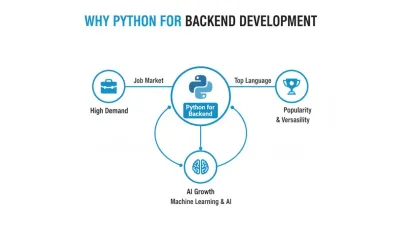
The visual below sums up why Python has become such a dominant force, driving its high demand, position as a top language, and its crucial role in the growth of AI.
This synergy shows that choosing Python isn't just about the language. It's about tapping into a massive ecosystem built to solve modern development problems.
How Python Manages the Request-Response Cycle #
Let's walk through a concrete example. Imagine you're signing up for a new social media app built with a Python backend.
- Request Initiated: You fill out the sign-up form and click "Submit." Your browser wraps this information into a
POSTrequest and fires it off to the server's URL. - Server Receives Request: A Python web server (like Gunicorn or Uvicorn) catches the request. It sees it's aimed at the
/signupendpoint. - Framework Routes the Request: Your web framework (like Django or FastAPI) acts like a switchboard, directing the request to the specific Python function you wrote to handle user sign-ups.
- Business Logic Executes: Now your Python code takes over. It validates the data—is the email address properly formatted? Is the password strong enough? Then, it securely hashes the password.
- Database Interaction: The code connects to the database and inserts a new record into the
userstable with your information. - Response is Sent: Once the user is successfully created, the backend sends a success response (like a
201 Createdstatus code) back to your browser. Your browser might then redirect you to a "Welcome" page.
This entire cycle, from click to confirmation, can happen in milliseconds. The backend's job is to perform these steps reliably and securely, thousands or even millions of times a day.
Building tests for each step of this process is what separates hobby projects from professional, reliable software. For a deeper look into this critical skill, check out our guide on how to write unit tests in Python. Once you get a feel for this flow, you’re ready to start building your own robust applications.
Picking a Python framework is one of the first big decisions you'll make on a new backend project. Think of it like choosing how to get across the country. Are you taking a fully-loaded RV with all the comforts, a stripped-down kit car you can customize yourself, or a high-performance race car built for pure speed?
Each choice gets you there, but the journey, capabilities, and what you can do along the way are completely different. In the world of Python for backend development, your main "vehicles" are Django, Flask, and FastAPI. Understanding their core philosophies is the key to not getting stuck with the wrong tool for the job.
Django: The All-Inclusive Toolkit #
Django is the fully-equipped RV. It’s built on a "batteries-included" philosophy, which means it comes with almost everything you need to build a massive, database-powered web application right out of the box.
This integrated approach gives you a serious head start. Django hands you:
- A powerful Object-Relational Mapper (ORM): This lets you talk to your database using Python classes and methods instead of writing raw, tedious SQL.
- An automatic admin panel: A production-ready, secure interface for managing your app’s data is generated for you. It’s a huge time-saver.
- Built-in authentication and security: It handles user accounts, permissions, and protects you from common web vulnerabilities by default.
Because Django gives you a clear, opinionated structure and so many features, it’s a fantastic choice for big, content-heavy sites like e-commerce platforms, social networks, and content management systems. Its structure enforces best practices, which is a lifesaver for larger teams or anyone who needs a guiding hand.
Flask: The Minimalist Workshop #
If Django is the all-in-one RV, Flask is the minimalist's workshop. It gives you a rock-solid engine and a basic frame but leaves the rest of the choices entirely up to you. It makes zero assumptions about what database you'll use or what libraries you'll need for things like user logins.
This approach gives you total freedom. You're the architect, and you get to pick every single component, from the ORM to the form validation library. This level of control makes Flask perfect for:
- Smaller applications and microservices.
- Projects with unusual requirements that don't fit a standard mold.
- Developers who want fine-grained control over every part of their tech stack.
Choosing Flask means you’re trading out-of-the-box convenience for maximum flexibility. You start with less, but you have the power to build a backend that is perfectly tuned to your specific needs, without any extra weight.
FastAPI: The High-Performance Engine #
FastAPI is the modern, high-performance race car of Python frameworks. It was engineered from the ground up for one thing: raw speed. It uses modern Python features like type hints and asynchronous code to deliver mind-blowing performance, which has made it the new standard for building APIs.
Its two killer features are its sheer speed and how easy it makes a developer's life. FastAPI is a true game-changer, with over 91,900 GitHub stars and the ability to chew through 20,000+ requests per second—that's roughly five times faster than Flask. Its adoption has skyrocketed, growing from 29% in 2024 to 38% in 2025, cementing its place as the go-to for modern REST APIs. It's no wonder companies like Microsoft, Uber, and Netflix are using it. You can see more data on its incredible growth in these backend framework adoption trends.
But it's not just about speed. FastAPI automatically generates interactive API documentation (using standards like OpenAPI and JSON Schema). This means as you write your code, you're also creating a live, testable "menu" of your API's endpoints. This is a massive productivity boost for you and anyone else who has to work with your API.
How to Choose The Right One for You #
So, which one should you pick? Your choice really boils down to your project's needs and your personal style.
| Framework | Best For | Core Philosophy | Key Feature |
|---|---|---|---|
| Django | Large, complex applications (e.g., e-commerce, CMS) | Batteries-Included | All-in-one toolkit with an admin panel and ORM. |
| Flask | Microservices, simple apps, custom solutions | Minimalist & Flexible | You choose your tools and libraries. |
| FastAPI | High-performance REST APIs, async tasks | Speed & Modernity | Blazing-fast performance and auto-documentation. |
The good news is that the lines between these frameworks are starting to blur. Tools like Django Ninja let you build FastAPI-style APIs right inside the mature Django ecosystem, giving you the best of both worlds. This hybrid approach allows you to lean on Django's stability and rich features while getting the speed and modern tooling that make FastAPI so popular.
So, you've picked a framework. Now what? Your backend logic needs a way to talk to the outside world—specifically, to the frontend application that your users will see. This is where APIs come in.
An API, or Application Programming Interface, is the communication bridge between your frontend and backend. For most modern web apps, this means you'll be building a REST API. Getting good at this isn't just a nice-to-have; it's a fundamental skill for any serious backend developer using Python.
Think of a REST API like a well-designed menu at a restaurant. The menu (your API) lays out everything the kitchen (the backend) can do. It tells the customer (the frontend) exactly what they can order and how to ask for it. This standardized system makes the whole interaction predictable and efficient.
This whole conversation is governed by a simple but powerful set of rules that form the common language of the web.
The Four Main Actions of a REST API #
Just like you can order food, change your order, or cancel it, a REST API uses a set of standard verbs called HTTP methods to manage data. These actions map directly to the four basic data operations, often known by the acronym CRUD (Create, Read, Update, Delete).
- GET: This is like asking to see the menu. A
GETrequest simply retrieves data from the server without changing a thing. For example,GET /api/products/would fetch a list of all available products. - POST: This is you placing a new order. A
POSTrequest sends new data to the server to create something new. For instance,POST /api/users/with a new user's details would create their account. - PUT/PATCH: This is asking the waiter to modify your order.
PUTandPATCHrequests are used to update data that already exists. A request likePUT /api/orders/123could be used to change the shipping address for that specific order. - DELETE: This is telling the waiter to cancel the order entirely. A
DELETErequest removes a specific piece of data from the server.DELETE /api/posts/45would permanently erase that blog post.
By sticking to these standard verbs, your API becomes instantly understandable. Any developer who sees a GET request to /api/articles/ will know exactly what it does—fetch articles—without needing to read a single line of your code.
Designing Clean and Predictable Endpoints #
If HTTP methods are the "verbs" of your API, then endpoints are the "nouns." An endpoint is just the URL that represents your data. Great API design is all about creating endpoints that are logical, consistent, and easy to guess. The goal is to make your API feel like a well-organized folder system.
An endpoint should always represent a collection of things (like
/users) or a specific one of those things (like/users/101). This noun-based approach keeps your API clean by separating the "what" (the resource) from the "how" (the HTTP method).
Let's say you're building a blog. Your endpoints would look something like this:
| HTTP Method | Endpoint | Action |
|---|---|---|
| GET | /articles |
Get a list of all articles. |
| POST | /articles |
Create a new article. |
| GET | /articles/123 |
Get the specific article with ID 123. |
| PUT | /articles/123 |
Update the entire article with ID 123. |
| DELETE | /articles/123 |
Delete the article with ID 123. |
This clean structure is a hallmark of professional work. For a much deeper look into crafting great APIs, our guide on REST API design best practices covers more advanced strategies and real-world examples.
How FastAPI Automates Your API Menu #
Here’s where modern Python frameworks really shine. One of the biggest wins of using a tool like FastAPI is how it automates the most boring parts of building an API.
FastAPI cleverly uses Python's built-in type hints to automatically validate incoming data and generate interactive API documentation for you.
This means as you write your Python functions, FastAPI is in the background building that "menu" we talked about. Other developers can go to a specific URL and see every endpoint you've created, what data it needs, and even try it out right in the browser. This feature alone saves countless hours of writing documentation by hand and makes your backend instantly usable.
Deploying and Scaling Your Python Application #
So, you’ve written some great code. That's a huge milestone, but it's not the end of the road. An application sitting on your laptop isn't helping anyone. To make it real, you have to get it out into the world where users can actually access it. This is where deployment and scaling come in—the art of turning your local project into a live, reliable service. And when you're using Python for backend work, you've got a whole suite of powerful tools ready to help.
The leap from your computer to a cloud server can feel like a big one, but the idea behind it is straightforward. You need a way to package up your code, its dependencies, and its entire environment into a neat, self-contained unit. This ensures that the application that works perfectly on your machine behaves the exact same way on a server somewhere else.
Containerizing Your App with Docker #
One of the best tools for this job is Docker. Think of it as creating a standardized shipping container for your application. This container holds everything your Python code needs to run: the specific Python version, all the libraries from your pyproject.toml, and any other system tools.
You define this entire setup in a simple text file called a Dockerfile. From that file, you build a lightweight, portable "image" of your app. This is what finally solves the classic "but it works on my machine!" headache. These containers can then be deployed consistently anywhere, from a tiny virtual server to a massive, scaling fleet of machines.
Automating Releases with CI/CD Pipelines #
Deploying your code by hand is a recipe for disaster. It's slow, stressful, and you're bound to make a mistake eventually. Modern dev teams automate this entire process using Continuous Integration and Continuous Deployment (CI/CD) pipelines. These are just automated workflows, often run using tools like GitHub Actions, that kick off every time you push new code.
A typical CI/CD pipeline for a Python backend application looks something like this:
- Build: The pipeline grabs your latest code and builds the Docker container.
- Test: It runs your entire test suite (using
pytest, for example) inside that new container to make sure you haven't broken anything. - Deploy: If all the tests pass, it automatically pushes the new, validated container to your servers, making it live.
This level of automation means you can ship new features and fixes multiple times a day with confidence, knowing every single change has been vetted.
CI/CD transforms deployment from a scary, all-hands-on-deck event into a boring, everyday task. It’s the key to shipping code quickly and safely.
Choosing Your Deployment Strategy #
When you're just starting out, the best approach is almost always to deploy your application as a single, cohesive unit—a monolith. A well-organized monolith is far simpler to build, test, and get online. This lets you get your product in front of users faster and make changes quickly without getting bogged down in complex infrastructure.
As your application grows, you might run into new kinds of problems. Maybe one part of your app, like a video processing feature, is hogging all the CPU, while the rest of the app is sitting idle. This is when the initial simplicity of a monolith can start to hold you back.
At this point, you might think about evolving toward microservices. This means breaking your big application down into a collection of smaller, independent services. Each service gets its own database and can be deployed and scaled on its own. This gives you incredible flexibility, but it also introduces a massive amount of complexity. You now have to manage communication, data consistency, and deployments across dozens of services.
For this reason, starting with a clean, well-structured monolith is the right move for the vast majority of projects. You can always break it apart later if—and only if—you need to.
Building Your Backend Developer Career Path #
Alright, you've started learning Python's syntax. Now what? The real journey begins when you shift from just learning concepts to actually building things. This is where you connect the dots between frameworks, APIs, and databases to create something tangible.
The goal isn't just to write code; it's to build a portfolio that tells a story. You want to show a hiring manager not just what you know, but how you think, solve problems, and deliver a finished product. That's what gets you hired.
The Project-Based Learning Path #
Forget about getting stuck in "tutorial hell," where you follow along with videos but can't build anything on your own. The only way to turn theoretical knowledge into a real-world skill is by getting your hands dirty with projects.
A structured, hands-on path forces you to apply what you've learned and build the muscle memory you need on the job. Here's a proven, step-by-step path that mirrors how professional backend engineers work.
- Master the Fundamentals: Get really comfortable with Python's core concepts, data structures, and especially Object-Oriented Programming (OOP). Modern frameworks like Django are built on OOP principles, so this isn't optional.
- Embrace Version Control: Learn Git and GitHub. Seriously. No professional team works without it. Get in the habit of committing your code frequently, even for small practice exercises.
- Build a Complete REST API: Pick a modern framework like Django Ninja and build a full API from scratch. This will push you to design clean endpoints, handle data, manage authentication, and structure a real application.
- Integrate a Database: Connect your API to a proper database like PostgreSQL. You'll learn how to manage schema changes (migrations), define data relationships, and write queries that don't fall over.
- Write Comprehensive Tests: Use a framework like
pytestto write unit and integration tests for your API. This is a non-negotiable skill. It proves you care about code quality and stability.
This progression isn't random; it’s designed to build skills incrementally. For a more detailed breakdown, check out our complete guide on how to become a backend developer.
Creating a Portfolio That Gets Noticed #
Your portfolio is the single most important asset you have as a new developer. A hiring manager isn't just glancing at your code; they're looking for your engineering mindset. Can you build, document, test, and deploy a complete solution?
Your portfolio should showcase one or two high-quality, fully-realized applications over a dozen half-finished tutorial projects. Depth is far more impressive than breadth.
Focus on building a project that solves a real problem, even a small one. Then, document it obsessively in a README.md file on GitHub. Explain the "why" behind your technical choices, link to the live, deployed application, and give clear instructions on how to run it locally.
This documentation shows you can communicate like an engineer—a skill just as crucial as writing clean code when using Python for backend development.
As you start building with Python on the backend, you’re bound to run into a few classic questions. Every developer has them. This section cuts through the noise to tackle the big ones, from performance anxiety to picking your first framework.
Let's clear up some of the uncertainties that trip up developers when they're getting started.
Is Python Fast Enough for High-Performance Backend Applications? #
This is the big one, and the short answer is a resounding yes.
Sure, Python is an interpreted language, which on paper is slower than compiled languages like Go or Rust. But for the vast majority of web applications, that raw execution speed is a red herring. Modern tools have completely changed the game.
A framework like FastAPI, for example, is built on top of seriously fast components (like Starlette for networking and Pydantic for data validation) and fully embraces asynchronous programming. This means a single Python process can juggle tens of thousands of simultaneous requests without breaking a sweat. For most businesses, the speed of development and the massive ecosystem of Python libraries are a much bigger win than micro-optimizing CPU cycles.
The ultimate proof is in the pudding. Python powers critical backend systems at massive companies like Netflix, Instagram, and Uber. They operate at a scale most of us will never have to worry about, showing that Python is more than ready for the big leagues.
Which Framework Should a Beginner Learn First? #
For someone just starting out, it’s often best to pick a framework that gives you a solid structure and introduces you to all the moving parts of a backend system. Django’s "batteries-included" philosophy is perfect for this. It forces you to get your hands dirty with the ORM, authentication, and the admin panel inside a well-documented, cohesive environment.
That said, a really smart modern approach is to start with a tool like Django Ninja. It’s a brilliant combination: you get the mature, robust foundation of Django, but with the raw speed and automatic API documentation that made FastAPI so popular. Learning this hybrid gives you experience with both established and newer patterns, which makes your skillset incredibly valuable to a huge range of employers.
How Do I Build a Portfolio That Stands Out? #
A portfolio that gets you noticed is all about depth, not breadth. Forget about building a dozen little projects from tutorials. Focus on one or two complete, polished applications that solve a real problem.
A hiring manager needs to see more than just a folder of code. A truly impressive project has:
- A clean, organized codebase hosted on GitHub.
- A well-designed REST API, complete with clear, auto-generated documentation.
- A solid test suite that proves your code is reliable.
- A detailed
README.mdfile that explains what the project does, why you made certain architectural choices, and how to run it.
And the final, most important step: deploy your application. Get it live on a cloud service. A working project that someone can actually interact with is the single best piece of evidence that you can build and ship a complete solution.
Ready to stop following tutorials and start building a portfolio that actually gets you hired? At Codeling, our hands-on curriculum is designed to guide you through creating complete, professional backend applications with Python. Start building real-world projects today.