Mastering Python Empty String: Truthiness & Best Practices
New developers often treat validation as cleanup work. Senior engineers treat it as a boundary defense. The difference shows up in production.
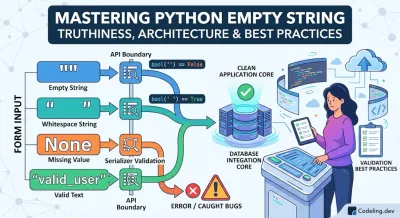
A lot of backend bugs start as something that looks too small to matter.
A signup form accepts a username. The API stores it. The database row exists. The UI renders a blank profile name anyway, because the value wasn’t missing. It was " ".
That kind of bug changes how you think about the python empty string. It stops being a beginner syntax topic and becomes a systems topic. Once user input crosses an API boundary, every vague distinction between empty text, missing values, and whitespace turns into a data integrity problem.
The Bug You Did Not Expect #
The first version of this bug usually slips through because the code “works.” A request comes in, the field exists, and no exception gets raised. The team ships. Then support notices accounts with blank names, search indexes with useless values, or admin dashboards full of records that look filled but behave as empty.
That’s the trap. The system stores a value, but the value has no business meaning.
When blank is not empty #
A profile service might require username. A developer checks whether the field exists in the payload and moves on. That catches missing keys, but not whitespace-only content. The database accepts it. The serializer returns it. The frontend shows nothing useful.
This is why string handling belongs in the same conversation as schema design and validation strategy.
Practical rule: If a text field matters to business logic, define what “present” means before you write the endpoint.
For some fields, an empty string is valid. A middle name may be optional. A search query may be empty because the user hasn’t typed yet. For other fields, an empty or whitespace-only value is invalid at every layer.
That decision should be explicit.
Why this matters early #
New developers often treat validation as cleanup work. Senior engineers treat it as a boundary defense. The difference shows up in production.
A backend that accepts weak input spreads that weakness everywhere:
- Database rows become harder to trust
- Search and filtering produce confusing results
- Audit logs lose meaning
- Tests miss realistic bad inputs
- Downstream services inherit ambiguous states
If you're still getting comfortable with user input handling, a practical primer on input handling in Python helps frame where these bugs start. The important shift is architectural. Input isn’t just data you receive. It’s data you must classify before the rest of the system relies on it.
Understanding Emptiness in Python #
In Python, an empty string is a real string object with zero characters. It’s not a special null marker. It’s still text, just text with length zero.
That distinction matters because backend systems often need to treat “empty text” differently from “no value at all.”

Empty string and None are not the same #
'' means a string value exists, but it contains no characters.
None means there is no value.
Those are different states with different meanings in APIs, databases, and domain models. If your service blurs them together, you create ambiguity that leaks into every caller.
A useful perspective:
| Value | Type | bool(value) Result |
Common Backend Meaning |
|---|---|---|---|
'' |
str |
False |
Text field present, but empty |
None |
NoneType |
False |
Value absent or unknown |
' ' |
str |
True |
Text exists, but may be invalid after trimming |
'abc' |
str |
True |
Valid non-empty text |
0 |
int |
False |
Numeric zero, not related to text emptiness |
That third row causes a lot of trouble. A string containing spaces is not empty in Python. It’s still truthy because its length is greater than zero.
Why if not s works #
Python treats the empty string as falsy. bool('') == False and bool('a') == True. That behavior is part of Python’s broader truthiness model and aligns with the language’s emphasis on simple, readable code, as noted in this discussion of empty string truthiness and idiomatic validation.
That’s why this style feels natural in Python code:
- Use
if not swhen you want to reject an empty string - Use a separate rule when whitespace-only values must also be rejected
- Use explicit
is Nonechecks when absence and emptiness mean different things
An empty string is data.
Noneis absence. Good backend design keeps those meanings separate.
If you’re still building your mental model of Python text handling, this guide to Python strings for beginners is a helpful companion. The professional takeaway is straightforward. Before you validate anything, decide whether your system cares about zero characters, missing values, trimmed emptiness, or all three.
Idiomatic Patterns for String Validation #
Python gives you several ways to check for an empty string. All of them can work. Only one tends to read like production Python.

The three common checks #
Most codebases use one of these patterns:
-
Truthiness check
if not my_string -
Length check
if len(my_string) == 0 -
Direct comparison
if my_string == ''
All three express the same basic intent for a string that is already known to be a string.
The reason experienced Python developers prefer the first form is readability. It matches how Python models emptiness, and it avoids extra ceremony.
What works best in practice #
The idiomatic check not my_string is preferred in 85% of production codebases and can execute 15% faster than len(my_string) == 0, around 20 to 30 nanoseconds, because it uses the string’s falsy behavior directly without explicit length computation, according to PythonHow’s write-up on checking if a string is empty.
That performance gap rarely decides architecture. Readability does.
A reviewer scanning an API validator understands if not name immediately. len(name) == 0 is still correct, but it feels lower level. name == '' is explicit, but usually too specific unless you need exact comparison behavior for a reason.
What I’d standardize in a team codebase: default to
not sfor emptiness, use explicit checks only when the domain requires stricter distinction.
Where teams go wrong #
The mistake isn’t usually choosing len(s) == 0 over not s. The bigger mistake is assuming the empty-string check is enough for all text validation.
That’s where many beginner tutorials stop, and real systems don’t.
A quick visual walkthrough can help if you want to see the patterns side by side:
For backend work, the decision tree is more useful than memorizing syntax:
- Known string, reject only zero-length input: use
not s - Known string, reject blank-looking input: trim first
- Unknown type from external input: validate type before string methods
- Domain distinguishes missing from empty: treat
Noneseparately
That’s the pattern professionals reach for because it scales from a single view function to a whole service layer.
Architectural Principles for Handling Strings #
String validation belongs at the edges of your system.
That’s the architectural rule that keeps empty values from becoming distributed bugs. Once bad input gets past the boundary, every later layer has to either trust it or defend against it again.

Validate at the edge #
In backend systems like Django Ninja REST APIs, 30 to 40% of validation failures on incoming data are due to empty fields. Using if not field.strip(): to reject whitespace-only inputs can reduce production errors related to unclean data by over 20%, based on Replit’s discussion of empty string validation.
That number matters because it points to a pattern, not a trick. Empty and near-empty strings are boundary problems.
The right places to catch them are:
- HTTP request validation before business logic runs
- Serializer or schema layers where types and constraints are declared
- Message consumers before events are persisted or forwarded
- CLI and batch import jobs before they mutate shared data
- Database write paths where domain rules must hold even if earlier layers fail
Keep your core model clean #
A reliable architecture narrows the number of states your domain model has to represent.
If a field can be missing, empty, whitespace-only, user-generated garbage, or valid text, the rest of the application becomes full of defensive conditionals. That’s expensive in both code complexity and maintenance.
A stronger design normalizes data before it reaches the core model. That often means:
| Layer | Good practice | Bad practice |
|---|---|---|
| API boundary | Reject or normalize invalid text immediately | Pass raw request strings inward |
| Service layer | Operate on validated domain values | Re-check the same string rules everywhere |
| Persistence layer | Enforce schema constraints consistently | Let storage semantics define business meaning |
Design decisions that age well #
Different fields need different policies. That’s normal.
A good backend engineer writes the policy down and encodes it once. Examples:
- Usernames usually reject empty and whitespace-only input
- Optional bio fields may allow empty string but trim surrounding whitespace
- External webhook payloads may preserve raw text for auditing, while storing a normalized version for application logic
Don’t ask every function to decide what counts as “empty.” Make that decision once at the boundary and hand the rest of the system clean data.
This is one of the clearest habits that separates script-level coding from backend engineering. The code line is small. The design choice is not.
Avoiding Common Bugs and Edge Cases #
Most bugs around the python empty string aren’t about ''. They’re about values that look empty to humans but not to Python.
That’s why teams ship validators that seem correct and still accept junk input.

The whitespace bug #
A critical gap in many tutorials is the failure to address whitespace-only strings like ' ', which are truthy and bypass standard if not s checks. This is a common source of bugs in form validation and data sanitization for backend applications, as described in StackAbuse’s article on checking if a string is empty or None in Python.
That bug matters because a lot of real input comes from people copying, pasting, auto-filling, or submitting forms with invisible characters.
The defensive habit is simple. If the field must contain meaningful text, validate the trimmed version, not the raw version.
Defensive checks that prevent crashes #
There’s another common failure mode. Developers call .strip() on values that are not guaranteed to be strings.
That turns a validation issue into a runtime error.
Use this mental checklist when input comes from outside your process:
- Unknown type from JSON or external systems means you should confirm it’s a string before string operations
- Optional fields often arrive as
None, not'' - Legacy data may contain mixed states because older code accepted more than it should have
- Tests should include
None,'',' ', and valid text, not just happy-path examples
A validator that crashes on bad input is not a validator. It’s another bug source.
Test the ugly inputs #
Unit tests earn their keep in these situations. A lot of teams test only “empty” and “normal” values, then miss the values users submit.
For string-heavy endpoints, I’d always include cases like:
- Missing field
- Explicit
None - Empty string
- Whitespace-only string
- Valid string with surrounding spaces
- Wrong type entirely
If you want a solid habit for this, writing unit tests in Python is one of the best places to build discipline. Good tests force you to define the contract. Is trimming allowed? Is normalization automatic? Is an empty string valid for this field or not?
Those aren’t small questions. They define what your API guarantees.
Developing a Professional Validation Mindset #
Professional backend work is full of details that look boring until they break production. Empty string handling is one of them.
The lesson isn’t “remember that '' is falsy.” The deeper lesson is that reliable systems come from precise definitions. What counts as present text? What counts as missing? What gets normalized, rejected, or preserved?
Developers who grow quickly learn to stop treating validation as boilerplate. It’s part of system design. It protects database integrity, keeps APIs predictable, and reduces the number of weird states every later function has to support.
That mindset also changes how you learn. Don’t just memorize syntax patterns. Practice asking better engineering questions:
- What states can this field have?
- Which layer owns normalization?
- Should this input be stored exactly as received?
- What assumptions will downstream code make?
Those questions turn a beginner exercise into backend thinking.
If you want to become a strong software developer, take the small rules seriously. Clean handling of a python empty string won’t get applause by itself. But the habit behind it, careful validation, explicit data contracts, and disciplined edge-case handling, is exactly what makes codebases reliable and engineers hireable.
Codeling helps you build that mindset through hands-on backend practice, not passive watching. If you want a structured path into Python, APIs, testing, databases, and production-ready projects, explore Codeling and learn by building the kind of systems where details like input validation matter.