How to Get a Software Engineering Job in 2026
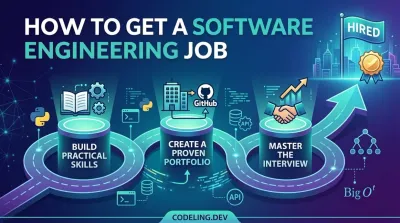
Breaking into software engineering comes down to three things: building the right skills, proving them with a solid portfolio, and then crushing the interview.
In today's market, success means going way beyond tutorials to show you can build real-world projects that solve actual problems.
Your Roadmap in a Competitive Software Job Market #
Let's be honest. Trying to land a great software engineering role can feel like shouting into the void. You can spend months tweaking your resume and firing off hundreds of applications with nothing to show for it.
The path that actually gets you hired is different. It's about showing a company your value before you even talk to a recruiter. Your main focus shouldn't be applying; it should be building the kind of things companies need.
What does that look like in practice? It means you master a language like Python, get your head around fundamentals like data structures, and then immediately put it all to work. For example, build a complete REST API with a database. That single project directly mirrors what professional backend engineers do every day.
If you're just starting out on that path, our comprehensive guide on how to become a backend developer is the perfect place to begin.
Understanding the Current Job Landscape #
The good news? Demand for software engineers is still strong. The Bureau of Labor Statistics projects 15% growth for software developers from 2024 to 2034, which translates to about 287,900 new jobs in the US alone. That's significantly faster than the average for all occupations.
The bad news? A recent wave of tech layoffs and hiring freezes has made the entry-level market incredibly competitive. According to HackerRank's 2025 Developer Skills Report, 74% of developers say that landing a tech job is difficult—and entry-level job postings for junior developers have dropped roughly 40% compared to pre-2022 levels.
To stand out, a portfolio of production-grade projects is no longer a "nice to have." It's a non-negotiable requirement. Your GitHub profile is your single most powerful asset—it's your proof that you can solve problems and write clean, effective code.
The Core Pillars of Your Software Engineering Job Search #
To help you organize your efforts, it's useful to think about the job search in terms of a few core pillars. Each one is a distinct phase you need to conquer to go from an aspiring developer to a hired engineer.
Here's a quick breakdown of what that journey looks like.
| Pillar | Focus Area | Key Outcome |
|---|---|---|
| Build Skills | Python, OOP, DSA, Git, Django/Flask | You have the job-ready technical skills to build real software. |
| Create Portfolio | Real-world projects, Clean code on GitHub | You have tangible, undeniable proof of your abilities. |
| Master Interview | Algorithms, System Design, Behavioral | You have the confidence and knowledge to pass every round. |
By working through these pillars one by one, you're not just learning—you're building a compelling story that proves you have what it takes. This guide will walk you through each one with actionable advice to get you from writing your first line of code to signing your first job offer.
Building Practical Skills That Get You Hired #
Watching endless tutorials can feel productive, but let's be honest: it's a trap. It gives you the illusion of progress without building real skill. Hiring managers don't care how many videos you've watched; they want to see what you can build.
To land a software engineering job, you need a portfolio that proves you can solve actual problems. This means shifting your mindset from passive learning to active building. Every new concept you learn should be applied immediately. This hands-on approach is what separates candidates who get interviews from those whose resumes are ignored.
Mastering the Foundational Backend Stack #
First things first, you need to pick your tools. Don't fall into the trap of trying to learn everything at once. Instead, focus on mastering a few core technologies that are in high demand and work well together.
A powerful and common starting stack looks like this:
- Python: A versatile, readable language that's perfect for beginners but powerful enough for massive applications.
- Linux Command Line: This is the standard environment for servers. Getting comfortable in the terminal is non-negotiable for backend work.
- Git and GitHub: The universal standard for version control. Your ability to use Git effectively is a direct signal of your professionalism.
- Django or a Similar Framework: A framework that helps you build robust web applications and APIs without reinventing the wheel.
This combination gives you a complete toolkit to build the kind of projects that get you noticed. You'll be able to write the logic, manage your code, and deploy a functional application.
From Python Fundamentals to Object-Oriented Thinking #
Your journey starts with Python, but it goes way beyond just learning the syntax. You need to understand its core principles to write clean, efficient, and maintainable code—the kind that doesn't make other engineers want to cry.
Start with the basics like variables, data types, and control flow. But push yourself into more advanced topics quickly. Your goal is to graduate from writing simple scripts to designing software systems using Object-Oriented Programming (OOP). OOP is just a way of structuring your code around "objects," and it's fundamental to how almost all large applications are built.
Don't get stuck on beginner exercises. The moment you understand a concept like classes or inheritance, your immediate next step should be to use it in a small project. This active application is what solidifies your learning and builds real confidence.
This progression—from basic syntax to OOP principles—is crucial. It's the difference between being a coder who can follow instructions and an engineer who can design solutions.
Understanding Data Structures and Algorithms #
Once you have a handle on a programming language, your next stop is Data Structures and Algorithms (DSA). A lot of aspiring developers try to skip this part, thinking it's too academic. That's a huge mistake. DSA is the science of efficient problem-solving.
- Data Structures are just ways of organizing data. Think of them as different containers (arrays, linked lists, hash tables), each with its own pros and cons.
- Algorithms are the step-by-step procedures you use to work with that data.
Learning DSA teaches you to think about efficiency and trade-offs. How do you find one user's record among millions without making the app grind to a halt? The data structure you choose directly impacts speed and scalability. This is exactly the kind of thinking hiring managers test for in technical interviews.
A platform like Codeling integrates DSA learning directly into the curriculum. This ensures you don't just learn the theory but immediately apply it in coding challenges that feel like real interview questions.
Learning to Work With AI Tools #
Here's something that wasn't on the checklist even two years ago: AI literacy is quickly becoming a baseline expectation for software engineers. Companies aren't just looking for developers who can code—they want developers who can code effectively with AI-powered tools.
This doesn't mean you need to become a machine learning expert. It means you should get comfortable using AI coding assistants, understand how to write effective prompts, and know when to rely on AI-generated code versus when to write it yourself. Engineers who can leverage AI to speed up routine tasks like writing boilerplate, generating tests, and debugging—while still applying their own judgment for architecture and design—are exactly the kind of candidates companies are prioritizing in 2026.
Think of AI tools as a multiplier for your existing skills, not a replacement for them. The developers who understand the fundamentals deeply and then use AI to accelerate their workflow are the ones standing out in interviews right now.
Building Your First Portfolio-Ready API #
With a solid foundation in Python, OOP, and DSA, it's time to build something that screams "hire me." For a backend developer, the quintessential portfolio project is a REST API.
An API (Application Programming Interface) is the engine that allows different software systems to talk to each other. It's what powers almost every modern web and mobile application.
Building a complete REST API with a framework like Django Ninja proves you can:
- Handle incoming web requests.
- Process data and apply business logic.
- Talk to a database to save and retrieve information.
- Send back structured, predictable responses.
This single project provides tangible proof that you have the end-to-end skills for a backend role. It's no longer about knowing Python; it's about using Python to build a functional, real-world service. This is the kind of evidence that will make your profile stand out and get you that much closer to landing the job.
Creating a Portfolio That Speaks for Itself #
Your skills are the foundation, but your portfolio is the proof. In a competitive job market, your GitHub profile is often the first—and most important—piece of evidence a hiring manager will see. It needs to do more than just store your code. It has to tell a compelling story about your abilities as an engineer.
Simply finishing a project isn't enough. The real goal is to curate a collection of 'portfolio-ready' applications that demonstrate not just what you can build, but how you build it. This is how you cut through the noise and make a strong case for why a company should invest in you.
What Makes a Project Portfolio-Ready #
A 'portfolio-ready' project is miles beyond a simple script or a tutorial clone. It's a polished piece of software that showcases your understanding of professional development practices. Hiring managers are hunting for signals that you can contribute to a real engineering team from day one.
These signals include things like:
- Clean Architecture: Is your code logically organized and easy to navigate? Does it follow established design patterns? This shows you can write software that other people can actually maintain.
- Comprehensive Tests: Including unit and integration tests proves you care about code quality and reliability. It's a dead giveaway of a professional mindset.
- Clear Documentation: A detailed README file is non-negotiable. It should explain what the project does, the tech used, and how to set it up and run it locally. No excuses.
- Scalability Considerations: Even if your project isn't built for millions of users, showing that you've thought about performance and how it might scale is a huge plus.
Think of each project as a product you are presenting to a potential employer. Every detail, from the code itself to the documentation that explains it, reflects on your professionalism and skill.
Your GitHub isn't a code dump; it's a curated gallery of your best work. Aim for 2-3 substantial, well-documented projects over a dozen small, unfinished ones. Quality always beats quantity.
Blueprint for a Standout Backend Project #
To truly impress, you need a project that mirrors the challenges of a real-world backend engineering role. A fantastic example is building a complete REST API for a practical application, like a simple contact manager or a personal blog platform.
A strong backend project should incorporate several key components that recruiters actively look for.
Essential Project Features:
- Full CRUD Functionality: The API has to allow users to Create, Read, Update, and Delete resources. Think creating a new blog post, reading all posts, updating one, and then deleting it.
- Database Integration: Use a real database like PostgreSQL to store application data. This is a core backend skill that demonstrates your ability to work with data persistence.
- User Authentication: Implement a system for user registration and login. Securing endpoints so that only authenticated users can perform certain actions is a critical, non-negotiable feature.
- Data Validation: Before you process or save anything to the database, you must ensure that incoming data from user requests is valid. This prevents a world of errors and security vulnerabilities.
By completing a project with these elements, you're not just showing you can write a function; you're proving you can build a complete, functional service from the ground up. If you need some inspiration, our tutorial on building a contact manager with a Python is a great place to start.
Showcasing Your Work on GitHub #
Once your project is built, how you present it is just as important as the code itself. Your GitHub profile should read like a narrative of your development process, not just a final snapshot of the code.
The job market is undeniably selective. LinkedIn data from early 2026 shows around 72,000 US software engineer job postings, reflecting a market that's stabilizing after the post-pandemic correction. And with AI tools increasingly boosting developer productivity, companies are prioritizing candidates who can demonstrate high-impact, practical skills. This is exactly why a rock-solid portfolio is so crucial—and platforms like Codeling are designed to help you build those GitHub-ready apps that recruiters want to see. You can read more about how project-based learning gives you an edge by checking out the latest software engineering job market trends.
Here's how to make your GitHub profile work for you:
- Pin Your Best Repositories: Use the "pinned repositories" feature to highlight your 2-3 most impressive projects. Make it impossible for visitors to miss them.
- Write Professional READMEs: Treat each README like a landing page. Include a clear description, setup instructions, and maybe even some API usage examples with code snippets.
- Maintain a Clean Commit History: Write clear, descriptive commit messages ("feat: add user authentication endpoint" not "stuff"). A history of small, logical commits shows you work methodically and actually understand version control.
- Use Project Boards: For larger projects, using a GitHub Project board to track tasks shows you can manage your work in an organized, agile-like fashion. It's a great signal.
This approach transforms your GitHub from a passive code repository into an active, powerful tool that demonstrates your entire engineering workflow. It tells a story of planning, execution, and attention to detail—the exact qualities that will help you land that software engineering job.
Crafting Your Resume and LinkedIn to Beat the Bots #
Here's a hard truth about job hunting: before a human ever sees your resume, it has to get past the bots. Companies use Applicant Tracking Systems (ATS) to scan thousands of applications and filter out anyone who doesn't look like a match on paper.
Your first challenge isn't impressing a hiring manager. It's satisfying an algorithm.
This means that fancy, multi-column resumes with cool graphics are basically resume poison. They might look great to you, but an ATS can't read them, and your application gets silently tossed into the digital void. Your goal is to create a clean, single-column resume that's easy for both bots and humans to understand.
Optimizing Your Resume for the ATS #
The secret to beating the ATS is all about keywords. The bot is programmed to look for specific words and phrases from the job description. Your job is to make sure those words are on your resume.
A great way to start is by pulling up five to ten backend engineering job descriptions you're interested in. Read through them and jot down the technical skills that keep showing up. You'll notice patterns pretty quickly.
Common Backend Keywords to Include:
- Languages: Python, Java, Go, Node.js
- Frameworks: Django, Flask, Spring Boot, Express.js
- Databases: PostgreSQL, MySQL, MongoDB, Redis
- APIs & Protocols: REST API, GraphQL, gRPC, HTTP
- Tools: Git, Docker, Kubernetes, AWS, CI/CD
Now, sprinkle these terms naturally through your resume, especially in your skills and project descriptions. Don't just list "API development" as a skill. If the job description wants "experience building REST APIs," your project description better say something like "Built a REST API..." You have to mirror their language.
Structuring Your Resume to Highlight Projects #
If you're switching careers or don't have formal dev experience, your projects are your experience. A traditional resume that puts your work history at the top is working against you. You need to flip the script and put your skills and projects front and center.
Try a layout like this:
- Contact Info & Links: Your name, email, phone, and direct links to your LinkedIn and GitHub profiles. Make them clickable.
- Summary: A sharp, 2-3 sentence pitch that highlights your core backend skills and what you're looking for.
- Skills: A bulleted list of your tech stack, broken into categories like Languages, Frameworks, and Databases for easy scanning.
- Projects: This should be the biggest, most detailed section. This is your proof.
- Experience/Education: Put your old jobs and degrees at the bottom. They matter, but not as much as what you can build today.
For each project, you need to explain what you did. A condensed version of the STAR method (Situation, Task, Action, Result) works great here. Describe the project's goal, the tech you used, and what you accomplished. For instance: "Developed a secure REST API for a blog platform using Django and PostgreSQL, enabling full CRUD functionality for posts and user authentication with JWT, resulting in a deployable backend service."
This project-first approach immediately shows recruiters what you can do, which is a thousand times more compelling than an unrelated job title from your past.
Turning Your LinkedIn into a Magnet for Recruiters #
Think of your LinkedIn profile as more than just a resume—it's an active billboard for your skills. Recruiters live on LinkedIn, constantly searching for candidates, and a well-tuned profile can bring them right to your inbox.
Your headline is the most important part. "Aspiring Software Engineer" is a waste of space. Get specific and pack it with the keywords recruiters are searching for.
Headline Examples:
- Backend Developer | Python, Django, REST APIs, PostgreSQL
- Software Engineer specializing in Backend Systems & API Development
- Python Developer | Building Scalable Web Applications and APIs
This small change makes you instantly discoverable. Follow it up with a summary that tells a story about your projects and your passion for backend engineering.
And please, don't just hoard connections. Actually engage with people. Share articles, post about what you're learning in your Codeling courses, and ask mentors for recommendations. This activity shows both the algorithm and the humans behind it that you're a serious, engaged member of the tech community.
Acing the Interview: From Technical Rounds to Behavioral Questions #
After all the skill-building and portfolio polishing, you've reached the final hurdle: the interview. This is where you prove, in real-time, that you have the technical chops and the collaborative spirit to join an engineering team.
It's not just about getting the right answer; it's about showing your thought process and how you handle pressure.
The typical software engineering interview process is a multi-stage gauntlet designed to test you from different angles. It usually kicks off with a quick phone screen with a recruiter, then moves to a technical screening or a take-home assignment.
The final stage is the "on-site" loop, which these days is almost always a series of back-to-back video calls. Each stage has a purpose, and you need to be ready for all of them.
Breaking Down the Technical Rounds #
The technical rounds are the heart of the interview process. You'll almost certainly face a data structures and algorithms challenge, and for any backend role, you can bet on questions about system design and APIs.
The key to success isn't just memorizing solutions; it's about demonstrating how you solve problems. Your interviewer wants to see you think.
Always start by clarifying the problem and stating your assumptions out loud. Talk through your initial ideas—even the imperfect ones—and explain the trade-offs of your chosen approach. This "thinking out loud" technique is critical because it gives them a window into your engineering mind.
A silent candidate who magically produces a perfect solution is a red flag. Interviewers are looking for collaborators, not code wizards who work in a black box. Your communication during the interview is just as important as the code you write.
This is especially true for complex problems. To really solidify the core concepts that power these interviews, a structured course on essential data structures and algorithms can give you the foundation you need to walk in with confidence.
The Algorithm and Data Structures Challenge #
This is the classic coding interview. You'll get a problem and be asked to write code to solve it in a shared editor, usually with a timer ticking. These questions are all about your fundamental computer science knowledge.
There are a few topics you absolutely must be comfortable with:
- Arrays and Strings: Manipulation, searching, and sorting are table stakes.
- Linked Lists: Proves you understand pointers and node traversal.
- Hash Maps (Dictionaries): These are crucial for efficient lookups and are a common ingredient in optimal solutions.
- Trees and Graphs: You need to know traversal algorithms like Breadth-First Search (BFS) and Depth-First Search (DFS) cold.
- Time and Space Complexity (Big O Notation): You have to be able to analyze your solution's efficiency and talk about how to optimize it.
Practice is the only way to get good at this. Use platforms with coding challenges and solve problems consistently. Focus on understanding the patterns behind the problems, not just memorizing the code for one specific question.
The System Design Interview #
For backend roles, the system design interview is a major hurdle. You won't be writing lines of code; you'll be designing a large-scale system from scratch. The prompt will be intentionally vague, like "Design a URL shortener" or "Design the backend for a social media feed."
This interview tests your ability to handle ambiguity and think about the big picture. Your job is to lead a discussion, clarify requirements, and sketch out a high-level architecture on a virtual whiteboard.
A typical system design discussion unfolds like this:
- Scope and Constraints: Start by asking questions to narrow things down. How many users are we talking about? What's the expected read/write ratio?
- High-Level Design: Draw the main components—web servers, application servers, databases, caches—and show how they talk to each other.
- Data Model: Discuss your database choice (SQL vs. NoSQL) and justify it. Outline a basic schema.
- Scaling and Bottlenecks: Identify where the system might break under load and talk about how you'd solve it with tools like load balancers, database replication, or a caching layer.
This round is all about demonstrating your experience and your ability to make reasoned architectural trade-offs.
Answering Behavioral Questions with STAR #
Finally, don't sleep on the behavioral interview. Questions like, "Tell me about a time you had a conflict with a teammate," or, "Describe a challenging bug you fixed," are designed to see if you have the soft skills to succeed. Your technical ability matters, but so does your ability to work well with others.
The best way to answer these is with the STAR method. It gives you a simple, powerful structure for telling a compelling story.
- S (Situation): Briefly set the scene. What was the project or situation?
- T (Task): What was your specific responsibility or the goal you were tasked with?
- A (Action): What specific steps did you take to address the situation? This should be the bulk of your answer.
- R (Result): What was the outcome? If you can, quantify it. For example, "We reduced API latency by 15%," or, "The fix resolved an issue affecting 5% of our user base."
Using STAR stops you from rambling and ensures your answer is focused, concrete, and demonstrates your impact. Prepare 3-5 solid STAR stories from your projects ahead of time. You'll walk into your behavioral interviews with confidence, ready to show them you're the well-rounded candidate they're looking for.
Some Common Questions About Landing a Software Engineering Job #
Once you move past learning the code and start firing off job applications, a whole new set of questions always seems to surface. It's one thing to build an app; it's another to navigate the final stretch of the job hunt.
Think of this as your guide for that home stretch. You've done the hard work of building skills and a portfolio. Now it's about understanding how the job market actually works and making sure you stand out.
How Long Does It Realistically Take to Get a Job with No Experience? #
This is the big one, and the only honest answer is: it depends. But you have more control over the timeline than you think.
For someone starting from scratch and really staying dedicated, becoming job-ready usually takes somewhere between 9 to 18 months. The single biggest factor is how you spend your time. Someone putting in 20-30 hours a week of focused, project-based work is going to get there much, much faster than someone just passively watching tutorials.
Consistency and the quality of your portfolio are what really move the needle. A structured program that forces you to build real-world backend projects is a huge accelerator because it gives you a clear path and ensures you're building things that actually impress hiring managers.
Do I Need a Computer Science Degree to Become a Software Engineer? #
Nope. A CS degree is definitely not a hard requirement for many software engineering jobs anymore. These days, employers care a lot more about what you can do than where you learned to do it.
Your ability to solve problems and write clean, working code is what gets you hired. We see self-taught developers and bootcamp grads succeed all the time, as long as they can prove they have the skills.
Your GitHub profile, filled with a few complex and well-documented projects, is your new degree. It's tangible proof you can do the work of a professional engineer, which is way more convincing than a piece of paper.
What Should I Learn First: Data Structures or a Framework? #
This is a classic chicken-or-the-egg debate, but there's a clear best practice here: build a solid foundation in Data Structures and Algorithms (DSA) first.
Learning DSA teaches you how to think like an engineer—how to write efficient code and solve tricky problems. Those are the fundamental skills that apply to everything you'll ever do. Frameworks like Django are just tools, and powerful ones at that, but they don't replace good problem-solving skills.
Learning DSA first makes you a better problem-solver, which in turn makes you way more effective when you pick up a framework. The best learning paths actually integrate the two: you learn a core concept like DSA, then you immediately apply it by building a real feature with a framework. This way, you understand the why, not just the how.
How Many Projects Should I Have in My Portfolio? #
Quality over quantity, always. Your goal should be to show off 2-3 substantial, polished projects, not a dozen small, half-baked tutorial clones.
These projects need to demonstrate a range of skills and some real depth. For an aspiring backend developer, a strong portfolio might look something like this:
- A complex REST API complete with user authentication and a real database.
- A project that shows you understand basic system architecture (e.g., microservices).
- An application that uses a modern tool or technology, like an AI-powered feature.
And here's the most important part: every single project must have a detailed README file. This document needs to explain what problem the project solves, the technologies you used, and have crystal-clear instructions on how to get it running.
A professional README shows you're not just a coder. It proves you're an engineer who thinks about the end-user, even if that user is another developer.
Ready to build the portfolio-ready projects that get you hired? Codeling provides a structured, hands-on curriculum that takes you from Python fundamentals to building and deploying complete backend applications. Stop guessing and start building with a clear path to your first software engineering job. Try it for free at https://codeling.dev.