Data Structures and Algorithms for Beginners: Practical Python Guide
Learning data structures and algorithms (DSA) is how you get hired as a backend engineer. This beginners guide will show you what you need to know.
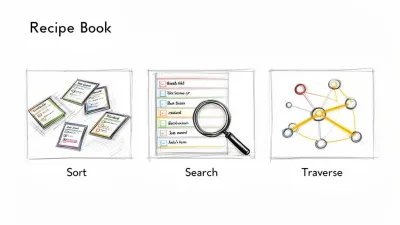
Data structures and algorithms (DSA) is the one skill that directly maps to better problem-solving, a much higher chance of passing coding interviews, and the ability to write code that doesn't fall apart under pressure.
Why Mastering DSA Is Your Backend Career Superpower #
Ever tried to build a skyscraper with just one type of screw? You might get a few floors up, but the whole thing would be fragile, wildly inefficient, and could never scale. That's exactly what it's like to code without a solid grasp of data structures and algorithms. You're stuck with the most basic tools, completely unprepared for complex problems.
This guide is designed to reframe DSA from that dreaded academic subject you have to memorize into your single most powerful asset for building modern software.
Here’s a simple way to think about it:
- Data Structures are just specialized ways to organize information. A filing cabinet, a deck of playing cards, a to-do list—these are all real-world data structures. Each one is designed for a specific job. One is great for finding things quickly, another for keeping things in a specific order.
- Algorithms are the step-by-step instructions for working with that data. They're the recipes that tell you exactly how to find a specific file, sort that deck of cards, or add a new item to your list without making a mess.
From Theory to Tangible Career Growth #
Learning DSA isn't an academic exercise anymore. It’s a practical skill that directly affects your ability to land a great backend role and actually succeed in it. Beginners who take the time to nail fundamental concepts, like analyzing an algorithm's efficiency, immediately stand out from the crowd.
In fact, one GitHub report found that developers who master DSA fundamentals early on see a 40% higher interview success rate. In massive tech markets like the US and India, where backend jobs are everywhere, this skill is a non-negotiable differentiator.
This is especially true when you’re working with a language like Python, which has a gigantic community of over 22 million developers. Its clean syntax lets you focus on the logic of the data structure or algorithm, rather than getting lost in confusing boilerplate code.
The goal isn't just to memorize definitions; it's to build a problem-solving intuition. You'll learn to look at a technical challenge and instinctively know which "container" (data structure) and which "recipe" (algorithm) will give you the most elegant and efficient solution.
This is exactly what hiring managers are looking for. When you can clearly explain why a hash table is a better choice than an array for a specific problem, you're demonstrating a level of understanding that goes way beyond just writing code that "works." Check out our guide on how to become a backend developer to see where DSA fits into the complete career journey.
To give you a head start, here is a quick overview of the most common data structures you'll encounter.
Core Data Structures At a Glance #
Think of this table as your quick-reference cheat sheet. These are the foundational "containers" you'll be using day-in and day-out as a backend developer.
| Data Structure | What It's Good For | Simple Analogy |
|---|---|---|
| Array | Storing an ordered list of items. Fast access if you know the index. | A row of numbered mailboxes. |
| Linked List | Storing an ordered list where items can be added or removed easily. | A scavenger hunt where each clue tells you where to find the next one. |
| Hash Table | Storing key-value pairs. Extremely fast lookups, insertions, and deletions. | A dictionary. You look up a word (key) to find its definition (value). |
| Stack | Adding and removing items from the top only (Last-In, First-Out). | A stack of plates. You take from the top and add to the top. |
| Queue | Adding to the back and removing from the front (First-In, First-Out). | A line at a coffee shop. The first person in line gets served first. |
| Tree | Storing hierarchical data with parent-child relationships. | A family tree or a company's organizational chart. |
| Graph | Storing complex relationships between items (nodes and edges). | A social network, where people are nodes and friendships are edges. |
Getting comfortable with these is the first major step. The rest of this guide will help you do just that.
This guide will take you on a journey from these core concepts all the way to building real projects that prove your skills. By the end, you won't just know DSA—you'll know how to use it to build faster, smarter, and more reliable software.
Your Step-By-Step Learning Path From Zero to Hero #
Diving into data structures and algorithms can feel like staring at a giant, confusing map with no "you are here" marker. With dozens of concepts to learn, it’s easy to get lost. So, where do you even begin?
The trick is to follow a proven roadmap. This isn't about memorizing everything at once; it's about building your knowledge piece by piece, in the right order. This path cuts through the noise and gets you focused on what actually matters.
The journey doesn't start with code. It starts with a single, crucial concept: efficiency. Before you can understand why one structure is better than another for a certain job, you have to know how to measure performance. This is where you'll meet Big O notation, the language we use to talk about how fast and scalable our code is.
Phase 1: The Foundations #
Once you can measure efficiency, you're ready to start building your toolkit. This first phase is all about the fundamental "containers" that hold your data.
- Arrays and Linked Lists: These are your bread-and-butter ordered lists. You'll learn how each one stores data and, more importantly, the critical trade-offs between them. Arrays give you lightning-fast access, but linked lists are incredibly flexible when you need to add or remove items.
- Stacks and Queues: Next up are two specialized types of lists. Stacks (Last-In, First-Out) and Queues (First-In, First-Out) are workhorses for managing tasks, handling web requests, and countless other backend processes. Think of them as fundamental patterns for controlling flow.
- Hash Tables: Hitting this point is a huge milestone. Hash tables (which you might know as dictionaries in Python) are the secret sauce behind near-instant data lookups. They are ridiculously powerful and show up everywhere in real-world applications.
A well-structured learning path is like building a house. You must pour a solid foundation of Big O and basic structures before you can start framing the walls with more advanced concepts. Skipping steps will only lead to a weak and unstable understanding.
Phase 2: Intermediate Tools and Logic #
With the basics under your belt, you can start tackling more complex structures and the logic that makes them work. This is where you begin to solve much more interesting problems.
- Trees and Graphs: These structures are all about representing relationships. Trees are hierarchical, like a file system, while graphs are networked, like a social media platform. Learning them opens up a whole new class of problems you can solve.
- Searching and Sorting Algorithms: Now you get to learn the "recipes." You’ll write classic algorithms like Binary Search, Merge Sort, and Quick Sort from scratch. This is where you see how algorithms bring your data structures to life.
Understanding Your Toolbox: The Core Data Structures #
Before you can build anything interesting, you need to know your tools. Think of it like a workshop. You wouldn't use a sledgehammer to hang a picture frame, right? In programming, data structures are your tools. They’re just different ways to organize information, and picking the right one for the job is a huge part of writing good code.
Let's open up the toolbox and look at the essentials. We'll skip the dry, textbook definitions and focus on what they actually do and when you should reach for them.
Arrays: The Filing Cabinet #
The Array is the bread and butter of data structures. The simplest way to think about it is a filing cabinet where every drawer is numbered. Or maybe a row of mailboxes. This structure is built for storing an ordered list of items.
Its superpower is instant access. If you know the drawer number (the "index"), you can grab the item inside immediately. This is what we call O(1), or "constant time" access, and it's lightning-fast. The downside? Adding or removing something from the middle is a pain. You have to shift all the other files down the line, which can be slow.
In Python, the built-in list type is actually a dynamic array, which is why it's so incredibly useful. If you want to go deeper, you should understand how Python lists work under the hood.
Linked Lists: The Scavenger Hunt #
A Linked List also stores an ordered sequence of things, but it works completely differently. Instead of one big, continuous block of memory like an array, a linked list is a chain of individual elements called "nodes." Each node holds its own data plus a pointer telling you where to find the next node in the chain.
It’s basically a scavenger hunt. Each clue (node) leads you to the next one. This structure is fantastic when you need to add or remove items all the time, especially from the beginning or end of the list. You just have to rewire a couple of pointers—much faster than shifting half an array. The trade-off is that there’s no instant access; to get to the 50th item, you have to follow the first 49 clues to get there.
Choosing the right data structure isn't just an academic exercise—it has real-world career implications. As data volumes explode, the global spend on big data is projected to hit $420 billion by 2026. This means companies desperately need engineers who can make smart decisions about performance. For those switching careers, LinkedIn data shows that Python backend developers with strong DSA skills are filling 35% more roles as hiring rebounds.
Stacks and Queues: Managing Flow #
Stacks and Queues are less about general-purpose storage and more about controlling the order of operations. Think of them as bouncers for your data. They're usually built using either arrays or linked lists.
-
Stacks (LIFO - Last-In, First-Out): A stack is just like a pile of plates in a cafeteria. You put a new plate on top, and you take a plate off the top. The last one you put in is always the first one to come out. This is exactly how your browser's "back" button works and how functions are called in a program.
-
Queues (FIFO - First-In, First-Out): A queue is a line at the grocery store. First come, first served. New people join the back of the line (enqueue), and the person at the front gets served next (dequeue). This is perfect for managing background jobs, processing requests to a web server, or handling a print queue.
Hash Tables: The Super-Fast Address Book #
The Hash Table—which you probably know as a dictionary in Python or a HashMap in other languages—is one of the most powerful and useful data structures you'll ever use. It stores data in key-value pairs. It's like an address book where you look up a person's name (the key) to instantly find their information (the value).
The magic is a "hash function" that takes any key and instantly converts it into an index in an underlying array. This gives you incredibly fast lookups, insertions, and deletions, all happening in what feels like constant time. Whenever you need to associate a unique ID with some data—like finding a user's profile from their user_id—a hash table is almost always the best tool for the job.
Data Structure Performance Showdown (Big O Complexity) #
So, how do you choose? It all comes down to trade-offs. The table below gives you a cheat sheet for the average performance of common operations. Don't worry if "Big O" still feels a bit fuzzy; just focus on the general idea: some are faster for certain tasks than others.
| Data Structure | Access | Search | Insertion | Deletion |
|---|---|---|---|---|
| Array | O(1) | O(n) | O(n) | O(n) |
| Stack | O(n) | O(n) | O(1) | O(1) |
| Queue | O(n) | O(n) | O(1) | O(1) |
| Linked List | O(n) | O(n) | O(1) | O(1) |
| Hash Table | N/A | O(1) | O(1) | O(1) |
As you can see, arrays give you blazing-fast access if you know the index, but hash tables are the undisputed champion for searching, inserting, and deleting by key. Linked lists shine when you need to add or remove from the ends frequently. Understanding these differences is the first step toward writing truly efficient code.
Bringing Data to Life With Essential Algorithms #
If data structures are the shelves where you store your information, algorithms are the actual work you do. They're the step-by-step instructions you follow to find, sort, and manage all that data.
Think about it. A perfectly organized data structure is useless if you don't have an efficient way to interact with it. It’s like having a huge, well-cataloged library with no librarian. The books are there, but how do you find the one you need? How do you add new ones and keep everything in order? That's what algorithms do. They're the brains of the operation.
Searching Algorithms: Finding a Needle in a Haystack #
One of the most frequent jobs in programming is finding a single piece of data inside a much larger collection. The way you search depends entirely on how your data is organized.
Linear Search is the most straightforward, brute-force method. You start at the beginning of a list and check every item, one by one, until you either find what you're looking for or you hit the end. Simple to write, but painfully slow for big datasets. Its time complexity is O(n).
Binary Search is a much cleverer and faster approach, but it comes with a catch: your data must be sorted first. Instead of starting at the beginning, you jump straight to the middle. Is your target item bigger? You can immediately throw out the entire first half of the list. Is it smaller? Ditch the second half. You keep repeating this—slicing your search area in half each time—until you find the item.
This is wildly efficient, with a time complexity of O(log n). To put that in perspective, for a list of a million items, a linear search might take a million steps. A binary search might take only 20.
The difference between a slow and fast algorithm isn't just a technical detail—it's what separates a snappy, responsive e-commerce site from one that makes users give up and leave. Knowing to use Binary Search on a sorted product catalog is the kind of practical decision that defines a skilled backend engineer.
Sorting Algorithms: Creating Order from Chaos #
Sorting is another one of those fundamental tasks. Sure, most programming languages have built-in sorting functions you can call, but understanding what’s happening under the hood is non-negotiable for a serious developer.
-
Simple Sorts (like Bubble Sort): These algorithms are easy to wrap your head around. Bubble Sort, for example, just walks through a list over and over, comparing adjacent items and swapping them if they're out of order. While it’s intuitive, its performance is terrible (O(n²)), making it completely impractical for anything but the tiniest datasets or for learning purposes.
-
Efficient Sorts (Merge Sort & Quick Sort): These are the real workhorses. They both use a powerful strategy called "divide and conquer." Merge Sort splits the list all the way down to individual items, then methodically merges them back together in sorted pairs. Quick Sort picks a "pivot" item and shuffles everything else into two piles: stuff smaller than the pivot and stuff larger than the pivot.
Both of these have an average time complexity of O(n log n), which is worlds better than the simple sorts and fast enough for most real-world jobs. Getting comfortable with these more advanced sorting algorithms is a huge step, because they teach you powerful patterns for solving problems.
Graph Traversal Algorithms: Navigating Complex Networks #
But what if your data isn't a neat list? What if it's a tangled web, like a social network, a flight map, or the twists and turns of city streets? This is where graph data structures shine, and we use special traversal algorithms to find our way through them.
The two you absolutely need to know are:
-
Breadth-First Search (BFS): This algorithm explores the graph in layers. Starting from a single point (or "node"), it visits all of its immediate neighbors first. Only after visiting all of them does it move on to the next layer of neighbors. Think of it like dropping a stone in a pond—the ripples spread out evenly. This makes BFS perfect for finding the shortest path between two points, which is exactly how your GPS app finds the fastest route.
-
Depth-First Search (DFS): This algorithm goes deep before it goes wide. It picks one path and follows it as far as it can possibly go. When it hits a dead end, it backtracks just enough to try the next available branch and goes deep again. This makes DFS great for things like solving a maze or checking if a network has loops.
Understanding these different "recipes" is what turns passive data into an active, useful system. It's the skill that lets you write code that isn't just correct, but also efficient, scalable, and a pleasure to work with.
Alright, let's bridge the gap between knowing about data structures and actually using them to build something.
Knowing about data structures and algorithms without applying them is like having a garage full of professional-grade tools but never building a single thing. The knowledge is useless until you get your hands dirty. This is where we go from theory to a real-world portfolio project that gets you noticed.
This is the part where it all clicks. When you stop doing textbook exercises and start building a real application, you're forced to think like an engineer. You have to look at a problem, pick the right tool for the job, and be ready to explain why you chose it.
From Problem to Project Idea #
First things first: you need a problem to solve. Don't try to build the next Facebook. Start small with a focused mini-project. The goal here is to show you can apply a specific data structure or algorithm to solve a problem well.
Here are a few classic ideas that are perfect for getting started:
- Task Scheduler: A command-line tool for managing a to-do list where tasks have different priorities. This is a perfect excuse to use a Priority Queue (usually built with a heap) to make sure the most important tasks always bubble to the top.
- Simple Social Network API: Think of a basic API that lets you add users and create friendships. The heart of this is a Graph to map out all the connections, which then lets you use an algorithm like BFS to find and suggest "friends of friends."
- URL Shortener: A service like Bitly that turns a super long URL into a short, unique one. This project is a fantastic way to show you've mastered Hash Tables for blazing-fast lookups and know how to handle annoying "hash collisions."
See the pattern? Each project is directly tied to a specific DSA. A great portfolio piece tells a story: "I saw this problem, and I chose this data structure to solve it efficiently." For a more complete, real-world example, you can follow this guide to creating a library management system.
The Engineer's Thought Process #
Let's break down the thinking for that social network API project. Your mission: build a feature that suggests new friends to a user.
- Analyze the Problem: You need a way to store users and how they're connected. The key operation isn't just storing them, but figuring out who is connected to whom and how many "degrees" of separation exist between them.
- Select the Data Structure: A simple list or array just won't cut it. Relationships aren't linear; they're a web of connections. This is a textbook use case for a Graph. Each user becomes a node (or vertex), and each friendship is an edge connecting them.
- Choose the Algorithm: To find potential new friends, you want to explore the network outwards from a starting user, one "layer" at a time. This screams Breadth-First Search (BFS). It naturally finds all direct friends first, then all friends-of-friends, which is exactly what you need.
Your knowledge of graphs is more relevant than ever. For backend engineers building modern AI applications, data structures like graphs and hash tables are fundamental to the vector database revolution. These databases, which have seen a 150% adoption surge since 2023, enable similarity searches up to 10x faster than traditional methods, powering everything from recommendation engines to real-time fraud detection. You can explore the full data trends report to see how these concepts are shaping the industry.
Building even a small project like this proves you can do more than just recite definitions. It shows you can translate theory into a working backend system—a skill every single tech company is desperate to find.
Got Questions About DSA? We've Got Answers. #
Diving into data structures and algorithms can feel like a huge step, and it's easy to get sidetracked by a nagging voice in your head. Do I need to be a math genius? Am I using the right language? Can I really land a backend job without a CS degree?
Let's cut through the noise. These are totally normal questions, and the answers are a lot more encouraging than you might think. We'll tackle them one by one so you can get back to what matters: learning.
How Much Math Do I Really Need for DSA? #
Here’s the good news: probably less than you think. While computer science has deep roots in formal mathematics, the day-to-day work of a backend engineer relies way more on logical reasoning than it does on advanced calculus.
The main place you'll see "math" is in understanding efficiency, which is what Big O notation is all about. You need to get a feel for how an algorithm's performance changes as you throw more data at it. This is more about basic algebra and a gut-level sense of logic, not writing complex proofs.
For example, what matters is knowing that an O(n²) algorithm will grind to a halt on a big dataset. You don't need to derive the formula; you need to understand the practical implication: "This will be slow, I should find a better way." That's the job.
What Is the Best Programming Language for Learning DSA? #
For anyone just starting out, Python is an outstanding choice. There’s a reason it’s so widely recommended. Its syntax is clean and straightforward, which means you can spend your brainpower on the concept you're learning, not on fighting with the language itself.
When you’re trying to wrap your head around how a linked list works, you want to be thinking about nodes and pointers—not wrestling with memory management or confusing type declarations. Python just gets out of your way.
The goal is to master the concepts; the language is just the tool you're using to do it. And since Python is a powerhouse in backend development, data science, and AI, every skill you build is immediately relevant for high-demand jobs.
Sure, people learn DSA with languages like C++ or Java all the time, but Python offers the smoothest on-ramp to truly understanding the core ideas.
Can I Get a Backend Job Without a CS Degree? #
Absolutely. More than ever, the tech industry cares about what you can do, not where you learned it. Plenty of top-tier backend engineers are self-taught or came from completely different careers. Your skills are your credentials.
Your success without a degree comes down to three things:
- A Solid Learning Plan: Don't just bounce between random YouTube videos. Follow a structured path that builds your knowledge from the ground up, like the one we've laid out here.
- Consistent Practice: You have to get your hands dirty. Actively solving problems on coding platforms is how you turn theory into skill.
- Real-World Projects: Nothing proves your ability like a finished project. Your portfolio is your proof.
When you can sit in an interview and talk about how you chose a graph algorithm to power a recommendation engine or used a queue to manage background jobs in a project you built, you're demonstrating the exact skills they're looking for. A degree suddenly becomes a lot less important.
How Do I Practice DSA Effectively for Coding Interviews? #
This is a big one. Effective practice is about quality and analysis, not just raw quantity. Grinding through hundreds of problems on autopilot is a fast track to burnout, not a job offer.
Instead, try this approach:
- Focus on the "Why": Before you even start a problem set, make sure you actually get the data structure. Why does it exist? What problems is it good at solving?
- Embrace the Struggle: When you hit a problem, give yourself a real shot at solving it. Spend a solid 20-30 minutes thinking, sketching, and talking your logic out loud before you even think about looking at the solution.
- Dissect the Solution: Whether you solved it or not, treat the optimal solution like you're a detective. Why was a hash map the best tool here? What underlying pattern does this problem use? Could I have used recursion?
This cycle of struggling, solving, and then deeply analyzing the "why" is what builds real problem-solving muscle. It prepares you to tackle problems you've never seen before—which is exactly what you'll have to do in a real interview.
Ready to put these answers into practice? The best way to build confidence is with a structured, hands-on plan that takes you from the basics to a job-ready portfolio.
At Codeling, our entire Python curriculum is built around this idea. With browser-based coding exercises, real-world projects, and instant feedback, we'll help you master the fundamentals and prove your skills. Start your journey on Codeling today.