Best Programming Language to Learn in 2026
Discover the top programming languages to learn. But first answer, what kind of engineer are you trying to become?
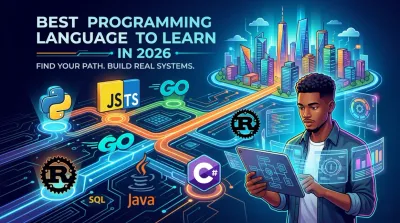
Stop asking for the single best programming language to learn as if there’s one answer for everyone. There isn’t. That question confuses syntax with career direction.
A better question is this. What kind of engineer are you trying to become?
If you want to build backend APIs, your path looks different from someone who wants to write cloud infrastructure, ship enterprise systems, work on browsers, or optimize high-throughput services. The language is only one layer. The bigger decision is what habits and architectural instincts you want to develop early.
Beginners usually get stuck on surface-level comparisons. Which language is easiest. Which one is hottest. Which one pays more. That’s not how good engineers choose tools. Good engineers work backward from the systems they want to build. They think about runtime constraints, maintainability, testing, team workflows, deployment targets, database patterns, and how fast they can turn an idea into something reliable.
That’s why this list isn’t just a ranking of syntax. It’s a map from language choice to engineering outcomes.
If your goal is backend development and AI work, Python is the clearest starting point. If you want one language across browser and server, JavaScript and TypeScript matter. If you care about cloud-native services, Go deserves attention. If you want memory safety and raw performance, Rust is worth the pain. And if you skip SQL, Git, shell skills, or data structures, you’re not becoming a serious developer no matter how many frameworks you memorize.
The best programming language to learn in 2026 depends on the engineer you want to become. Start there. Then pick the language that helps you build real systems, not just finish tutorials.
1. Python – The Foundation for Backend Development & AI Engineering #
Python is the default recommendation for a reason. It gives beginners the fastest path from “I can write code” to “I can build a service somebody might use.”
Python led the TIOBE Index with a 25.87% share in June 2025, after gaining more than 10% month-over-month, according to Lemon.io’s roundup of programming language trends. That matters because it lines up with where real work is happening. Backend APIs, data pipelines, automation, and AI integration all pull in the same direction.
Why Python wins early #
Python’s biggest advantage isn’t that it’s “easy.” That word gets abused. Its real advantage is that it stays useful after the beginner stage.
You can start with scripts, then move to FastAPI or Django, then build services with authentication, database migrations, background jobs, tests, and deployment. That progression is clean. You don’t have to throw away your first language once you become more serious.
For someone targeting backend work, I’d focus on:
- Virtual environments first: Learn
venvand package isolation before you install random dependencies globally. - One web framework thoroughly: Pick Django or FastAPI and build the same ideas repeatedly. CRUD, auth, pagination, caching, queues.
- Type hints early: Python lets you be sloppy. Don’t take that deal.
- Database-backed projects: Pure scripts don’t teach backend engineering.
If you want a structured route into that stack, this Python learning path for backend engineering is aligned with the kind of work that appears in junior backend roles.
Practical rule: Learn Python as a backend language, not as a collection of disconnected scripts.
What beginners get wrong #
A lot of people stay in tutorial land too long. They learn syntax, basic loops, and maybe a toy API, but never touch architecture. That’s where progress stalls.
Build Python projects with:
- Clear layers: routes, services, repositories, models
- Tests from day one: unit tests for logic, integration tests for endpoints
- PostgreSQL instead of fake JSON files: real persistence changes how you think
- Async where it matters: not everywhere, only where concurrency helps
Python is the best programming language to learn if you want the broadest runway into backend development and AI work without wasting your first year on unnecessary friction.
2. JavaScript/Node.js – Full-Stack Capability & API Development #
JavaScript is the practical choice when you want one language on both sides of the wire. Browser in the front, Node.js on the back.
That convenience is real. So are the trade-offs.
If your goal is full-stack work, JavaScript shortens the mental context switch between client and server. You can build a React frontend, an Express or Fastify API, and share data shapes across both. For many teams, that’s enough reason to pick it.
A lot of modern developers also need to understand APIs before they need to understand language theory. This explanation of what an API is and how it works is the foundation you need before debating frameworks.
Here’s the architecture mindset that makes Node useful: it shines when your service spends a lot of time waiting. Waiting on network requests, databases, message brokers, file operations, external APIs. That’s why it fits chat systems, dashboards, gateways, and real-time services better than CPU-heavy processing.
A quick visual helps:

Where Node is strong #
Node is a strong option when you need:
- Shared language across teams: frontend and backend developers can collaborate with less friction
- I/O-heavy services: APIs, webhooks, sockets, streaming
- Fast iteration: huge package ecosystem, low setup overhead
- Microservices around web products: especially when the company already runs JavaScript in the frontend
Node is excellent for glue code and web plumbing. It’s a weaker choice when your service is dominated by heavy computation.
What works and what doesn’t #
What works:
- Learn TypeScript early, even if you start with JavaScript.
- Use a framework with opinions. Express is flexible, Fastify is cleaner for many API use cases.
- Treat middleware as architecture, not magic.
- Validate request and response schemas explicitly.
What doesn’t:
- Building everything as anonymous callback soup.
- Relying on package sprawl instead of understanding the runtime.
- Mixing business logic directly into route handlers.
- Ignoring backpressure, streams, and error propagation.
JavaScript is not my first recommendation for every beginner. But for someone who knows they want full-stack capability, it’s still one of the best programming languages to learn because it maps directly to how many web teams ship software.
3. Go (Golang) – Scalable Microservices & Cloud-Native Development #
Go is what I recommend to people who like straightforward tools and want to build systems that behave well under operational pressure.
It doesn’t try to impress you. That’s part of why it works.
Go fits the cloud-native world because it produces simple deployable binaries, has strong standard library support, and handles concurrency in a way that encourages practical service design. That’s why you keep seeing it around infrastructure, internal platforms, platform tooling, and microservices.
Why backend engineers grow into Go #
If Python teaches you speed of expression, Go teaches you service discipline.
When you build in Go, the code tends to push you toward small interfaces, explicit error handling, and cleaner dependency boundaries. That makes it a strong language for engineers who care about uptime, observability, and maintainability more than syntactic flair.
You see Go in the ecosystem around Kubernetes, Docker, and Prometheus for a reason. It’s a language designed for production systems, not just for learning syntax.
Here’s the mental model I’d use:
- Use Python when you want breadth, rapid product iteration, or AI-heavy integration.
- Use Go when you want predictable services with simpler operational characteristics.
- Use both if your team prototypes in one and hardens in the other.
What to learn if you choose it #
Don’t start with “goroutines are cool.” Start with service design.
- Learn the standard library thoroughly: HTTP, context, JSON, testing, timeouts
- Use goroutines with restraint: concurrency helps, uncontrolled concurrency creates new failure modes
- Design around interfaces carefully: not every abstraction needs one
- Write tests for handlers and service logic separately: keep boundaries sharp
- Handle cancellation and deadlines properly: production quality starts to become apparent

Go is not the most expressive language on this list. It is one of the most useful. If you want to work on APIs, internal tools, infrastructure services, and distributed systems without fighting your toolchain, Go is one of the best programming languages to learn.
4. TypeScript – Type-Safe Backend Development & Enterprise Systems #
TypeScript is what many JavaScript developers eventually admit they wanted from the start.
It keeps the ecosystem reach of JavaScript but adds enough structure to make larger codebases survivable. For backend systems, that matters a lot. Small codebases tolerate ambiguity. Team codebases don’t.
Why TypeScript matters in real teams #
Most backend bugs in JavaScript systems aren’t caused by syntax mistakes. They come from unclear contracts. A field is missing. A payload shape changed. A function returns something slightly different than callers expect. TypeScript helps catch that drift earlier.
That’s why TypeScript is strong for enterprise APIs, internal platforms, SDKs, and shared service layers. If multiple teams depend on the same contracts, types become documentation that the compiler can enforce.
I’d choose TypeScript over plain JavaScript when:
- the codebase will outlive the first prototype
- several developers will touch the same modules
- API schemas need to stay consistent
- refactoring speed matters
The right way to learn it #
Don’t treat TypeScript as “JavaScript with annotations.” Treat it as a design tool.
Good TypeScript habits:
- Turn strict mode on: weak TypeScript is mostly theater
- Model API contracts explicitly: request DTOs, response types, domain objects
- Use generics when they simplify reuse: not when they make code unreadable
- Prefer narrow types over
any:anyis often a confession that design work was skipped
The point of TypeScript isn’t to please the compiler. It’s to make system boundaries obvious before production traffic finds the weak spots.
What doesn’t work is using TypeScript while importing half the project as untyped data and bypassing checks whenever they become inconvenient. That gives you ceremony without safety.
For developers who like the Node ecosystem but want stronger guardrails, TypeScript is one of the best programming languages to learn because it teaches a useful engineering instinct. Define the contract first. Then implement.
5. SQL & Database Languages – Essential Backend Data Foundation #
If you want to be a backend engineer, SQL is not optional.
I don’t care how good you are with Python, Go, Java, or TypeScript. If you can’t model data, write joins, reason about indexes, and spot an expensive query, you are limited fast.
Too many beginners hide behind ORMs. That works right up until the application gets real traffic, real reporting needs, or real data integrity requirements.
Why SQL changes how you think #
SQL forces you to think in sets, relationships, and constraints. That’s good for you.
A backend engineer who understands SQL doesn’t just fetch data. They design systems that store it responsibly, query it efficiently, and evolve without breaking everything six months later.
Start with the basics and stay there until they’re solid:
- SELECT and WHERE: retrieve only what you need
- JOINs: understand how tables relate
- GROUP BY and aggregates: reporting is backend work too
- Indexes: know why a query is slow, not just that it’s slow
- Transactions: consistency matters when money, inventory, or permissions are involved
This visual is worth keeping in mind while you learn joins:

What strong backend developers do differently #
They don’t ask the ORM to save them from SQL. They use the ORM after they understand SQL.
That means:
- Parameterize queries: never trust raw input
- Read execution plans: use
EXPLAINand understand the output - Design schemas intentionally: primary keys, foreign keys, constraints
- Normalize first, denormalize later if needed: optimize after you understand usage patterns
- Separate domain logic from persistence logic: your database model and your business model are related, not identical
SQL is one of the best programming languages to learn because every useful backend system eventually becomes a data problem.
6. Rust – Systems Programming & High-Performance Backend Services #
Rust is not the right first language. It might be the right second or third one if you’re serious about performance, reliability, and systems-level thinking.
The language has earned real respect. In the 2025 Stack Overflow Survey, Rust was the most admired language at 72%, according to the Stack Overflow technology survey. Admiration isn’t the same as broad adoption, but it tells you something important. Engineers who get through the learning curve tend to value what they gain.
Why Rust is worth the struggle #
Rust forces you to think clearly about ownership, memory, lifetimes, concurrency, and failure handling. Those are not beginner-friendly topics. They are valuable topics.
For backend work, Rust becomes attractive when the service is performance-sensitive, highly concurrent, or close to infrastructure. That includes gateways, low-latency APIs, edge services, internal platforms, and compute-heavy components.
The practical appeal is simple. You get memory safety without giving up systems-level performance.
When to learn Rust #
Learn Rust after you can already build applications in something more forgiving.
You’ll get more out of it if you already understand:
- request lifecycles
- database access patterns
- async execution
- testing and deployment
- API boundaries
Then Rust stops feeling like punishment and starts feeling like an advantage.
What works in Rust:
- Learning ownership before frameworks
- Using Cargo properly
- Treating
Resultas normal control flow - Keeping modules small and explicit
- Building one serious project, not ten toy exercises
What doesn’t:
- jumping straight into advanced async stacks without understanding the basics
- scattering
unwrap()everywhere - trying to write “clever” Rust before you can write clear Rust
Rust pays off most when failure is expensive. That’s why infrastructure teams keep reaching for it.
If your goal is beginner-friendly momentum, Python beats Rust easily. If your goal is long-term depth in safe, high-performance systems, Rust is one of the best programming languages to learn.
7. Java – Enterprise Backend Systems & Scalable Applications #
Java remains one of the safest bets for large organizations with long-lived systems.
That’s not glamorous. It is profitable, practical, and hard to ignore.
Java shines in environments where teams need stability, explicit structure, mature tooling, and operational predictability. Banks, insurance companies, enterprise SaaS vendors, internal platforms, and large B2B systems still rely on the JVM for exactly those reasons.
Why Java still earns its place #
A lot of beginners dismiss Java because the syntax feels heavier than Python or JavaScript. Fair enough. But the language teaches habits that matter in big codebases: clear interfaces, layered design, dependency injection, packaging discipline, and strong build workflows.
Once you learn Spring Boot well, you’re not just learning a framework. You’re learning how enterprise services are assembled. Configuration, dependency wiring, validation, security, observability, persistence, and deployment all become part of the same mental model.
That’s useful even if you don’t stay in Java forever.
What to focus on #
Don’t get lost in every corner of the Java ecosystem. Stay on the path that maps to real backend work.
- Spring Boot: the standard entry point for modern Java APIs
- Dependency injection: understand why services are wired the way they are
- Maven or Gradle: builds are part of engineering, not build-server magic
- Exception handling and logging: errors need consistent operational treatment
- JVM basics: memory, threads, profiling, startup behavior
A common beginner mistake is overengineering because Java makes enterprise patterns visible early. Resist that. Not every project needs six layers and fifteen interfaces.
Java is one of the best programming languages to learn if you want access to enterprise backend work and you don’t mind a more structured, opinionated path into software engineering.
8. C# and .NET – Modern Enterprise Backend Development #
C# is often the most underrated language on lists like this.
It’s modern, productive, strongly typed, and backed by an ecosystem that’s mature without feeling ancient. For backend development, especially in companies that use Microsoft tooling or Azure, C# is a very solid choice.
Where C# stands out #
C# gives you many of the benefits people like in Java, but with language ergonomics that many developers find smoother. You get strong IDE support, a mature runtime, first-class async support, and a framework stack that handles API development cleanly.
ASP.NET Core is the centerpiece. If you want to build REST APIs, background workers, internal tools, and cloud services in a strongly typed environment, it’s excellent.
The language also rewards engineers who care about clean architecture. Dependency injection is built in. Testing support is strong. Entity Framework Core makes data access productive, as long as you remember the same rule that applies elsewhere: don’t let the ORM replace your understanding of databases.
How to approach learning it #
The right way to learn C# is not to memorize syntax differences from Java or JavaScript. Build one service all the way through.
That means:
- Create an API in ASP.NET Core
- Use async and await properly for I/O
- Add authentication and validation
- Connect a relational database
- Write tests at the controller and service layers
- Deploy it somewhere real
If you’re targeting corporate backend roles, C# is often a better bet than trendier languages because the tooling and team practices are usually stronger from day one.
C# is one of the best programming languages to learn for developers who want serious backend work, strong tooling, and a stack that scales from internal apps to public APIs.
Top Languages & Skills for Backend Development #
| Item | Implementation Complexity 🔄 | Resource Requirements & Ecosystem 💡 | Speed / Efficiency ⚡ | Expected Outcomes & Impact 📊 | Key Advantages ⭐ |
|---|---|---|---|---|---|
| Python – The Foundation for Backend Development & AI Engineering | Low → fast ramp-up; async/typing add complexity | Massive libraries (Django, FastAPI, ML stacks); strong community | Moderate execution; slower than compiled languages | Rapid prototyping, AI/LLM integration, high hiring demand | Readability, ecosystem breadth, AI/data focus |
| JavaScript/Node.js – Full-Stack Capability & API Development | Low → async patterns can increase complexity | Huge NPM ecosystem; frontend/backend parity | ⚡ Excellent for I/O-bound workloads; single-threaded CPU limits | Real-time apps, full‑stack role readiness, fast iterations | I/O efficiency, massive package support, frontend reuse |
| Go (Golang) – Scalable Microservices & Cloud-Native Development | Moderate → simple syntax but concurrency design needed | Growing ecosystem; strong stdlib for networking & containers | ⚡ High performance; fast builds; single-binary deployment | Scalable microservices, cloud-native tooling, container-first apps | Concurrency model, easy deployment, runtime speed |
| TypeScript – Type-Safe Backend Development & Enterprise Systems | Moderate → adds compile step and typing discipline | Leverages JS ecosystem + types; excellent IDE support | Comparable to Node.js at runtime; better dev safety | Maintainable large codebases, safer refactors, enterprise readiness | Static typing, refactorability, team scalability |
| SQL & Database Languages – Essential Backend Data Foundation | Moderate → schema design and optimization complexity | Mature DB engines and tooling (Postgres, MySQL) | Performance varies; highly optimizable with indexes | Reliable transactional systems, analytics, data integrity | Industry-standard for relational data and ACID guarantees |
| Rust – Systems Programming & High-Performance Backend Services | High → steep learning curve (ownership/borrow checker) | Growing ecosystem; strong tooling (Cargo) but fewer libs | ⚡ Very high performance; low-level control, safe concurrency | Ultra-reliable, low-latency systems, systems/infrastructure roles | Memory safety without GC, C/C++ performance, safety guarantees |
| Java – Enterprise Backend Systems & Scalable Applications | Moderate-to-high → verbose but well-structured | Extremely mature ecosystem (Spring, JVM tools) | High runtime performance; higher memory/startup overhead | Enterprise-grade scalable systems, financial and legacy systems | Stability, ecosystem depth, enterprise tooling |
| C# and .NET – Modern Enterprise Backend Development | Moderate → modern features with .NET learning curve | Strong tooling (Visual Studio), Azure-first ecosystem | High performance with ASP.NET Core; good async support | Enterprise APIs, Azure-native cloud apps, real-time systems | Modern language features, LINQ, Microsoft ecosystem |
Your Path From Learning to Earning #
Ignore the endless argument about the single "best" programming language. That question is too vague to help anyone build a career.
A better question is simpler. What do you want to build, and which language or skill gets you to real engineering work fastest?
For backend and AI-adjacent paths, Python is still the strongest starting point for many learners. It lets you build useful things early, and it keeps paying off as you move from scripts to APIs, data work, automation, and machine learning. As noted earlier, employer demand for Python is consistently strong. Python gives beginners enough traction to spend time on the parts that make someone employable.
Those parts are not just syntax.
Teams hire people who can design a small service, model data properly, debug failures, write tests, use Git without making a mess, and explain trade-offs in plain English. That is why this article treats SQL, Git, Bash, and data structures and algorithms as languages worth learning too. A new developer who can read query plans, trace a bad deploy, and choose the right data structure is far more useful than someone who has sampled five frameworks and finished none.
A practical path looks like this:
- Start with Python if your target is backend development, automation, or AI engineering.
- Learn SQL right away, because nearly every backend system is really a data system with HTTP on top.
- Study data structures and algorithms while building projects, so performance and design decisions feel concrete instead of theoretical.
- Add JavaScript or TypeScript if you want full-stack range or plan to work closely with frontend systems.
- Add Go, Java, C#, or Rust once your direction is clearer and the trade-offs matter to the kind of systems you want to build.
That sequence matters. Early career progress usually comes from depth, not from collecting language badges. One language, one web stack, one database, one testing habit, and one solid portfolio project beat a scattered list of half-finished courses.
I have seen this play out repeatedly. Learners stall when they keep restarting with a new language every few weeks. They improve much faster when they stay on one path long enough to build APIs, connect a database, handle auth, write tests, deploy something small, and fix their own mistakes.
If you want structure around that path, Codeling is a relevant option. Its Python track focuses on hands-on backend work rather than passive video consumption. The curriculum covers Python fundamentals, object-oriented programming, Git, Linux, data structures, REST APIs, databases, and AI-oriented workflows. That mix lines up well with how junior developers become useful on a team.
The shortest route from learning to earning is usually boring in the best way. Choose a direction. Build real projects. Get good at the surrounding skills that make software work in production. Then let the next language solve a real problem, instead of serving as another distraction.