Best Books for Programming: Professional Engineering Mindset
Learning Python syntax is easy enough. Learning to think like a professional software engineer is harder, because that means building judgment. These books will help build that judgement.
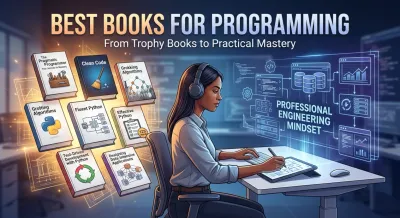
Most advice about the best books for programming is too shallow. It treats books like trophies, not tools. You get a stack of classics, feel productive for a weekend, and then go back to writing the same tangled code, guessing at architecture, and avoiding tests because the books never got translated into practice.
That’s the gap worth fixing. Learning Python syntax is easy enough. Learning to think like a professional software engineer is harder, because that means building judgment. You need to understand why one abstraction survives change and another collapses, why one API is easy to extend and another becomes a maintenance tax, and why readable code is really a team communication tool.
The books below matter because they shape that judgment. Some teach habits. Some teach algorithmic thinking. Some teach Python thoroughly enough that you stop fighting the language. Some teach system design at the level where backend trade-offs finally make sense. Used in the right order, they form a learning path, not just a reading list.
If you’re trying to become a backend engineer, this is the practical version of “best books for programming.” Not just famous titles, but books that help you move from beginner competence to professional engineering mindset.
1. The Pragmatic Programmer Your Journey to Mastery #

Start here if you want the broadest upgrade to how you work. The Pragmatic Programmer isn't a Python book and that's exactly why it belongs near the top of the list. It teaches habits that survive every language change, framework rewrite, and job switch.
What junior developers usually miss is that software quality comes from thousands of small decisions. Naming. Boundaries. Debugging discipline. Version control hygiene. The book is strong because it treats those decisions as a craft, not as random style preferences.
Why it earns an early spot #
The short, self-contained structure works well if you're learning while building. You can read a section, apply it the same day, and see whether your code gets clearer or your workflow gets less error-prone.
That matters more than people think. A lot of “best books for programming” lists jump straight to heavyweight theory. That’s useful later, but many newer developers first need operating principles for daily work.
- Durable advice: It improves judgment on design, testing, debugging, and collaboration.
- Low friction: You can read it in bursts instead of waiting for a long uninterrupted study block.
- Cross-stack value: The advice still applies if you move from scripts to Django services or from backend to platform work.
Practical rule: Read this book with an active project open. If a chapter doesn't change a decision in your codebase, you read it too passively.
Its weakness is simple. It won't teach you Python syntax, web APIs, or databases. You need hands-on material alongside it. The best use is to pair it with real implementation work and a mindset piece like thinking like an engineer, so the principles stop being abstract and start shaping how you structure features.
2. Clean Code A Handbook of Agile Software Craftsmanship #

A lot of developers read Clean Code too prescriptively. That’s the wrong way to use it. Treat it as a sharpening stone, not scripture.
Its real value is vocabulary. Once you've read it, you can look at a function and say why it feels wrong. Mixed levels of abstraction. Poor naming. Hidden side effects. Fragile responsibilities. Those are reviewable problems, not vague discomfort.
What it teaches well #
This book is strongest when your code already works but is painful to maintain. It pushes you to see readability as a design constraint. That matters in backend systems where business rules, validation, database access, and external integrations all compete for space in the same service layer.
It’s also useful because teams need shared language. If everyone on a project has a similar idea of what “clean” means, refactoring conversations get faster and less personal.
Code is read far more often than it’s written. Backend code gets read under pressure, during incidents, rushed fixes, and onboarding. That’s why clarity beats cleverness.
Where people misuse it #
The book can make newer developers overcorrect. They start splitting every function into tiny pieces, wrapping simple logic in needless abstractions, or treating every naming preference like a moral issue. That creates ceremony, not quality.
Use the ideas with context:
- Apply naming rules aggressively: Bad names create confusion fast.
- Apply abstraction rules carefully: Too much indirection can hide simple behavior.
- Use testing guidance pragmatically: Good tests support refactoring. Bad tests make refactoring harder.
The OOP bias is real, so if your team uses more functional patterns, you’ll need to translate some advice. Still, for maintainability, code review discipline, and refactoring instincts, it remains one of the best books for programming if your goal is professional code quality rather than just getting features shipped.
3. Grokking Algorithms #

Most self-taught developers wait too long to study algorithms. Then they hit a wall. Their code works on small inputs, but they can’t explain performance, choose data structures confidently, or reason about trade-offs in an interview.
Grokking Algorithms is a good fix because it lowers the intimidation factor. The visuals and step-by-step explanations help learners build intuition before they drown in formalism.
Why this book works for backend learners #
Backend engineering isn't just about HTTP endpoints and ORMs. You constantly make algorithmic choices, even if you don't label them that way. Pagination strategy, deduplication, caching keys, graph-like relationships, ranking, batch processing, retry queues. Under the surface, you're always dealing with search, ordering, storage, traversal, and complexity.
Here, accessible books triumph over prestige picks. You don't need a mathematically dense text on day one. You need a book that makes complexity feel concrete.
- Best for intuition: Search, sorting, graphs, and trees become easier to reason about.
- Good bridge book: It sits between beginner coding and deeper systems thinking.
- Useful for interview prep: It builds the mental models employers expect without overwhelming most readers.
A practical next step is to use it alongside data structures and algorithms for beginners, then implement the ideas in small Python exercises instead of only reading about them.
What it won’t give you #
It won’t make you an algorithms specialist. If you want deeper rigor, you'll need another text later. That isn't a weakness for most readers. It’s a sign the book knows its job.
When used correctly, this is one of the best books for programming because it teaches you to ask the right question early: “Will this still behave well when the input gets larger?” Many junior developers don't ask that often enough.
4. Fluent Python #

Fluent Python is where you stop writing Python that merely runs and start writing Python that fits the language well. That distinction matters. Production code gets harder, not easier, when developers fight the language’s data model, iteration patterns, typing tools, or concurrency model.
This is not a first Python book. It’s the book you read after you can already build things and want your code to become more idiomatic, more expressive, and less clumsy.
The real payoff #
Python gives you elegant tools, but it also gives you many ways to write code that looks fine and ages badly. Developers who skip deeper Python knowledge often build backend services that are technically functional but awkward to extend. They misuse magic methods, ignore protocols, force Java-style class design onto Python, or mishandle async code.
This book corrects that by teaching how Python behaves under the hood.
A good Python engineer doesn't just know syntax. They know what the language wants the code to look like.
That’s especially useful in backend work where you care about data transformations, clear interfaces, and concurrency behavior.
Best use case #
Read this after you’ve built a few APIs or services. Then revisit your own code.
- Refactor one module: Improve collections, iteration, and object behavior.
- Revisit typing decisions: Add type hints where they clarify contracts.
- Audit async boundaries: Understand where concurrency helps and where it only adds complexity.
The trade-off is time. It’s a long, dense book, and not every chapter will matter immediately. That’s fine. It works best as a sustained reference for serious Python developers.
If your current problem is “I can’t build anything yet,” this isn’t the next book. If your problem is “my Python works, but it still looks amateur,” this probably is.
5. Effective Python #

If Fluent Python is the deep dive, Effective Python is the operating manual you keep beside your keyboard. The itemized format makes it unusually practical for working developers.
That structure matters because many books are hard to apply mid-project. This one isn't. You can open a chapter during a sprint, improve one pattern, and move on.
Why this format is useful #
Most developers don't improve through dramatic breakthroughs. They improve through repeated corrections. Better default argument handling. Cleaner comprehensions. Safer concurrency choices. Smarter use of generators. Clearer typing and packaging decisions.
This book supports exactly that kind of growth.
- High signal: The advice is short enough to apply without losing momentum.
- Strong for code reviews: Many items map directly to recurring review comments.
- Good second Python book: It helps once you already understand the language basics.
What it does better than bigger books #
It respects the reality of day-to-day work. You won’t always have time to spend weeks studying internals. Sometimes you just need to stop making a specific class of mistake.
That makes it one of the best books for programming for developers who are already shipping code and want steady gains in quality. It complements style guides well because style guides usually tell you what to do, while this book does a better job explaining why a pattern tends to work better in practice.
Its limitation is also obvious. It’s not a fundamentals text. If you're still wrestling with variables, loops, classes, or basic control flow, this will feel too advanced and too compressed. But once you cross that threshold, it becomes a strong habits book for modern Python development.
6. Test-Driven Development with Python #

A lot of developers think they understand testing because they’ve written a few assertions. Then they join a real project and discover they don't know how to design code that stays testable as the system grows.
Test-Driven Development with Python is valuable because it treats testing as a development discipline, not a cleanup task. It walks through building a Django app from the outside in, which is much closer to real backend work than isolated toy examples.
Why this matters #
Test-first thinking forces design decisions into the open. If a module is painful to test, there’s usually a design reason. Responsibilities are blurred. Dependencies are too implicit. Side effects are spread everywhere. The feedback is architectural, not just procedural.
That’s why this book punches above its weight. It doesn't only teach tests. It teaches separation of concerns, deployment hygiene, and iterative delivery.
Field advice: Use tests to expose design friction. If writing the test feels unnatural, the production code often needs a cleaner boundary.
The practical trade-off #
Some examples use older tooling, so you’ll likely adapt pieces to newer Django versions, pytest, or modern browser testing tools. That adaptation is normal and not a reason to skip the book.
What still holds up:
- Outside-in development: Start from behavior, not internals.
- Tight feedback loops: Small cycles reduce risk.
- Deployment awareness: Backend code isn't done when it passes locally.
If you’ve been postponing tests because they feel abstract, pair this book with active implementation and a practical guide on how to write unit tests in Python. Testing only becomes real once it protects code you care about.
7. Designing Data-Intensive Applications #

This is the book people reach for when backend work stops being local and starts becoming systemic. Designing Data-Intensive Applications teaches the concepts behind scalable, reliable systems: storage engines, replication, partitioning, consistency, streams, and coordination.
It’s dense. That’s not a flaw. It reflects the subject.
Where it fits in the path #
Don’t read this too early. If you haven’t built applications with databases, background jobs, and API boundaries, many of the trade-offs won’t stick. Once you have, the book becomes a major revelation because it gives names and models to problems you've already felt.
It also fills a gap that generic “best books for programming” lists often ignore. Backend engineers need more than code style and clean abstractions. They need mental models for how data moves, fails, duplicates, delays, and scales.
The broader context matters here. Generic recommendation lists often prioritize language-agnostic classics while neglecting backend-specific needs like APIs, databases, scalability, testing, Git, Linux, and Django workflows. That leaves self-taught learners with a theory-heavy path that doesn't map well to production work. A contrarian but useful correction is to treat static books as principle builders and pair them with structured practice that mirrors deployable backend work.
One related classic worth reading carefully #
Design patterns still matter, but only when you understand why you’re using them. The common mistake is collecting patterns as trivia for interviews. The better use is to learn recurring solutions to recurring design pressures.
One data point is worth noting. A future-dated 2026 JetBrains ecosystem figure cited by Tableau’s programming books article says Design Patterns: Elements of Reusable Object-Oriented Software has 62% adoption among self-taught Python backend engineers. Treat that as directional, not as a reason to force every pattern into Python.
Patterns are compression for experience. They help once you've felt the problem they solve.
If you want architecture depth, this book belongs near the top of the advanced tier.
7 Best Programming Books Comparison #
| Item | Complexity 🔄 | Resources ⚡ | Expected outcomes 📊 | Ideal use cases 💡 | Key advantages ⭐ |
|---|---|---|---|---|---|
| The Pragmatic Programmer: Your Journey to Mastery (20th Anniversary) | Low–Moderate, conceptual, practice-oriented | Low, book + time for reflection | Better engineering judgment and durable habits | Career switchers, rising engineers building professional habits | Broad, language‑agnostic advice; easy to dip into |
| Clean Code: A Handbook of Agile Software Craftsmanship (2nd Ed, 2025) | Moderate, prescriptive refactoring and examples | Medium, time for refactoring and applying patterns | More readable, testable, maintainable codebases | Teams standardizing style, code review culture | Concrete refactoring guidance and shared vocabulary |
| Grokking Algorithms (2nd Ed, 2024) | Low, beginner‑friendly, visual walkthroughs | Low–Medium, exercises and practice time | Intuition for core algorithms and basic complexity | Learners preparing for performance reasoning or interviews | Clear visuals, Python examples, approachable pacing |
| Fluent Python (2nd Ed, 2022) | High, in‑depth, advanced Python internals | High, extensive reading and hands‑on exploration | Idiomatic, performant, maintainable Python for backends | Experienced Python devs mastering idioms and async | Deep coverage of language features and concurrency |
| Effective Python: 125 Specific Ways to Write Better Python (3rd Ed, 2024) | Low–Moderate, bite‑sized actionable items | Low, quick reference during development | Incremental, practical improvements in real code | Developers seeking fast wins during sprints or reviews | Concise, ready‑to‑apply tips for modern Python |
| Test‑Driven Development with Python (2nd Ed) | Moderate, project‑based, iterative TDD workflow | Medium–High, dev stack, Django, testing tools | TDD discipline and a deployable, well‑tested web app | Learners adopting test‑first workflows for web services | Hands‑on end‑to‑end TDD with deployment checklists |
| Designing Data‑Intensive Applications (2nd Ed, 2026) | High, dense systems and trade‑offs | High, study time and prior systems knowledge | Deep intuition for reliable, scalable backend design | System designers, architects, system‑design interview prep | Comprehensive treatment of consistency, storage, and streams |
From Reading to Building Your Next Steps #
The best books for programming won't make you an engineer by themselves. They can sharpen taste, improve judgment, and expose better ways to think, but reading is still the easy part. The hard part is converting those ideas into habits under real constraints.
That’s why a learning path matters more than a popularity list. Start with broad engineering judgment from The Pragmatic Programmer. Use Clean Code to improve readability and refactoring instincts. Build algorithmic intuition with Grokking Algorithms. Then deepen your Python fluency with Fluent Python and Effective Python. Add testing discipline through Test-Driven Development with Python. Once you’ve built enough to feel scaling pain, move into Designing Data-Intensive Applications.
There’s a useful contrast in the beginner tier. Dr. Charles Russell Severance’s Python for Everybody became massively influential through its associated Coursera course, which has over 3 million enrollments since launch and a 4.8 out of 5 rating from more than 250,000 reviews according to Coursera’s beginner books article. That kind of reach shows how strong beginner-friendly, hands-on teaching can be. It’s a good reminder that foundational learning works best when theory and execution stay close together.
The same idea shows up in Allen Downey’s Think Stats. Julia Evans’ roundup notes its role in teaching statistics through Python, and the verified background on the book highlights case-study learning with real datasets and methods like bootstrapping, which is exactly the kind of practice-first framing that helps technical concepts stick in software work. You don't need to become a statistician to benefit from that mindset. You need to get used to learning concepts by applying them.
The practical rule is simple. Don’t read two hundred pages and call that progress. Read a chapter, then implement something that forces the idea into code. If a book talks about boundaries, refactor a service layer. If it talks about testing, write tests around existing behavior. If it talks about scalability, inspect your data access patterns and identify the bottleneck you’d hit first.
Books build your standards. Projects prove your skills. You need both.
If you want a practical way to turn these books into backend engineering skill, Codeling is a strong next step. It gives you a structured, hands-on Python path with browser-based exercises, local project workflows, and portfolio-ready applications that cover the backend skills generic book lists often skip: APIs, databases, Git, Linux, testing, architecture, and modern AI engineering. That’s the missing bridge between reading about software craftsmanship and proving you can build real systems.