How to choose a beginner programming course
Learn what to look for in a good beginner programming course.
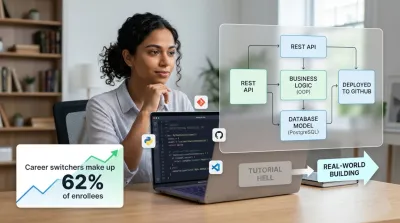
A good beginner programming course online does more than just show you how to write code; it teaches you how to think like an engineer. It’s the difference between memorizing a few phrases in a new language and actually understanding the grammar so you can form your own sentences. The goal is to stop passively following instructions and start actively solving problems with well-designed software.
Learning to Code vs Learning to Engineer #
Lots of aspiring developers get their start with video tutorials. They follow along, meticulously typing code line-by-line, and at the end, they have a working app. So what’s the problem? They often have no clue why it works or how to design something different on their own.
This is a classic trap known as "tutorial hell."
This passive approach teaches you syntax—the rules of a language—but it doesn't teach you how to architect a solution. It's like learning how to use a hammer and a saw but never seeing a blueprint. You might be able to assemble a pre-cut birdhouse, but you can't design and build a house from scratch.
The Shift to an Engineering Mindset #
A real software engineer, on the other hand, is an architect first and a builder second. Before a single line of code gets written, they’re thinking about the big picture. They ask tough questions about the system's design, how all the pieces will connect, and how to build it so it's efficient and doesn't become a nightmare to maintain later.
This problem-solving mindset is what separates a short-term coder from a long-term software engineer. A modern beginner programming course online must build this from day one. Instead of just showing you what to type, it should be constantly challenging you to think about system architecture and best practices.
The most effective path to becoming a developer is one that prioritizes a "learning by doing" approach. It focuses on building engineering intuition through practical, project-based work, not just memorizing syntax.
From Asking "Where Do I Start?" to Building Solutions #
The demand for developers has created a massive market for online education. The online coding education market hit $20 billion in 2025 and is projected to grow 15% annually. This boom is driven largely by career switchers, who make up a whopping 62% of enrollees.
Just look at some of the popular courses on Coursera—one has enrolled over 3 million learners. You can see the top coding courses for beginners on Coursera.org to get a sense of the scale. The interest is clearly there.
This growth highlights just how critical it is for courses to deliver real-world outcomes. The key is a structured curriculum that moves you logically from simple concepts to complex software architecture. When you focus on high-level principles and apply everything you learn to real projects, you finally move beyond asking, "Where do I start?" and start confidently designing, building, and shipping your own applications.
What a Great Programming Course Actually Teaches You #
A truly great beginner programming course online does more than just show you code. It’s supposed to build your engineering intuition, teaching you to think like an architect who designs the building, not just a construction worker who follows the blueprint. The real goal is to get you past the point of just copying and pasting code and into genuinely understanding why things are built a certain way.
Lots of courses will promise to teach you a language like Python. But the best ones teach you a mindset. They start with the absolute basics—things like data types and control flow—and build a straight line toward the complex, high-level thinking that professional engineers use every day.
Beyond Syntax and Into Software Design #
Let's be honest, learning the vocabulary of a programming language is the easy part. The real work starts when you learn the grammar of software design. This is where a quality course earns its keep. It’s about understanding the core principles that apply no matter which language you’re writing in.
A top-tier curriculum is designed to build your skills in a logical order, focusing on high-level concepts like:
- Software Architecture: Understanding how to structure an entire application. This includes principles like layering your code (e.g., Clean Architecture) so your business logic is separate from your database or web framework. This makes your app testable, maintainable, and scalable.
- Design Patterns: These are established, reusable solutions to common software problems. Learning patterns like Singleton, Factory, or Observer is like a builder learning proven construction techniques—they prevent you from reinventing the wheel and writing brittle code.
- Object-Oriented Programming (OOP): This isn't just a buzzword. It's a paradigm for organizing complex systems into logical, reusable "objects." It's a foundational skill for building software that can grow without becoming a tangled mess.
When you master these concepts, you're not just learning to write code; you're learning to engineer software that is stable, efficient, and built to last.
From Passive Watching to Active Building #
The old way of learning to code was to passively watch hours of video tutorials. You might follow along and build a project, but this approach often leaves a massive gap: you can’t actually apply what you’ve learned on your own. It’s a common trap known as “tutorial hell,” and it’s where countless aspiring developers get stuck.
A great course should actively pull you out of that cycle. The most effective learning happens when you're forced to solve problems and get immediate feedback on your work. It’s the difference between watching a video about swimming and actually jumping in the water.
A well-designed course forces you to apply concepts immediately after you learn them. This project-based approach, supported by instant feedback, is scientifically proven to accelerate skill retention and build genuine confidence.
The journey from a passive learner to a competent engineer looks a lot like this:

This shift from being a follower to becoming a problem-solver who can build real applications is the most critical part of your learning journey.
To see how these learning philosophies compare, let's break down the differences between the traditional video-based model and the modern, project-based one.
Comparing Learning Models for Beginner Programmers #
| Feature | Passive Video-Based Model (Traditional) | Interactive Project-Based Model (Modern) |
|---|---|---|
| Learning Style | Passive watching and listening. | Active doing, building, and problem-solving. |
| Skill Application | Delayed. You watch first, try to apply later. | Immediate. Concepts are applied in projects right away. |
| Feedback Loop | None or very slow (e.g., forum posts). | Instant, automated feedback on your code. |
| Common Pitfall | "Tutorial Hell" – able to follow but not create. | Can be challenging, requires active effort. |
| Outcome | Illusion of progress without true skill. | Demonstrable skills and a portfolio of work. |
| Job Readiness | Low. Lacks practical, independent experience. | High. Mirrors real-world problem-solving. |
As you can see, the modern approach is built to prevent you from getting stuck. By forcing you to build things, it ensures you are actually internalizing the skills you need for a real job.
Mirroring a Real-World Development Environment #
Finally, a top-tier beginner programming course online has to prepare you for what it’s actually like to be a software engineer. The tools and workflows you use while learning should be the same ones you’ll encounter on the job. This is what creates a smooth transition from being a student to becoming a professional.
Look for a course that integrates these industry-standard practices right from the start:
- Version Control with Git: Git is how developers track code changes and collaborate. A course that makes you
commityour code, manage branches, and push to GitHub from day one is giving you non-negotiable, real-world experience. - Command-Line Fluency: For a backend developer, working in the terminal (or command-line interface) is a core skill. It’s how you’ll interact with servers, run scripts, and manage your projects efficiently.
- Project-Based Learning: The entire curriculum should be structured around a series of projects that get progressively more complex. This guarantees you are constantly applying skills to build something tangible, leaving you with a portfolio that proves what you can do.
When a course combines strong theory with hands-on practice in a professional environment, it does more than just teach you syntax. It puts you on the direct path to becoming a real software engineer.
Thinking Like an Architect, Not Just a Coder #
Learning the syntax of a programming language is just the start. The real skill that separates a junior coder from a genuine software engineer is knowing how to design clean, scalable, and maintainable systems. This is the difference between simply writing code and architecting software.
Think about building a house. A coder knows how to use a hammer, cut wood, and hang drywall. They're focused on the task at hand. An architect, on the other hand, creates the blueprint first. They figure out where the walls go, how the electrical and plumbing will integrate, and whether the foundation can support the entire structure for decades.
Writing software is the same. A great beginner programming course online will teach you to think like that architect. It forces you to plan the whole system before you write a single line of code, ensuring what you build is solid, efficient, and won't fall apart the moment you need to change something.
The Blueprint of Modern Software #
In software, that "blueprint" is your system design. It’s all about thinking through how different parts of your app will talk to each other, where data will be stored, and how you'll handle user requests securely. Jumping straight into code without this plan is like starting construction without a blueprint—you’re basically guaranteeing you'll have to tear down a wall later.
A course that builds this architectural mindset will drill you on a few key concepts:
- Clean Architecture: This is a way of organizing your code into layers. It makes sure your core business logic isn't a tangled mess of database queries and web framework details, which makes your application way easier to test and maintain.
- Design Patterns: These are battle-tested, reusable solutions to common software problems. Learning them is like an apprentice architect studying classic building designs; it gives you a vocabulary of solutions that actually work.
- System Planning: This is the practical skill of sketching out your application's components on a whiteboard. You learn to map out how a request from a user flows through your system—from the initial API call, to the database, and all the way back.
The real differentiator between a coder and a software engineer is the ability to design systems. A course that teaches you to create a software 'blueprint' before coding empowers you to build applications that don't just work today, but are built to last.
Designing the Backend Engine #
For anyone serious about becoming a backend engineer, this kind of thinking is absolutely non-negotiable. The backend is the engine of any application, and its design dictates everything from performance and security to whether it can handle 10 users or 10 million.
A good curriculum won't teach critical backend skills as isolated topics. It will frame them as essential parts of the "big picture" design process. Two of the most fundamental pieces of this puzzle are REST API design and database modeling.
A REST API is just the set of rules that lets the front end (like a website or mobile app) talk to your backend server. Designing a good API is an art form. It has to be logical, predictable, and easy for other developers to figure out without reading your mind.
Likewise, database modeling is about designing the structure of your database. You have to decide what data you need to store and how different bits of information relate to each other. Get this wrong, and you can bring even the most powerful server to its knees. If this is a new idea, our guide on thinking like an engineer is a great place to start.
Choosing a Course That Teaches You to Think #
When you’re looking at a beginner programming course online, don't just look for a program that shows you how to build a specific app. Instead, find a curriculum that explains the why behind every technical decision.
A course that pushes you to think about system design gives you the power to solve any problem, not just the one in the tutorial. It’s a timeless skill that goes beyond any single programming language or framework. This is the knowledge that turns you from a coder following instructions into a software engineer who can build powerful, lasting solutions from scratch.
Building a Portfolio That Gets You Hired #
Let’s be real for a moment. In the world of software development, your portfolio is your resume. It’s the hard, tangible proof that you can actually build things. The projects you showcase speak volumes more than any certificate ever could, telling a hiring manager what you know, how you think, and how you solve problems.
This is where a solid beginner programming course online has to deliver. It can't just teach you syntax; it must guide you in building projects that demonstrate architectural thinking and best practices.
Moving Beyond Basic Projects #
The good news is that the demand for software developers is booming. The US Bureau of Labor Statistics projects a 23% growth in developer jobs by 2032. The not-so-good news? Competition is growing right along with it.
But here’s your edge: only about 25% of applicants have meaningful projects on their resumes. That’s a massive opportunity. Data from across the industry suggests that learners with apps deployed to GitHub are 3x more likely to land interviews. Building just three solid projects can even boost skill retention by as much as 50%. You can discover more insights about the impact of project-based learning on Codecademy.com.
The takeaway is clear: the kind of projects you build matters immensely. A calculator app proves you understand basic syntax. A real-world application proves you can think like an engineer.
To really stand out, you need projects that show you can apply high-level principles:
- A Fully Functional REST API: Build an API that follows clean architecture principles. This shows you can design logical endpoints, separate concerns, and think about how other developers will consume your service—a core backend skill.
- A Web Scraper: This project demonstrates your ability to process unstructured data, but you can elevate it by designing a robust system for storing and managing the scraped information, showcasing your data modeling skills.
- A Tool Leveraging a Database: Create an application with a well-designed database schema. Explain your design choices in the README, showing you understand data relationships, normalization, and performance considerations with a database like PostgreSQL.
For more ideas, check out our guide on programming projects for beginners that are designed to make an impact.
How to Showcase Your Work on GitHub #
Having great projects is only half the battle. You also have to present them professionally. Your GitHub profile is your public gallery, and you need to treat it that way.
A hiring manager will spend just seconds glancing at your profile, so that first impression has to be strong. Think of each project repository as the professional packaging for your work.
A well-documented project on GitHub is a signal to employers that you are not just a coder, but a professional communicator. It shows you care about maintainability, collaboration, and the developer experience—hallmarks of a true engineer.
Every single project repository should include these three things:
- A Clean README File: This is your project’s front door. It must explain what the project is, the technologies you used, and—most importantly—the architectural decisions you made and why.
- A Professional Commit History: Your
git commitmessages tell a story of how you work. Small, frequent commits with clear messages show a methodical and professional approach. Vague messages like "updated code" are a red flag. - Demonstrated Knowledge of Scalability and Testing: Even in a beginner project, you can show you’re thinking ahead. Mentioning how you designed a database schema for future growth or including a folder with unit tests proves you’re not just solving today's problem, but thinking about tomorrow's.
Ultimately, your portfolio is what ties everything together. It’s the bridge between the concepts you learn in a beginner programming course online and the engineering job you want. When you focus on building projects that solve real problems and present them with care, you provide undeniable proof of your skills.
How to Avoid Common Learning Traps #
Getting started as a developer is exciting. But that excitement can quickly turn into frustration if you fall into a few common traps that trip up most beginners. The people who succeed aren't always the smartest or the ones who study 12 hours a day. They're the ones who learn how to sidestep the big-time progress killers.
If you know what these traps are ahead of time, you give yourself a massive head start. Two of the biggest hurdles for anyone taking a beginner programming course online are the infamous "tutorial hell" and the paralysis that comes with trying to pick the "perfect" first language.
Escaping Tutorial Hell with a Build-First Mindset #
Tutorial hell is a trap that feels surprisingly productive. You watch a video, you code along, you build the instructor's project, and you feel great. But the second the tutorial ends and you're staring at an empty file, you freeze. You have no idea where to even start. You can follow instructions, but you can't actually create.
This happens because you've been passively consuming, not actively problem-solving. Following a recipe doesn't make you a chef. The only way out is to adopt a "build-first" mindset.
Instead of asking, "What tutorial should I watch next?" ask, "What problem can I solve with what I've just learned?" The moment you start building on your own, breaking things, and fixing them is the moment you truly start learning.
Here's how to put this into practice after every tutorial or course module:
- Extend the Project: Take what you just built and add one small feature the instructor didn't cover. Think about how this new feature impacts the existing design.
- Rebuild from Scratch: Wait a day, then try to design and build the same project again from memory, focusing on the architecture first.
- Start a Small, New Project: Use the core principles from the tutorial to build something completely different, no matter how simple.
This forces you to internalize what you've learned. It turns flimsy, borrowed knowledge into a durable skill you actually own.
Overcoming Language Paralysis #
Another classic trap is "analysis paralysis." You spend weeks, maybe even months, agonizing over the "best" first programming language. Python? JavaScript? Go? This indecision can stop your journey before it even begins.
Let me be direct. For your first language, the specific choice matters way less than just picking one and starting. The real fundamentals of programming—things like logic, loops, data structures, and functions—are universal. A good beginner programming course online will drill these concepts, which you'll use no matter what language you end up with.
A language like Python is a fantastic, pragmatic choice to start with. Its syntax is clean and readable, which means you spend less time fighting with confusing rules and more time learning how to structure your code and think like an engineer. Plus, it's incredibly versatile, so you can immediately start building things like backend APIs, data tools, or even simple AI scripts.
Don't let the search for the "perfect" language become an excuse not to start. Pick a practical language, find a course that makes you build stuff, and write your first line of code. Your career begins when you start writing your own code, not when you finish watching someone else write theirs.
Your Questions About Learning to Code Answered #
Thinking about learning to code? You've probably got a dozen questions bouncing around your head. It's a big decision, and it's easy to get overwhelmed by all the conflicting advice out there.
Let's cut through the noise and tackle the big questions head-on so you can move forward with confidence.
How Long Does It Realistically Take to Become Job-Ready? #
There's no magic number, but let's talk reality. For a quality, structured program, you should budget for a few hundred hours of real, focused work. If you can dedicate a consistent 10-15 hours per week, most people can build a portfolio that gets them interviews in about six to nine months.
But remember, this isn't a race. The goal isn't just to finish quickly. What really lands you a job is the consistent effort you put in and the quality of the projects you build along the way, demonstrating a solid grasp of software design principles.
Do I Need a Computer Science Degree to Get a Developer Job? #
Nope. For many software roles—especially in backend and web development—a CS degree is no longer a hard requirement. It can help, sure, but it's not the gatekeeper it once was.
These days, hiring managers care a lot more about what you can do. A strong portfolio of projects that shows you understand software architecture and design patterns will open more doors than a diploma will. It’s concrete proof you can actually engineer software.
Is Python the Best Language to Start With? #
If you want to be a backend developer, Python is a fantastic first choice. Its syntax is clean and readable, which means you can spend more time learning core programming concepts instead of fighting with complicated language rules.
For beginners, Python’s versatility is a key advantage. The skills you acquire are immediately transferable to building powerful, real-world applications in areas like data science, AI, and backend services.
What Is More Important: Learning a Framework or Core Principles? #
Core principles, hands down. It’s not even close. Frameworks like Django or Flask are just tools—they come and go. But a deep understanding of software architecture, design patterns, and Object-Oriented Programming will serve you for your entire career.
A great course will teach you the principles first, and then show you how to apply them with a framework. That's what makes you adaptable. Once you know the "why," you can pick up any new technology that comes along. If you want to dive deeper, you might be interested in our guide on where to get a programming certificate online.
Ready to build the real-world skills that employers are actually looking for? Codeling provides a structured, hands-on path to becoming a backend software engineer. Move beyond passive videos and start building your portfolio today at https://codeling.dev.